
If you're getting ready to sit for the REX PN exam, you've probably already noticed how many prep courses claim to be "the best." Some promise huge pass rates, others sell bundles of PDFs and call it a program, and a few actually build a structured path from where you are now to exam-day readiness. The problem is that from the outside, most course pages look nearly identical.
This guide breaks down what a genuine REX PN exam prep course should include, what separates a strong program from a shallow one, and the exact questions to ask before you enroll - so your money and study hours actually move you closer to a pass.
What Is the REX PN Exam, Briefly
The Regulatory Exam – Practical Nurse (REX PN) is a computer-adaptive test used by Canadian provincial nursing regulators to determine whether a candidate has the minimum competency to practice safely as a Licensed Practical Nurse (LPN) or Registered Practical Nurse (RPN). It has replaced the CPNRE in provinces such as Ontario and Alberta, with British Columbia adopting it as well, and it evaluates candidates across four major competency areas: safe and effective care, health promotion, psychosocial integrity, and physiological integrity.
Because the format is adaptive rather than fixed, generic multiple-choice practice isn't enough. This is exactly why the structure of your rex pn exam prep course matters so much - the right program trains you for how the exam actually behaves, not just what topics it covers.
Why Course Quality Makes or Breaks Your Preparation
Two candidates can spend the same number of hours studying and land in completely different places on exam day. The difference usually comes down to structure. A well-built REX PN course doesn't just hand you content - it sequences it, tests your recall under realistic conditions, and adjusts based on where you're actually weak.
A poorly built course, on the other hand, tends to dump hundreds of static questions on you without rationale, skip pacing practice, or ignore the adaptive testing format entirely. That gap is why choosing the right rex pn prep courses is less about finding the cheapest option and more about finding the one that actually mirrors the exam you'll sit.
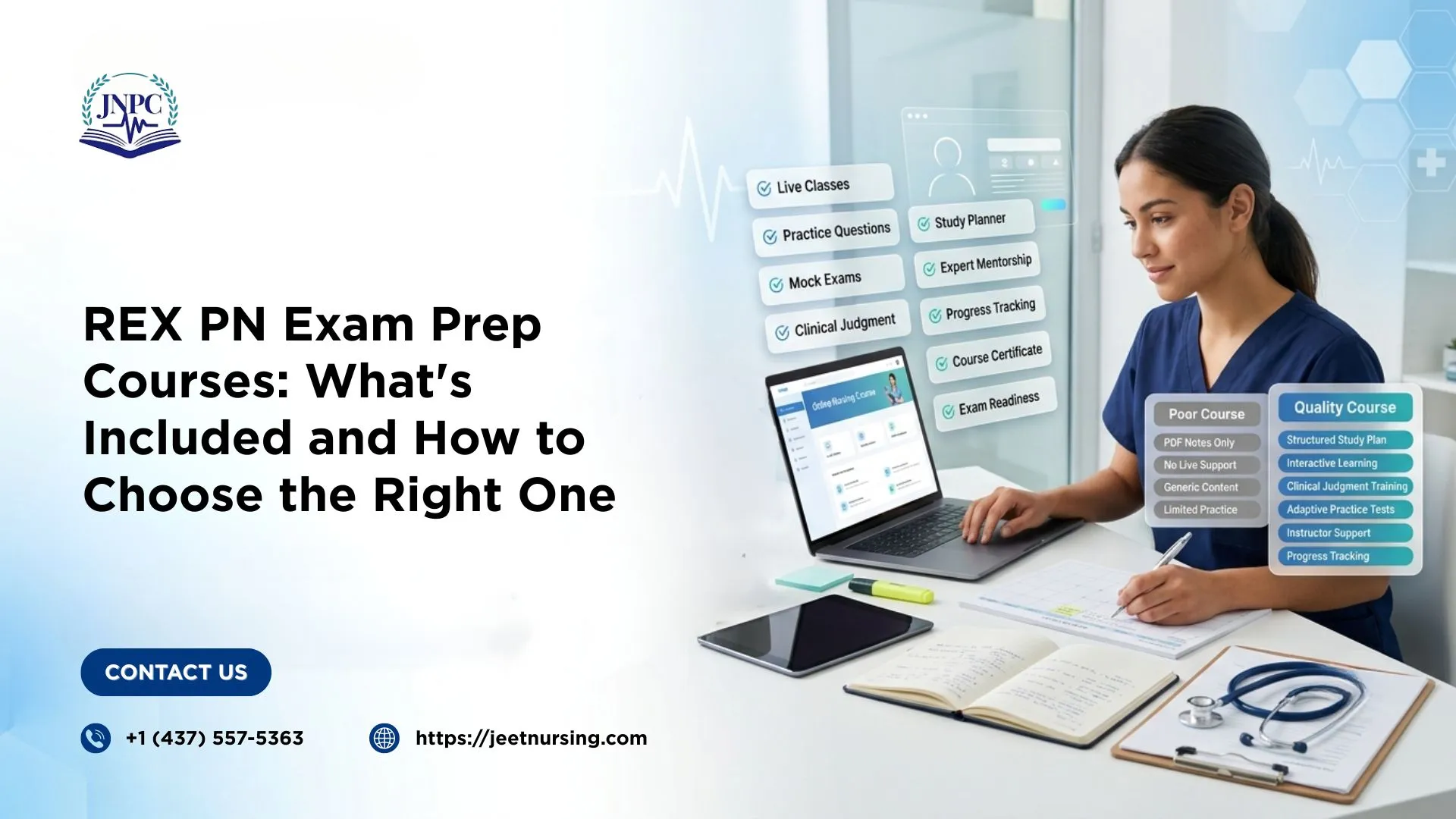
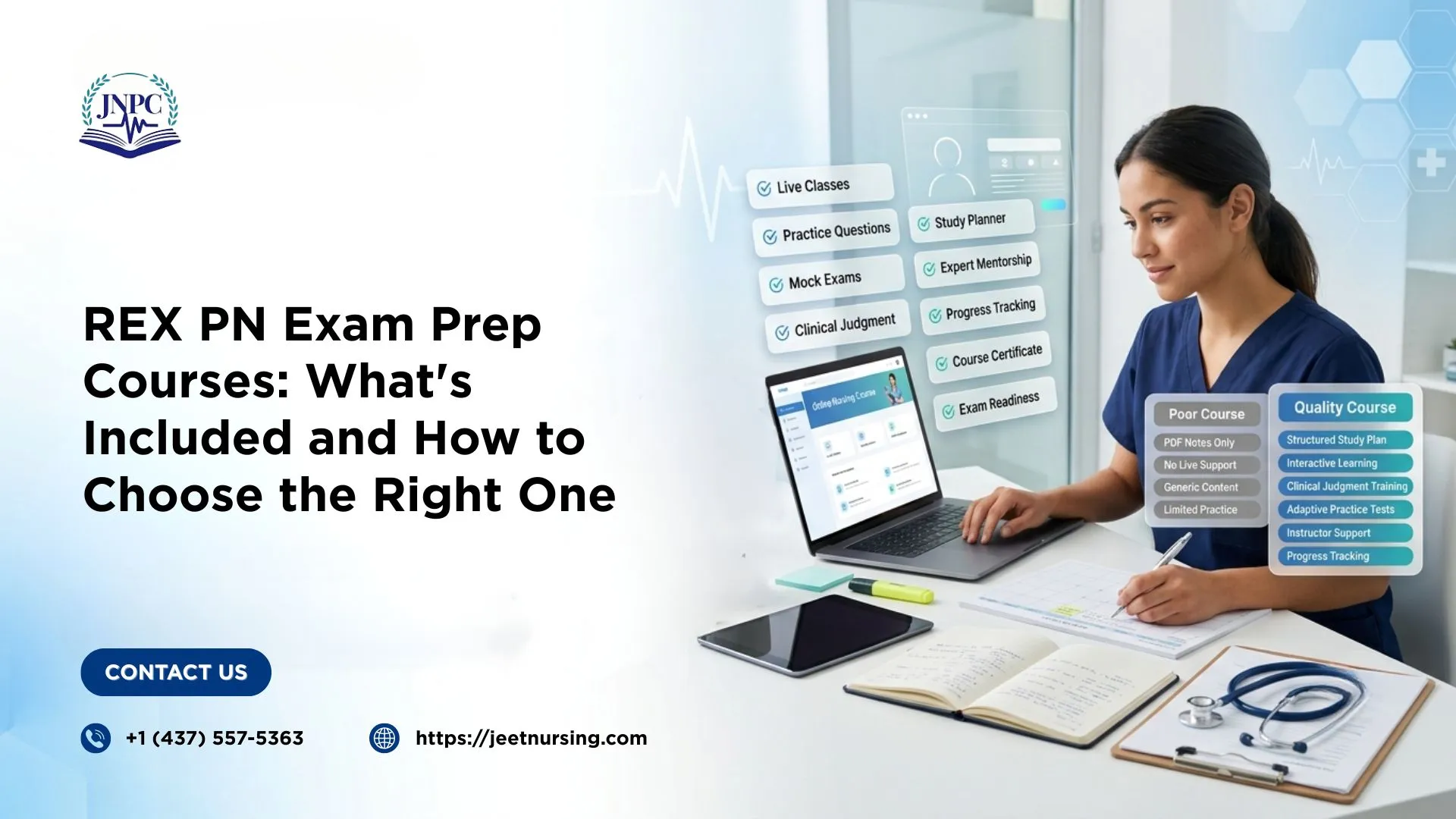
What Should Be Included in a REX PN Exam Prep Course
Before enrolling anywhere, check whether the course actually includes these core components.
1. Content Mapped to the Official Test Plan
Your course material should be organized around the same competency categories the exam tests, not around a generic nursing curriculum. That means dedicated coverage of:
- Management of care and delegation within scope of practice
- Safety and infection control
- Health promotion and maintenance
- Psychosocial integrity, including coping, grief, and situational stress
- Basic care, comfort, and pharmacology
- Physiological adaptation and risk reduction
If a course can't clearly show you how its lessons map back to these categories, it's likely built for a different exam and repackaged.
2. A Genuine Question Bank, Not Just a Question List
Look for a bank of exam-style questions large enough to expose you to varied scenarios - ideally in the thousands rather than a few hundred. More importantly, every question should come with a rationale explaining why each option is right or wrong. Rationale-based learning is what actually builds clinical reasoning, which matters more on an adaptive exam than raw memorization ever will.
3. CAT-Style Practice, Not Just Static MCQs
Since the REX PN uses computer-adaptive testing, your prep should include practice formats that resemble it: multiple-response (select-all-that-apply) questions, fill-in-the-blank dosage calculations, ordered-response and drag-and-drop items, and chart or exhibit-based questions. A course built entirely on flat multiple-choice quizzes will not prepare you for how the real test adjusts difficulty in real time.
4. Full-Length, Timed Mock Exams
Weekly or biweekly mock exams under timed conditions build the stamina you need for a test that can run up to four hours. A good course should offer full-length simulations that mirror real pacing - roughly 1.5 minutes per question - along with score breakdowns by content area so you know exactly where to focus next.
5. Live or Instructor-Led Support
Even the best self-paced material has limits. Access to instructors - whether through live classes, scheduled doubt-clearing sessions, or ongoing messaging support - helps you resolve confusing concepts quickly instead of getting stuck. Look for courses that offer real interaction, not just pre-recorded content with no follow-up channel.
6. Flexible Formats for Different Timelines
Not everyone has the same runway before exam day. Strong programs usually offer more than one format:
- Live classes for structured, instructor-paced learning over a few months
- Self-study plans with lifetime or extended access to recordings for flexible learners
- Crash courses for candidates with a near-term exam date who need a condensed, high-intensity review
- Focused modules (such as a pharmacology-specific track) for candidates who need to strengthen one high-yield area quickly
7. A Personalized Study Plan, Not a One-Size-Fits-All Template
The best courses start with a diagnostic assessment to identify your baseline, then build a week-by-week roadmap based on your exam date, weekly availability, and prior attempt history if applicable. As your practice scores come in, the plan should adjust - prioritizing weaker content areas instead of repeating what you've already mastered.
How to Choose the Right REX PN Prep Course: A Checklist
Use these questions to evaluate any course before you pay for it:
- Is the content updated for the current test plan? NCSBN periodically updates the REX PN blueprint, including scoring rules and content weighting. Outdated material can teach you the wrong emphasis.
- Does it include CAT-style question formats? If the practice questions are all flat multiple-choice, the course isn't training you for the actual exam experience.
- Are rationales provided for every question? Rationale-based explanations build the clinical reasoning the exam is actually testing.
- Are there full-length, timed mock exams? Content review alone won't build exam-day stamina or pacing.
- What format fits your timeline and learning style? A working nurse with two hours a night needs a different structure than someone with a dedicated 45-day study window.
- Is instructor support actually accessible? Check whether "support" means a real person answering your questions or just a generic FAQ page.
- Does the course address the Canadian healthcare context? Since REX PN candidates are often internationally educated, generic US-focused material can miss Canadian-specific clinical and regulatory context that shows up in scenario-based questions.
- Is there a clear plan for pharmacology? Pharmacology is consistently one of the most heavily weighted and heavily tested areas, so a course with only a light touch on it is a red flag.
Common Mistakes Candidates Make When Choosing a Course
- Choosing based on price alone. A cheaper course with outdated, generic material can cost you more in retake fees and lost time than a properly structured one.
- Ignoring the adaptive format. Practicing exclusively with static question sets leaves you unprepared for how the real exam escalates or eases difficulty based on your responses.
- Underestimating pharmacology and dosage calculations. These areas are consistently high-yield and deserve dedicated study time, not a last-week cram.
- Skipping full-length mock exams. Content knowledge without stamina and pacing practice often leads to fatigue-driven mistakes in the final stretch of a long exam.
- Assuming all courses cover the same content. Course quality varies significantly - always check whether material is mapped specifically to the current REX PN blueprint.
Final Thoughts
A strong REX PN exam prep course should feel less like a stack of study guides and more like a structured coaching relationship - one that adapts to your pace, tests you the way the real exam will, and gives you clear feedback on where you stand. When evaluating rex pn prep courses, prioritize programs that combine updated content, CAT-style practice, rationale-driven question banks, full-length mock exams, and real instructor access.
Jeet Nursing Prep Center structures its REX PN programs around exactly this approach - diagnostic-based study plans, content mapped to the current test outline, and mock exams built to mirror real exam pacing - which is one option worth considering as you compare programs. Whichever course you choose, the goal stays the same: walk into exam day having already practiced everything it will ask of you, so nothing about the format or pressure catches you off guard.





























Sign in to leave a comment.