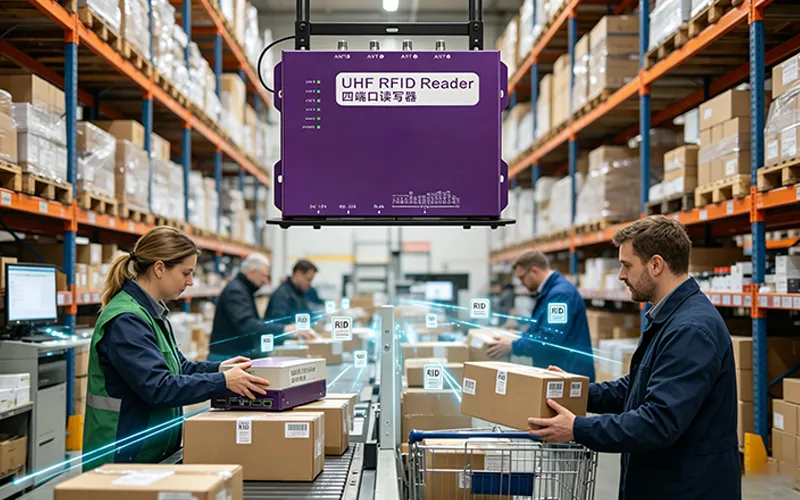

The first rfid industrial reader I deployed didn’t fail in a dramatic way. No alarms, no shutdowns. It just started missing things—quietly.
A pallet passed through a checkpoint, tags should have been captured, but a few weren’t. Not enough to stop operations, just enough to create doubt. That’s worse.
We checked the hardware. Everything was functioning. Power levels were correct. Network stable.
The problem wasn’t the device. It was the environment slowly pushing back.
That’s when it becomes clear: a rfid industrial reader isn’t tested by installation day—it’s tested by everything that happens after.
Industrial Conditions Don’t Stay Still
On paper, a rfid industrial reader operates within defined parameters—UHF frequencies (860–960 MHz), EPC Gen2 / ISO 18000-63 compliance, stable read rates.
In practice, the environment keeps shifting:
- Metal surfaces reflecting signals unpredictably
- Machinery introducing electromagnetic noise
- Temperature changes affecting performance margins
- Inventory density fluctuating throughout the day
According to data from the RAIN RFID Alliance, UHF RFID systems can achieve read rates above 99% in optimized conditions. The keyword there is “optimized.”
Factories rarely are.
Industrial RFID Reader for Manufacturing: Precision Beats Coverage
In a industrial rfid reader for manufacturing setup, the instinct is often to maximize coverage—make sure every tag gets read.
That approach backfires.
In one assembly line, we initially configured the rfid industrial reader for wide coverage. Components moving between stations were picked up across multiple zones. The system showed them in two places at once.
The fix wasn’t adding more power. It was reducing it.
- Lower transmit strength
- Narrow antenna angles
- Clearly defined read zones
Accuracy improved immediately.
Research from Auburn University RFID Lab supports this—tight control of read zones significantly improves process accuracy in manufacturing environments.
Rugged RFID Industrial Reader Warehouse: Durability Is Only the Start
A rugged rfid industrial reader warehouse setup is expected to handle dust, vibration, and temperature swings.
That’s necessary, but it doesn’t guarantee performance.
In one warehouse deployment, the hardware performed flawlessly from a durability standpoint. But during peak hours, read consistency dropped.
The issue wasn’t physical—it was RF interference.
Multiple readers operating simultaneously, combined with dense tag populations, created signal collisions. We enabled dense reader mode (DRM) and adjusted frequency hopping.
Performance stabilized.
Technical guidance from Impinj highlights this: interference management is critical in high-density RFID environments, especially in warehouses.
UHF RFID Industrial Reader System: It’s More Than Hardware
A uhf rfid industrial reader system is often described as a set of devices. In reality, it’s a layered system:
- Reader units
- Antennas
- RF cabling
- Middleware
- Integration with enterprise systems
In one project, everything looked correct at the hardware level. Tags were being read consistently.
But inventory reports didn’t match physical counts.
The issue was middleware—duplicate reads weren’t filtered properly. Items lingering in a read zone were counted multiple times.
Fixing the software resolved the issue.
The rfid industrial reader was never the problem.
RFID Industrial Reader Asset Tracking: Narrowing the Focus
Asset tracking introduces a different challenge.
Instead of reading everything, you need to read only what belongs in a specific location.
In a tool tracking deployment, adjacent storage areas created overlapping read zones. Tools appeared in multiple locations in the system.
We adjusted:
- Directional antennas
- Reduced transmit power
- Physical barriers where possible
Coverage decreased slightly. Accuracy improved significantly.
According to Deloitte supply chain insights, improved asset visibility through RFID can reduce operational inefficiencies by up to 20–30%—but only when location data is precise.
The Small Adjustments That Matter
Some of the most impactful improvements don’t involve new equipment:
- Rotating antennas by a few degrees
- Adjusting mounting height
- Switching polarization types
- Replacing low-quality RF cables
In one case, a persistent blind spot disappeared after shifting the rfid industrial reader less than half a meter.
No upgrade. Just alignment.
What Happens After Go-Live
There’s always a phase where the system seems stable.
Then something changes:
- New equipment is installed
- Inventory density increases
- Layout adjustments alter RF behavior
In one facility, adding metal shelving reduced read accuracy by nearly 10%. The rfid industrial reader didn’t fail—the environment changed.
We recalibrated antenna placement and power levels.
Accuracy returned.
RF systems evolve with their surroundings.
What Experience Teaches Over Time
After multiple deployments, a few patterns become clear:
- Increasing power often creates interference rather than solving problems
- Environment has a greater impact than hardware specifications
- Data quality depends heavily on system configuration
These aren’t theoretical—they show up in practice.
Author Background
Over the past 10+ years, I’ve worked on RFID system design and deployment across manufacturing, logistics, and asset tracking environments—focusing on rfid industrial reader configurations in real-world conditions. My work aligns with GS1 standards and performance benchmarks validated by Auburn University RFID Lab, widely recognized in RFID implementation.
At Cykeo, the focus is on ensuring systems perform reliably over time, not just during initial testing.
The Quiet Outcome
When a rfid industrial reader is configured correctly, it doesn’t stand out.
No constant adjustments. No visible effort.
Just consistent data.
Closing Thought
A rfid industrial reader isn’t defined by how it performs in controlled conditions. It’s defined by how it adapts when those conditions change.
When tuned correctly—and retuned when needed—it becomes part of the operation itself.
Almost invisible.
























Sign in to leave a comment.