

Two tests, four answers, one trap. Read the pair together and the ENT stem gives up its diagnosis.
Patrizia Fairs, Independent Medical Education Writer — NEET PG, INI-CET & FMGE I read standard textbooks and the research behind them side by side, and I flag where they disagree.
Last updated: October 15, 2026
Here is the viva question that catches good students: a patient hears nothing at all in the right ear, yet the right Rinne comes out negative. Negative means conductive loss. So does this patient have a conductive loss? No. That ear is dead, and the fork is being heard by the other cochlea.
That one paradox explains why Rinne and Weber test interpretation is never about one test: Rinne tells you the type of loss, Weber tells you the side. For ENT questions in the National Eligibility cum Entrance Test – Postgraduate (NEET PG), the Institute of National Importance Combined Entrance Test (INI-CET) or the Foreign Medical Graduate Examination (FMGE), you read the pair together, the way an examiner does. Below, six patients meet the same 512 Hz fork, and you will see where respected sources print different numbers.
Key Takeaways
- Rinne positive (air conduction louder than bone) is normal or sensorineural; Rinne negative (bone louder) points to conductive loss.
- Weber goes to the worse ear in conductive loss and to the better ear in sensorineural loss. It stays central when both ears are equal.
- A false negative Rinne happens in severe unilateral sensorineural loss. Weber going to the opposite ear exposes it; masking the good ear confirms it.
- ABC is reduced only in sensorineural loss. Schwabach is reduced in sensorineural loss and lengthened in conductive loss.
- Sources disagree on the air-bone gap that turns Rinne negative: 15–20 dB in Dhingra, 30 dB elsewhere.
Why Is the 512 Hz Fork the Standard?
The 512 Hz fork is the routine choice because lower forks are felt as vibration and higher forks fade too fast. Dhingra's Diseases of Ear, Nose and Throat (7th edition) calls 512 Hz ideal for clinical practice for exactly this reason.
A 256 Hz fork buzzes on the mastoid, so the patient may report the feel, not the sound. A 1024 Hz fork decays faster, so the tone fades before the comparison is done.
Research backs the choice. In a study of 200 patients with known air-bone gaps, Richard A. Chole and Gary B. Cook (Archives of Otolaryngology–Head & Neck Surgery, 1988) found the 256 Hz fork more sensitive but prone to false positives. They concluded: "we believe that the 512-Hz tuning fork should become the standard tuning fork used in performance of the Rinne test to screen patients for conductive hearing loss."
How Do You Do and Read the Rinne Test?
Rinne compares air conduction with bone conduction in the same ear. Louder beside the ear canal is positive; louder on the mastoid is negative. It is the only test of the four that compares one ear against itself.
The method in Dhingra: strike the fork, place its base on the patient's mastoid, and when the patient stops hearing it, bring the prongs beside the external ear canal. The Oxford Medical Education guide uses a loudness version: 2–3 seconds on the mastoid, then the prongs about 1 cm from the canal.
| Result | What the patient reports | What it means |
|---|---|---|
| Rinne positive | Air conduction > bone conduction | Normal ear, or sensorineural loss |
| Rinne negative | Bone conduction > air conduction | Conductive loss (if the result is true) |
| False negative Rinne | "Bone" heard, air not heard | Severe or total sensorineural loss in that ear |
The trap: a positive Rinne does not mean normal hearing. A sensorineural ear loses air and bone conduction together, so air still beats bone. The StatPearls chapter "Rinne Test" (Belardo, Kong and Sutton, updated 2026) says the test should be done alongside Weber for exactly this reason, and that neither replaces pure-tone audiometry.
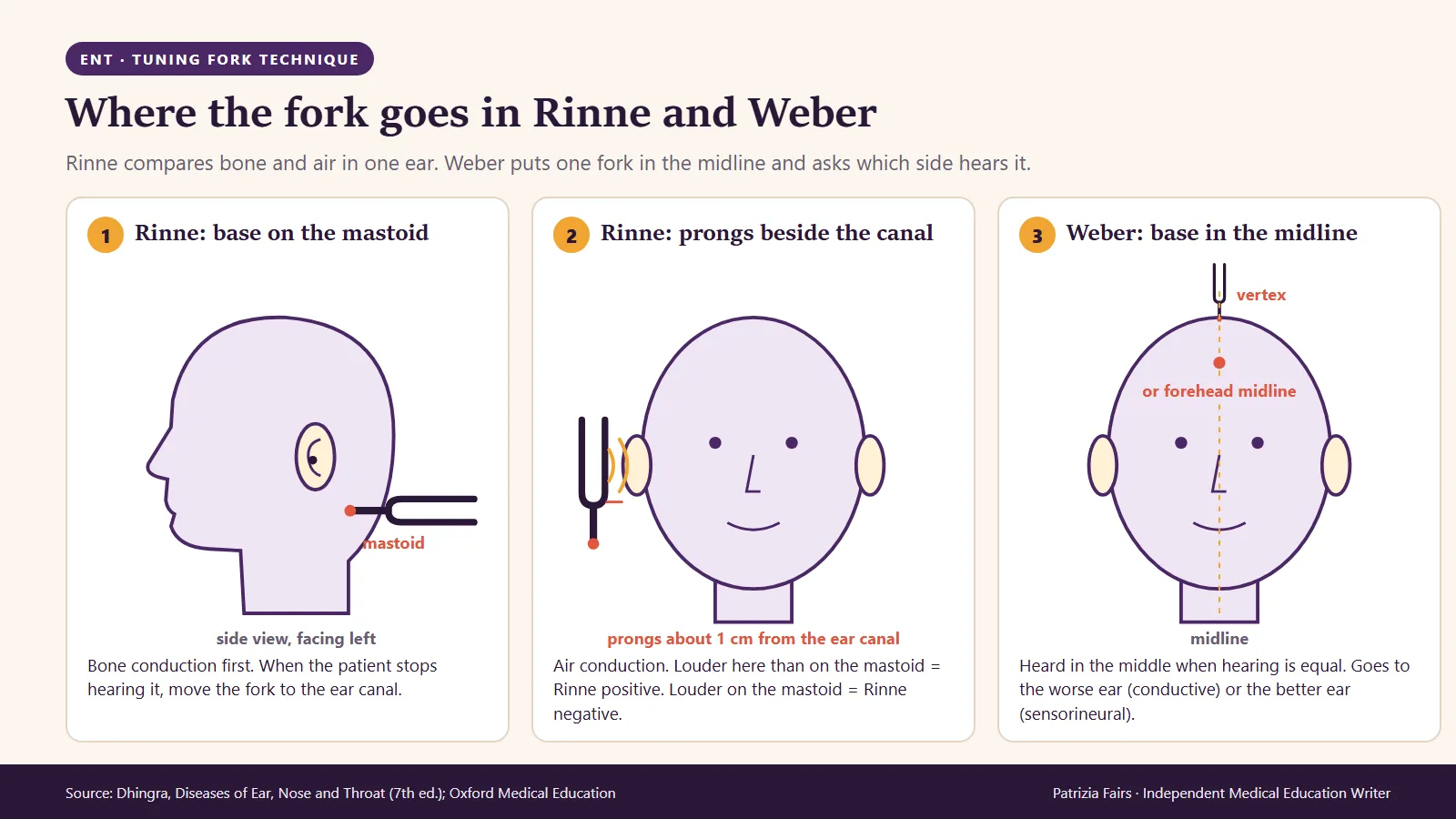
Where the fork goes: Rinne on the mastoid, then beside the ear canal; Weber in the midline. Placement as described in Dhingra (7th edition).
Which Way Does Weber Lateralise, and Why?
Weber goes to the worse ear in conductive loss and to the better ear in sensorineural loss. With equal hearing, it is heard in the middle. Dhingra places the fork at the middle of the forehead or the vertex.
In conductive loss, room noise no longer reaches the affected cochlea to mask the fork, and less bone-conducted sound escapes through the canal, so the fork sounds louder on the bad side. In sensorineural loss, the damaged cochlea simply hears less, so the good ear wins. The StatPearls chapter "Weber Test" (Wahid, Hogan and Attia, 2023) states the same rule.
Weber is also more sensitive: Oxford Medical Education says it lateralises with a difference of about 5 dB. The 2018 systematic review by Kelly, Li and Adams reports Weber turning abnormal at just 2.5–4 dB of asymmetry between the ears.
One sentence to memorise: Weber tells you which ear; Rinne tells you what kind.
When Is a Negative Rinne Lying?
A negative Rinne is false when the tested ear has severe or total sensorineural loss. The fork on the mastoid is heard by the other cochlea, through the skull. Dhingra calls this a false negative Rinne.
Bone-conducted sound crosses the skull with little loss. Put the fork on a dead ear's mastoid and the healthy ear hears it; move it beside the dead ear's canal and nothing is heard. The result looks conductive. The StatPearls "Rinne Test" chapter warns that the test "is unreliable and may yield false-negative results in patients with severe unilateral or total sensorineural hearing loss."
Two moves expose it:
- Look at Weber. In true conductive loss, Weber goes to the same ear. In a dead ear, it goes to the opposite, better ear. A negative Rinne with Weber going away from that ear is the warning sign.
- Mask the good ear. Dhingra describes masking the non-test ear with a Bárány noise box while testing bone conduction. The "bone conduction" response disappears, because the dead ear never heard it.
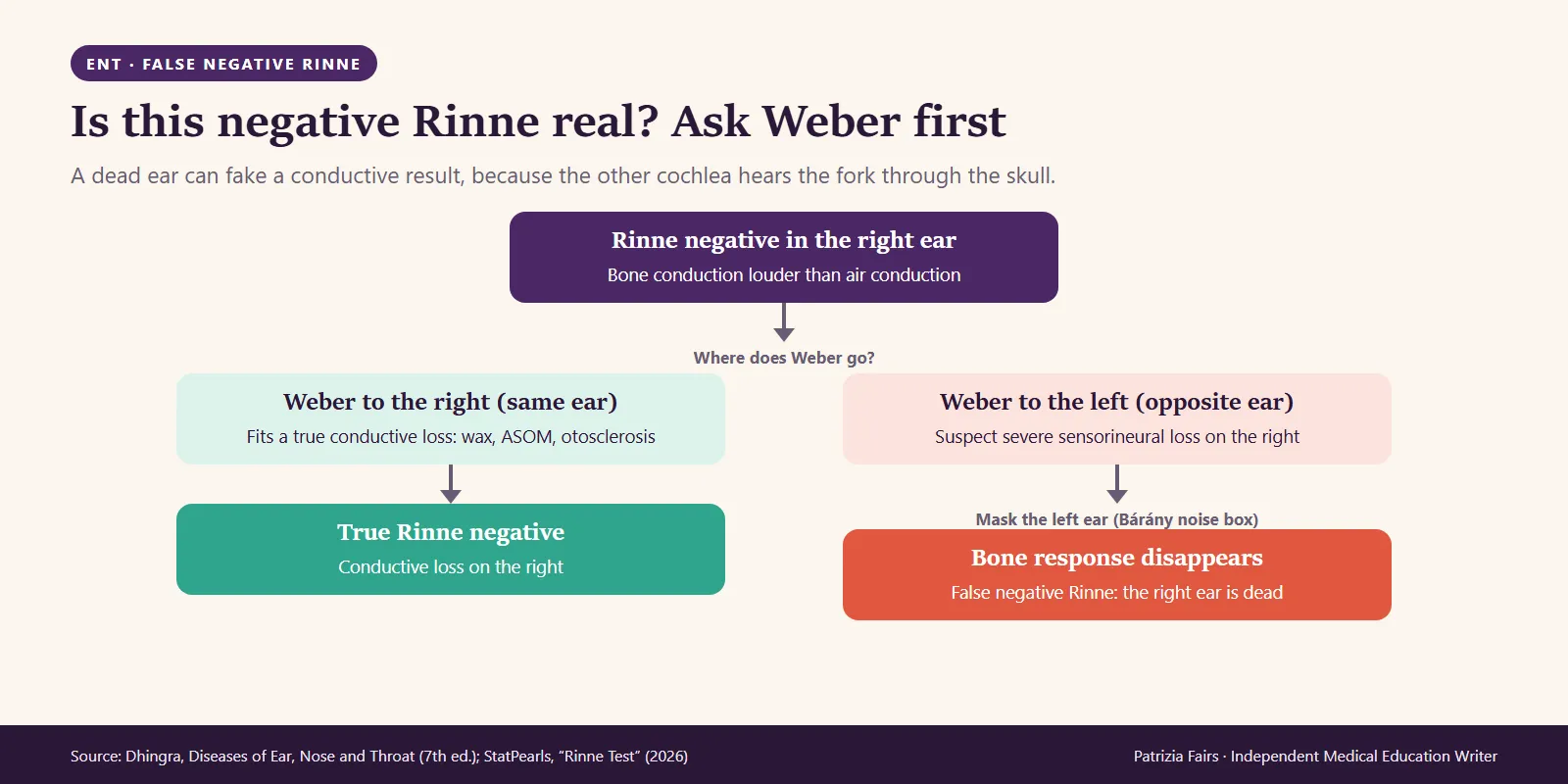
How to catch a false negative Rinne: check where Weber goes, then mask the better ear. Steps from Dhingra (7th edition).
How Much Air-Bone Gap Turns Rinne Negative?
Sources disagree. Dhingra says a negative Rinne means an air-bone gap of at least 15–20 dB; Oxford Medical Education says Rinne only picks up conductive loss of at least 30 dB. Both figures are in circulation, so know who says which.
Research shows why no single number fits. A systematic review of 17 studies with 3,158 participants by Elizabeth A. Kelly, Bailey Li and Meredith E. Adams (Otolaryngology–Head and Neck Surgery, 2018) found that Rinne turned abnormal anywhere between 13 and 40 dB of conductive loss. The sensitivity of the 512 Hz Rinne ranged from 16% to 87% across studies. The authors' advice: "Clinicians should remain mindful of these differences and optimize these techniques in specific clinical applications to improve TFT accuracy."
The metal matters too. MacKechnie and colleagues (Otolaryngology–Head and Neck Surgery, 2013) found that the chance of a negative Rinne reached 50% at a 19 dB gap with a stainless-steel 512 Hz fork, but only at 27 dB with an aluminium one. A 2019 Siriraj Medical Journal study (Phonpornpaiboon and colleagues) found the 512 Hz Rinne caught more than 80% of ears with a gap of 20 dB or more, and more than 90% with 30 dB or more.
Dhingra also grades the gap using three forks:
| Rinne result | Air-bone gap (Dhingra, 7th ed.) |
|---|---|
| Equal or negative at 256 Hz, positive at 512 Hz | 20–30 dB |
| Negative at 256 and 512 Hz, positive at 1024 Hz | 30–45 dB |
| Negative at 256, 512 and 1024 Hz | 45–60 dB |
For the exam, use the textbook line (15–20 dB and the three-fork table). Just know that real thresholds vary with technique and the fork.
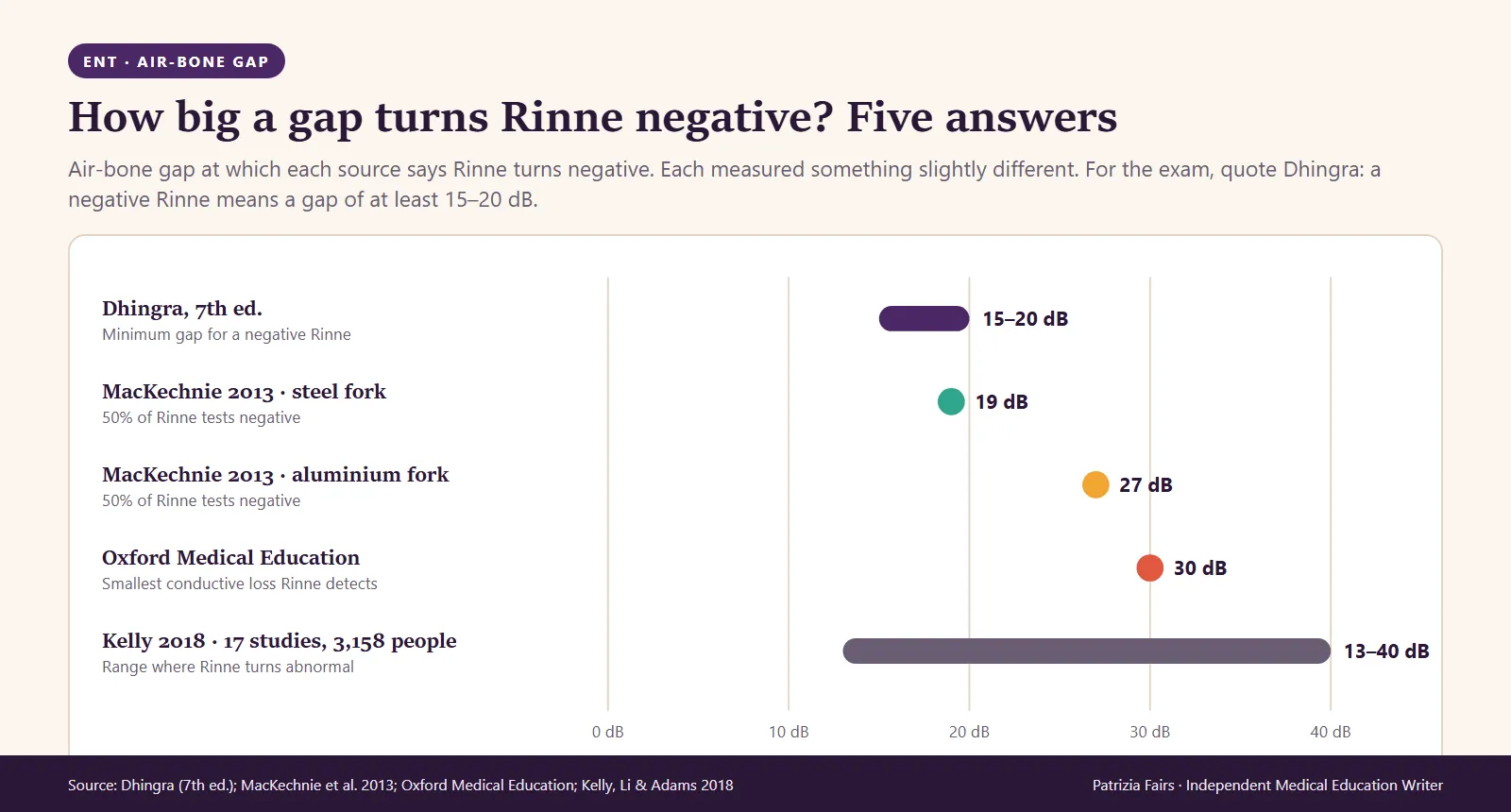
Five sources, five numbers. Values from Dhingra (7th edition), MacKechnie 2013, Oxford Medical Education and Kelly 2018.
What Do ABC and Schwabach Add?
Both compare the patient's bone conduction with the examiner's. ABC is reduced in sensorineural loss and normal in conductive loss; Schwabach is reduced in sensorineural loss and lengthened in conductive loss. The only difference is the ear canal.
In the absolute bone conduction (ABC) test, Dhingra has both ear canals, the patient's and the examiner's, occluded by pressing the tragus, and the fork moved between the two mastoids. In conductive deafness, both hear it for the same time. In sensorineural deafness, the patient stops hearing it sooner.
In the Schwabach test, the canal stays open. The conductive ear now has an edge, because room noise is not masking its cochlea, so the patient outlasts the examiner: Schwabach is lengthened.
| Test | Compares | Conductive loss | Sensorineural loss |
|---|---|---|---|
| Rinne | AC vs BC, same ear | Negative | Positive |
| Weber | Right vs left (midline fork) | To the worse ear | To the better ear |
| ABC | Patient BC vs examiner BC, canals occluded | Same as examiner | Reduced |
| Schwabach | Patient BC vs examiner BC, canal open | Lengthened | Reduced |
Both assume the examiner hears normally. Dhingra also lists the Gelle test, negative when the ossicular chain is fixed or broken and now largely replaced by tympanometry.
Six Patients, One Fork: How Do the Classic Stems Read?
Name the side from the history, predict Weber, then check Rinne on the bad side. If they agree, you have the category. Findings per Dhingra.
- Wax impaction, right ear. Conductive: Rinne negative on the right (if the gap is large enough), Weber to the right, ABC normal, Schwabach lengthened.
- Acute suppurative otitis media (ASOM), left ear. Conductive: Rinne negative on the left, Weber to the left, ABC normal, Schwabach lengthened.
- Otosclerosis, both ears, worse on the right. A young woman who hears better in noise. Rinne negative, Weber to the worse (right) ear, ABC normal, Schwabach lengthened. The audiogram adds Carhart's notch, a bone-conduction dip greatest at 2000 Hz.
- Acoustic neuroma, right side. Slow one-sided sensorineural loss with tinnitus. Rinne positive on the right, Weber to the left (better) ear, ABC and Schwabach reduced.
- Ménière's disease, left ear. Episodic vertigo, tinnitus, fullness and fluctuating sensorineural loss, low frequencies first. Rinne positive on the left, Weber to the right, ABC and Schwabach reduced.
- Dead right ear. Total unilateral sensorineural loss. Rinne negative on the right (false), Weber to the left, ABC and Schwabach reduced. Masking the left ear makes the right "bone conduction" vanish.
Cases 1 and 6 both show a right negative Rinne. Only Weber separates them.
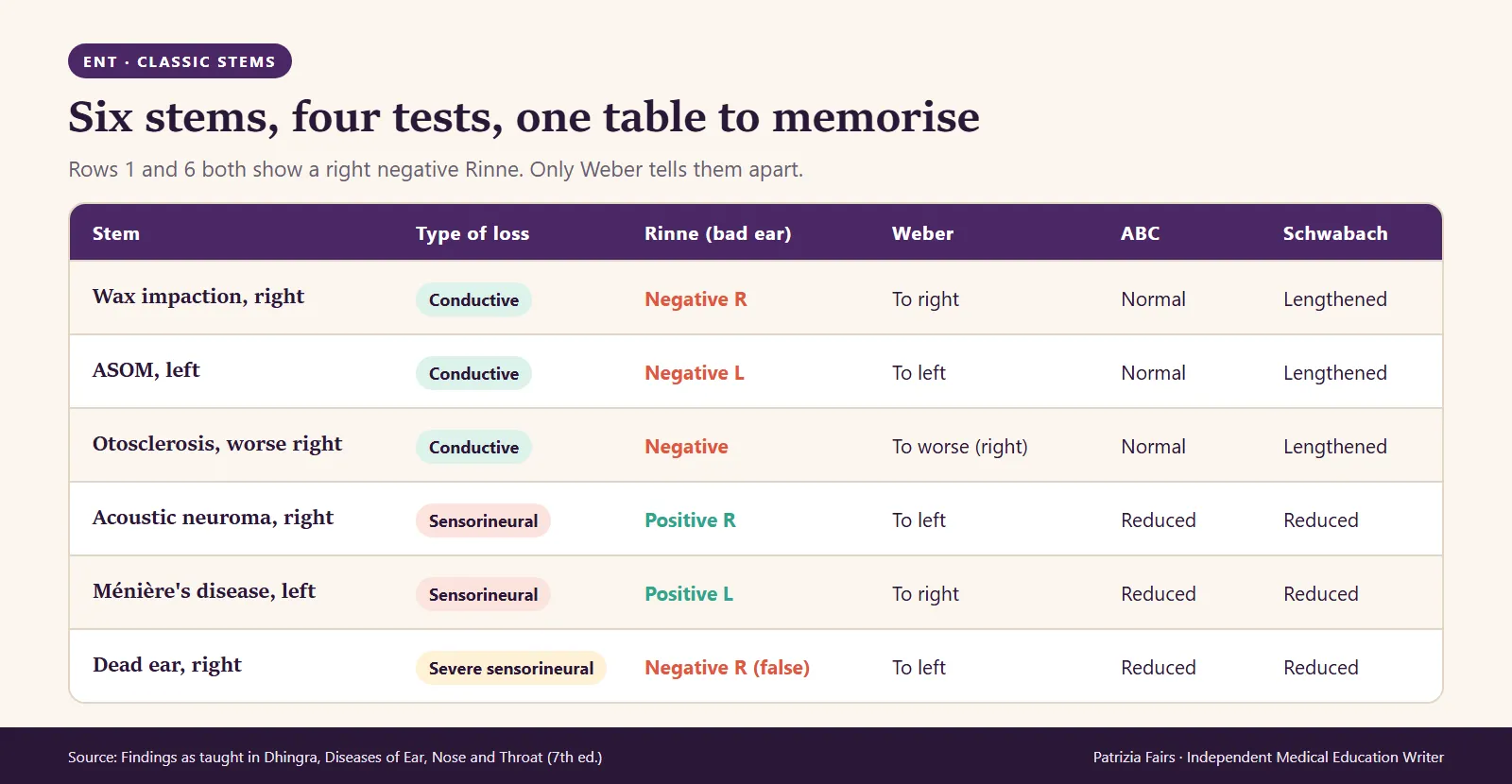
Six stems, four tests. Findings as taught in Dhingra (7th edition).
How Do Tuning Fork Results Map to an Audiogram?
Tuning forks estimate what the audiogram measures. A negative Rinne predicts an air-bone gap; a positive Rinne with Weber to the other ear predicts air and bone lines dropping together. The audiogram then gives the numbers.
On a pure-tone audiogram, the air line tests the whole pathway and the bone line tests the cochlea and nerve. The distance between them, the air-bone gap, belongs to the outer and middle ear.
- Conductive: bone line near normal, air line lower, a clear gap (the negative-Rinne ear).
- Sensorineural: both lines drop together, no gap (positive Rinne, Weber going away).
- Mixed: both lines drop, with a gap between them.
A fork tells you a gap is probably there, roughly how big (with three forks) and on which side. Tuning forks do not replace pure-tone audiometry; when history and forks disagree, the audiogram settles it.
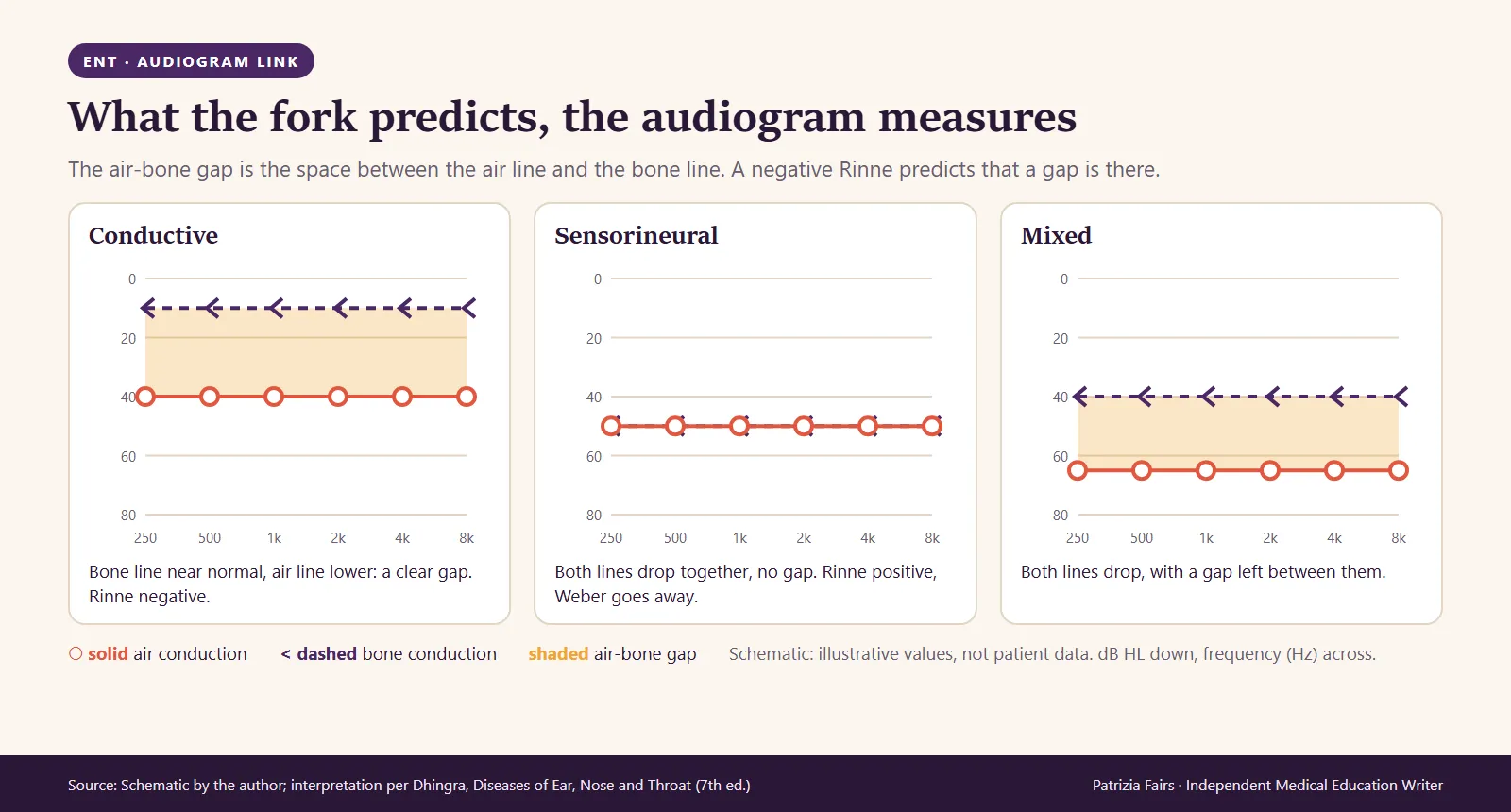
Schematic only: the gap between the air and bone lines is what a negative Rinne predicts. Illustrative values, not patient data.
Frequently Asked Questions
Q: What does a negative Rinne test mean? A negative Rinne means the patient hears the fork better by bone conduction than by air conduction in that ear. It points to conductive hearing loss, unless the ear has severe sensorineural loss, which gives a false negative.
Q: In which ear is Weber heard in conductive deafness? In the affected (worse) ear. In sensorineural deafness it is heard in the better ear, and with equal hearing in the midline.
Q: Why is a false negative Rinne seen in a dead ear? Sound from the mastoid crosses the skull to the healthy cochlea, so "bone" is heard but air is not. Masking the good ear with a Bárány noise box removes the false response.
Q: What is the difference between the ABC and the Schwabach test? Both compare the patient's bone conduction with the examiner's. In ABC, both ear canals are occluded, and the result is normal in conductive loss. In Schwabach, the canal is open, and the result is lengthened in conductive loss. Both are reduced in sensorineural loss.
Q: What are the tuning fork findings in otosclerosis? Otosclerosis gives a conductive pattern: Rinne negative, Weber to the worse ear, ABC normal and Schwabach lengthened. The audiogram may show Carhart's notch at 2000 Hz on bone conduction.
Drill the Pair Until It Reads Itself
Pattern recognition is the whole game. Write the four-test table from memory once, then try it on mixed questions where the stem hides the side of the loss in the history.
Three lines for the exam hall:
- Weber tells you which ear; Rinne tells you what kind.
- A negative Rinne with Weber going the other way is a dead ear until proven otherwise.
- ABC stays normal in conductive loss; Schwabach gets longer.
When the six stems feel automatic, test them against the clock with these free ENT practice MCQs, part of a bank of 33,500+ MCQs across all 19 subjects, free with no credit card and no daily cap.
Patrizia Fairs, Independent Medical Education Writer — NEET PG, INI-CET & FMGE I read standard textbooks and the research behind them side by side, and I flag where they disagree.
This content is for exam preparation and educational purposes only. Always refer to the official NBEMS (natboard.edu.in), AIIMS (aiimsexams.ac.in) and NMC (nmc.org.in) notifications for the latest exam pattern, dates, eligibility and cut-offs. It is not medical advice.






























Sign in to leave a comment.