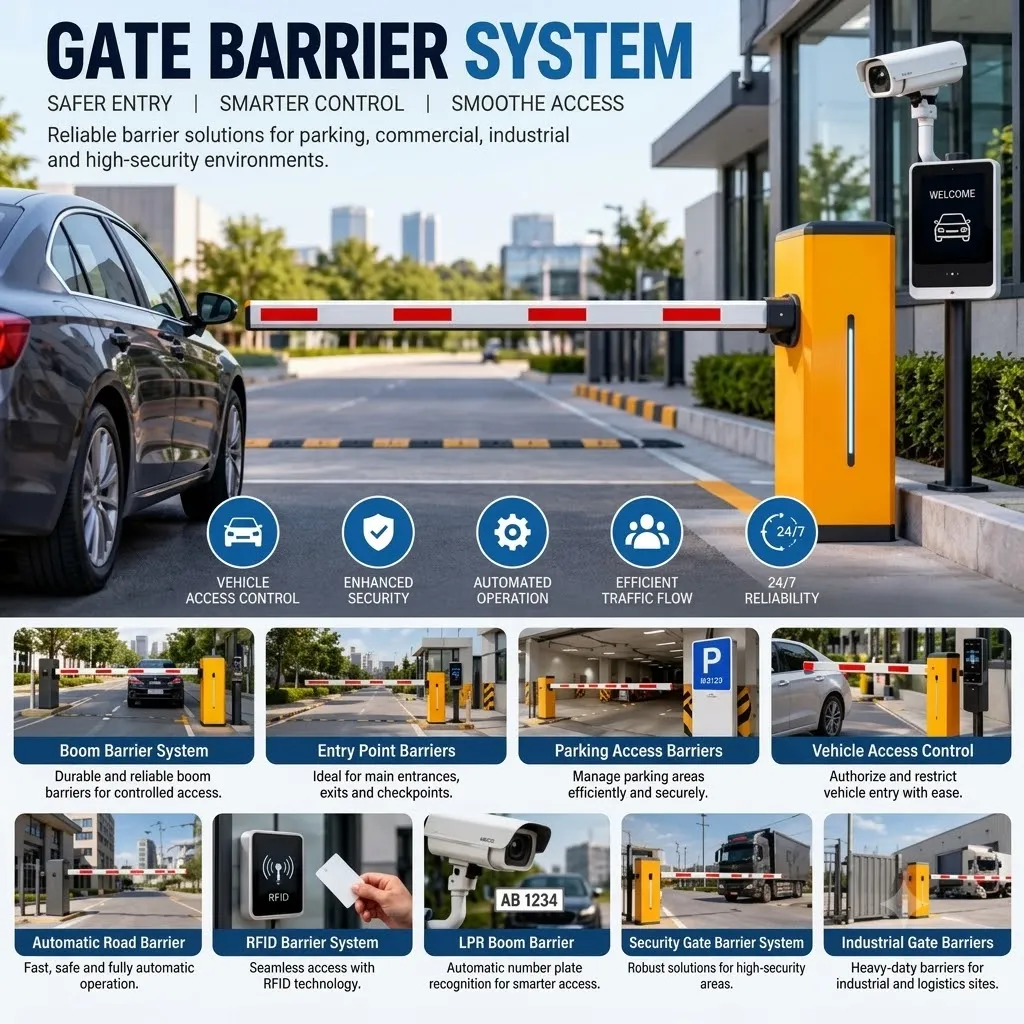

A hospital in Doha, an LNG facility at Ras Laffan, a university campus in Education City, and a logistics hub near Hamad International Airport all need vehicle access control, but none of them need exactly the same equipment. A well-specified Gate Barrier System looks completely different depending on the facility it protects, which is exactly why a single generic setup so often disappoints once real daily operations begin.

A barrier rated for a quiet residential compound will fail quickly at a facility processing hundreds of heavy vehicle movements a day, while an industrial-grade unit is needlessly expensive and mechanically excessive for a small clinic's staff parking area.
Getting this match right matters particularly in Qatar, given the sheer diversity of facility types developed in close proximity — energy sector installations, world-class hospitals, flagship universities, and logistics free zones all operating within a relatively compact national footprint.
This article walks through how barrier specification should genuinely change by facility type, so procurement and facilities teams can make an informed choice rather than defaulting to whatever configuration a supplier happens to have readily available.
One Technology, Many Facility Types Across Qatar
At a fundamental level, every automated vehicle barrier performs the same function: verify a credential, raise an arm, and log the event. What genuinely differs across Qatar's diverse facility types is duty cycle, verification method, and the surrounding safety and integration requirements each sector demands.
Understanding those differences before specifying equipment prevents two of the most common and costly mistakes in vehicle access projects: over-speccing a low-traffic site with unnecessary capability, or under-speccing a high-traffic site with equipment that fails within its first year of operation.
Boom Barrier System Basics: What Every Facility Manager Should Know
Whatever the sector, a Boom Barrier System uses a motorized arm paired with a sensor or credential reader to control vehicle passage, cycling the arm only once a vehicle has been verified as authorized to enter or exit the site.
The core mechanism stays consistent across applications, but the motor rating, arm length, and cycle speed all need to be matched to the specific traffic volume and vehicle type a given Qatari facility actually experiences on a normal working day.
Entry Point Barriers for Government and Public Sector Facilities
Qatari government ministries and public service centers require Entry Point Barriers that balance strong verification with the throughput needed to process citizens, residents, and official visitors without creating the kind of queue that undermines confidence in a facility's operational efficiency.
These sites also typically require integration with a visitor pre-registration system, since government facilities routinely host scheduled appointments and official delegations that benefit from pre-approved, time-limited access rather than manual verification at the point of arrival.
Parking Access Barriers for Malls, Hospitals, and Mixed-Use Towers
High-footfall destinations across Doha rely on Parking Access Barriers that manage capacity as much as security, directing traffic to available levels and differentiating automatically between validated shoppers, hospital visitors, and monthly subscription holders using the same facility.
Major hospitals need this capacity management to work flawlessly, since a full emergency department parking area during a critical arrival is a genuinely different problem from a shopping destination running short of spaces on a busy weekend.
Vehicle Access Control for Healthcare and Education City Campuses
Hospitals, clinics, and the university campuses within Education City need Vehicle Access Control tuned for a mixed population of staff, patients, students, and emergency vehicles, each requiring a different access rule and priority level at the same physical gate.
Ambulance and emergency vehicle override capability is non-negotiable at healthcare sites, requiring a barrier system that can be manually or automatically bypassed instantly during a genuine emergency without any delay caused by standard credential verification.
Automatic Road Barrier Solutions for Logistics and Free Zone Hubs
Qatar's expanding logistics and free zone network near Hamad International Airport and the port depends on a heavy-duty Automatic Road Barrier engineered for continuous, high-frequency cycling, processing truck after truck through a gatehouse without the mechanical wear a lighter residential unit would experience under comparable volume.
Wider arm spans and reinforced motor housings are typically specified at these sites to accommodate larger commercial vehicles, alongside vehicle detection loops calibrated for a heavier average vehicle weight than a standard passenger car installation would require.
Industrial Gate Barriers Built for Qatar's Energy Sector
LNG terminals, petrochemical facilities, and industrial complexes around Ras Laffan and Mesaieed rely on Industrial Gate Barriers engineered for extreme duty cycles, harsh outdoor exposure, and integration with site-wide safety and security management systems appropriate for critical energy infrastructure.
These installations often need to withstand not just high traffic volume but genuinely demanding environmental conditions — heat, humidity, and coastal salt exposure — requiring sealed electronics and corrosion-resistant housings rated well beyond a standard commercial specification.
RFID Barrier System Deployment for Fleet-Heavy Operations
Facilities operating large vehicle fleets — logistics companies, utility providers, and industrial sites with heavy internal vehicle movement — benefit significantly from an RFID Barrier System that reads a windshield-mounted tag automatically, letting known vehicles pass without stopping.
This hands-free verification reduces both gate congestion and unnecessary wear on vehicle brakes and engines, a meaningful operational saving at sites where hundreds of internal vehicle movements occur across a single working shift.
LPR Boom Barrier Technology for High-Turnover Visitor Sites
Retail destinations, hospitals, and any Qatari site welcoming a large volume of one-time or infrequent visitors benefit from an LPR Boom Barrier that reads and verifies a license plate automatically, extending controlled access to vehicles that will never carry a permanent RFID tag.
Because the plate itself becomes the credential, this approach also builds a searchable movement record without requiring any pre-registration step, making it particularly well suited to sites where the visiting vehicle population changes constantly.
Security Gate Barrier System Design for Multi-Layered Facilities
Large, complex sites rarely rely on a single verification method. A properly layered Security Gate Barrier System typically combines RFID for known fleet vehicles, LPR for general visitor traffic, and biometric or intercom verification as a fallback at the most sensitive access points.
Designing this layered approach around each facility's actual risk profile, rather than applying the same combination everywhere, is what separates a genuinely effective deployment from a generic package that technically works but never quite fits the site.
Meeting Gate Barrier System Qatar Requirements Across Sectors
Regardless of facility type, organizations pursuing Gate Barrier System Qatar deployments must confirm alignment with Qatar Civil Defence emergency vehicle access requirements and relevant municipal permitting rules, standards that apply consistently whether the site is a hospital, an LNG facility, or a government building.
Sector-specific procurement standards also apply in regulated industries such as healthcare and energy, where additional documentation of vendor certification and local support coverage is frequently required before a barrier system can be formally approved for installation.
Why Doha's Diverse Facility Types Need Gate Barrier System Doha Expertise
The capital's mix of government ministries, hospitals, universities, corporate campuses, and logistics zones makes Gate Barrier System Doha projects genuinely varied, requiring a supplier capable of specifying correctly across radically different traffic profiles rather than applying one standard configuration everywhere.
A local team with cross-sector Doha project experience can advise facility managers accurately on what similar sites in the capital have actually needed in practice, rather than relying purely on manufacturer specification sheets disconnected from real-world local conditions.
Matching Barrier Specification to Facility Risk Profile
The starting point for any specification exercise should be an honest risk assessment: what is being protected, who needs access, how often, and what the consequence of a security failure would actually be at this specific site.
A facility protecting high-value energy infrastructure or sensitive government functions warrants a fundamentally different verification and barrier strength standard than a residential compound whose primary concern is convenience and basic deterrence for its own residents.
Common Mistakes When One Barrier Type Is Used Everywhere
A frequent mistake is a facilities team purchasing the same barrier model across every site in a portfolio for simplicity, only to discover that a unit perfectly adequate for a quiet office car park fails prematurely at a high-traffic logistics facility in the same portfolio.
Another common gap is failing to reassess barrier specification as a facility's use changes over time, leaving equipment originally sized for a smaller operation struggling to keep pace once a site's traffic volume grows well beyond its original design assumptions.
Finally, some organizations centralize procurement decisions without input from the facility managers who actually understand each site's daily traffic reality, resulting in a standardized purchase that looks efficient on paper but underperforms in practice.
Working with a Proven Regional Security Partner
Tektronix has deployed gate and barrier infrastructure across government, healthcare, energy, logistics, and residential facilities throughout the GCC, with engineers experienced in matching barrier specification to each sector's real operating conditions. Facility managers in Qatar evaluating a rollout can review the full range of gate and barrier solutions built for every facility type in Qatar to compare duty cycle ratings and verification methods against their site's specific traffic profile.
Integrating Barrier Infrastructure into a Wider Facility Security Plan
Vehicle barriers perform best as one layer within a broader facility security strategy tailored to that site's actual role, whether that is a hospital, an energy facility, or a government building. Organizations planning a multi-site rollout often start by requesting a portfolio-wide assessment through Tektronix's vehicle access control specialists, who can recommend a different barrier mix for each facility type in the portfolio.
Conclusion
No single Gate Barrier System configuration fits every Qatari facility. A properly rated Boom Barrier System, consistent Entry Point Barriers, and well-managed Parking Access Barriers each serve a different purpose. Reliable Vehicle Access Control, a heavy-duty Automatic Road Barrier, and rugged Industrial Gate Barriers, paired with RFID Barrier System and LPR Boom Barrier technology, form a complete Security Gate Barrier System. For Gate Barrier System Qatar compliance, or a Gate Barrier System Doha rollout, Tektronix matches the right barrier to every facility type.




























Sign in to leave a comment.