
Unlike most purchases, an elevator isn't something you quietly replace if it turns out to be the wrong fit. It becomes part of a building for decades, which is exactly why the company standing behind it deserves as much scrutiny as the product itself. India's elevator industry isn't one interchangeable pool of vendors, either. It's made up of large global manufacturers, established domestic companies, and brands built entirely around residential use, and each has earned its place through a different strength: engineering at scale, smart-building capability, or design made specifically for homes.
This framework walks through the top elevator brands shaping India's elevator market in 2026, what genuinely separates one category from another, and how your decision should change depending on whether you're fitting out a high-rise, a commercial building, or your own house.

Why the Manufacturer's Track Record Is Worth Your Attention
Buying an elevator doesn't end the moment it's installed. It marks the start of a relationship that can run for twenty years or longer, and how fast help arrives when something malfunctions usually comes down to how deeply established the manufacturer is in your city. A handful of signals tend to point toward a reliable company: consistent engineering standards, well-designed safety systems, easy access to spare parts, and honesty upfront about ongoing maintenance costs.
What matters also shifts with the setting. Commercial and high-rise buildings prioritize speed, traffic capacity, and integration with building management systems. Homes need something altogether different: a compact footprint, quiet operation, and finishes that feel like part of the house rather than a corporate lobby.
Three Categories Worth Knowing
Global Manufacturers Built for Scale
Several large international companies maintain a substantial presence in India, most headquartered abroad but with decades of local operations behind them. These manufacturers are typically the default choice for high-rise towers, commercial offices, shopping malls, and airports, where the real challenge is moving large volumes of people reliably every single day. Their scale also brings a practical benefit: wide service coverage, useful for properties spread across multiple cities.
Within this category, some manufacturers have built their reputation on smart-building features, such as app-based lift summoning or integration with security systems, while others are better known for engineering precision or a smoother ride during periods of heavy traffic.
Established Domestic Manufacturers
India has its own long-running elevator companies, many with decades of domestic engineering experience. These manufacturers often have a strong presence in residential societies, schools, and institutional buildings and tend to compete less on scale and more on local responsiveness and willingness to customize for a specific project. Several regional manufacturers, operating out of different Indian cities, also serve this mid-market segment.
Brands Built Exclusively for Homes
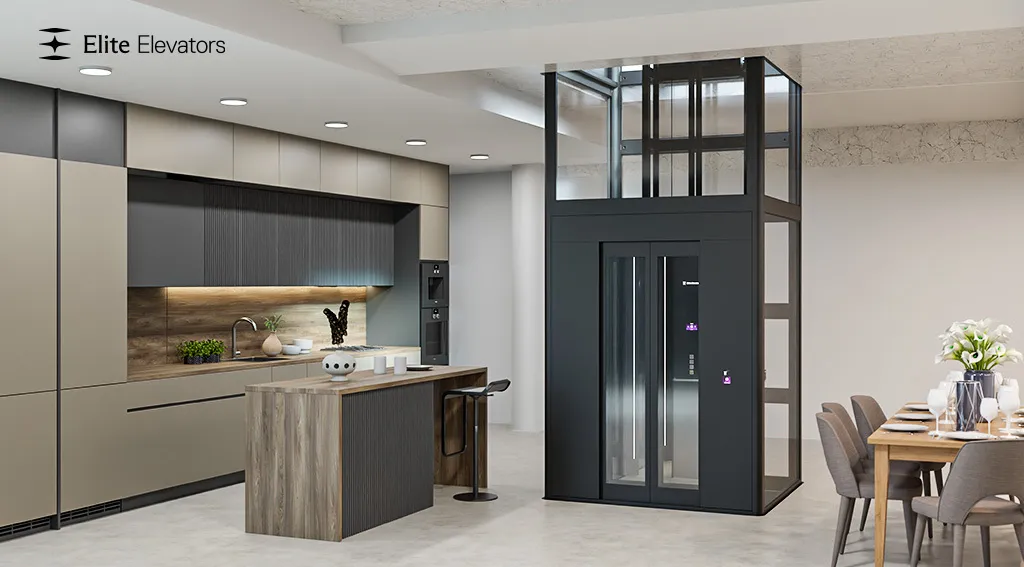
Not every elevator company competes in every segment. A distinct category has emerged around residential-only lifts, where the priorities look nothing like commercial-scale work: smaller footprints, quieter mechanisms, and interiors designed to disappear into a home rather than stand out in an office setting.
This group includes companies that build nothing but residential elevators, stairlifts, and platform lifts, frequently specializing in compact, machine-room-less shafts suited to homes with limited space. Some have also carved out a niche around alternative mechanisms, such as vacuum-driven or pneumatic systems, often chosen for retrofits where a conventional shaft simply won't work.
Don't Skip the Drive Mechanism
Before committing to a brand, it's worth understanding the two dominant drive technologies, since not every manufacturer handles both equally well.
Hydraulic lifts move the cabin with a piston. They're mechanically straightforward, generally more budget-friendly, and a sensible fit for homes with fewer floors.
Gearless and belt-drive lifts cost more at the outset, but they deliver quieter operation, a smoother ride, and typically a longer service life, which suits households using the lift frequently across multiple floors.
Some brands specialize heavily in one of these technologies; others offer both. Knowing where a shortlisted brand genuinely performs best can matter more than which broad category it belongs to.
Putting Together a Realistic Shortlist
For a commercial or high-rise project, pay attention to:
- Whether the system can realistically handle your expected footfall at the right speed
- Compatibility with building management or security systems
- The strength of the local service network and typical response times
- Comparable projects the manufacturer has already completed in your city
For a home lift, pay attention to:
- Whether the company genuinely specializes in residential work, rather than treating it as a side product
- What shaft your home actually requires, since retrofitting often calls for machine-room-less or compact solutions
- Home-specific safety features, including an automatic rescue device, emergency calling, and auto-releveling
- What after-sales support and the Annual Maintenance Contract genuinely include
Comparing Brands on Facts, Not Pitches
Once your list is narrowed to two or three names, ask each one for identical information: the drive mechanism offered, shaft requirements for your specific space, safety certifications, a realistic installation timeline, and what the AMC actually covers. Judging brands on the same specific details, rather than whichever pitch sounds most persuasive, is the only reliable way to see which one truly fits.
Among the best home elevator brands in India, the decision often comes down to something simpler than it initially seems: do you need a manufacturer built for large-scale commercial work, or one built specifically for residential needs? These are two fundamentally different problems, and getting that distinction right makes everything that follows considerably easier.
Where This Leaves You
There's no single "best" elevator brand in 2026, because the market was never built around one winner. Global manufacturers dominate high-rise and institutional projects, while specialist companies exist to serve homes with an entirely different set of priorities. The right choice depends on your building type, the mechanism suited to your space, and how reliably a company can support the installation once it's running. Comparing your shortlist detail by detail, rather than being swayed by whoever pitches the loudest, is ultimately what separates a sound decision from a rushed one.

























Sign in to leave a comment.