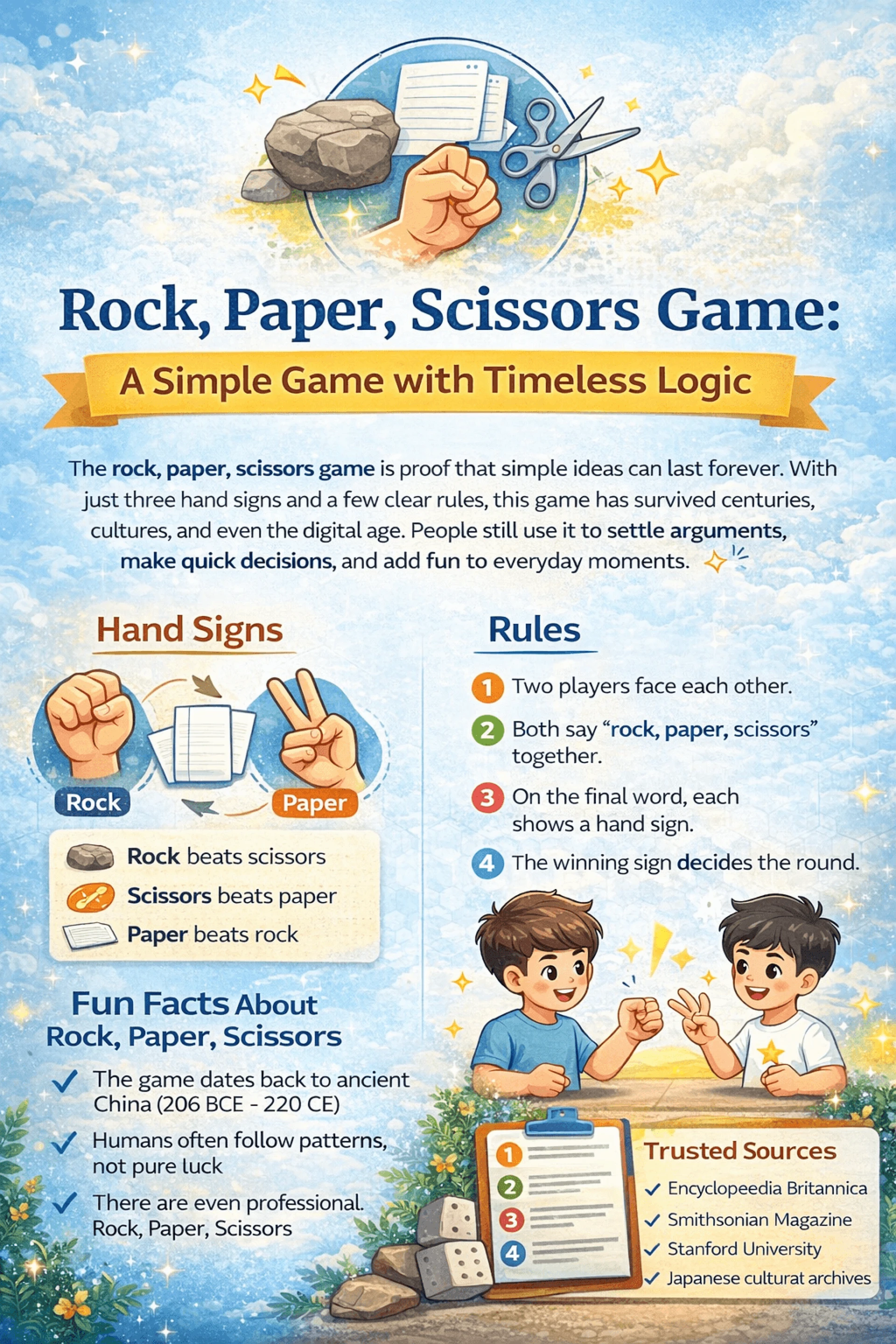
The rock, paper, scissors game is proof that simple ideas can last forever. With just three hand signs and a few clear rules, this game has survived centuries, cultures, and even the digital age. People still use it to settle arguments, make quick decisions, and add fun to everyday moments.
Let’s explore how this small game works, where it came from, and why it still makes perfect sense today.
What Is the Rock, Paper, Scissors Game?
Rock, paper, scissors is a two-player hand game where both players choose one of three symbols at the same time:
- Rock
- Paper
- Scissors
Each symbol beats one and loses to another. That balance makes the game fair and predictable in rules, but unpredictable in results.
You don’t need equipment, preparation, or instructions that take ten minutes to explain. If you have hands, you can play.
Rules of Rock, Paper, Scissors
The rules stay the same almost everywhere in the world.
How a Round Works
- Two players face each other.
- Both say “rock, paper, scissors” together.
- On the final word, each player shows a hand sign.
- The winning sign decides the round.
Winning Logic
- Rock beats scissors
- Scissors beats paper
- Paper beats rock
If both players show the same sign, the round ends in a tie.
No confusion. No debate. No referee needed.
Where Did Rock, Paper, Scissors Come From?
The game may feel modern, but it isn’t.
Historical Origin
Historians trace the roots of rock, paper, scissors back to ancient China, where similar hand games existed as early as the Han Dynasty (206 BCE – 220 CE). The concept later spread to Japan and evolved into Jan-Ken, which closely matches the version we play today.
From Japan, the game reached Europe and other parts of the world during the 18th and 19th centuries through cultural exchange.
Trusted sources like Encyclopedia Britannica and the Smithsonian confirm this historical path.
Why the Game Feels Fair Every Time
Rock, paper, scissors works because it follows perfect balance.
Each option:
- Wins against one
- Loses against one
- Draws with itself
That balance removes advantage. No sign is stronger than the others. If both players choose randomly, each has an equal chance of winning.
This fairness is why people trust the game to make decisions, even serious ones like who goes first or who takes responsibility.
Is Rock, Paper, Scissors Just Luck?
Not exactly.
The Human Factor
While the game looks random, humans rarely behave randomly. Research in behavioral science and game theory shows that players often follow patterns.
Common tendencies include:
- Choosing rock in the first round
- Repeating a move after winning
- Changing strategy after losing
Studies from universities such as Stanford show that experienced players can predict opponents by watching habits, timing, and confidence.
So the game mixes chance with psychology—which makes it more interesting than it appears.
Rock, Paper, Scissors as a Strategy Game
At casual level, the game stays playful. At higher levels, it becomes strategic.
Competitive Play
Yes, competitive rock, paper, scissors exists. Organized tournaments take place in countries like Japan and the United States.
Professional players focus on:
- Reading body language
- Breaking predictable patterns
- Staying emotionally neutral
At that point, the game becomes less about hands and more about minds.
Popular Variations of Rock, Paper, Scissors
Over time, people added variations to keep things fresh.
Well-Known Versions
- Rock, Paper, Scissors, Lizard, Spock
- Best-of-three or best-of-five rounds
- Online and mobile app versions
- Team-based formats
Even with variations, the core idea remains unchanged: balanced choices and instant outcomes.
Educational Value of the Game
Teachers and educators often use rock, paper, scissors for a reason.
Skills It Builds
- Decision-making under pressure
- Emotional control during wins and losses
- Understanding fairness
- Basic probability awareness
For children, it teaches turn-taking. For adults, it reminds us that losing isn’t the end of the world sometimes it’s just paper covering rock.
Rock, Paper, Scissors in Modern Life
The game appears everywhere today.
You’ll see it used:
- In offices to make quick choices
- On playgrounds to resolve disputes
- In mobile games and apps
- In movies, TV shows, and pop culture
It even shows up in computer science, where programmers use it to test algorithms and randomness models.
Few games cross so many boundaries with such ease.
Why Rock, Paper, Scissors Still Matters Today
Technology has changed how we play games, but rock, paper, scissors still survives because it fits human nature.
It is:
- Fast
- Fair
- Social
- Easy to understand
In a world full of complicated decisions, this game offers a reminder that simple logic still works.
Final Thoughts
The rock, paper, scissors game is more than a childhood pastime. It’s a balanced system built on logic, history, and human behavior. That combination keeps it relevant even today.
Whether you play it for fun, strategy, or decision-making, one thing stays true: this tiny game punches far above its weight.
Sometimes, the smartest choice really does come down to rock, paper, or scissors.


























Sign in to leave a comment.