
- Introduction to SaaS and its role in business efficiency
- Understanding SaaS and its key benefits
- Assessing business readiness and goals
- Selecting the right SaaS solution and vendor
- Planning implementation, integration, and data migration
- Ensuring security, compliance, and user adoption
- Optimizing performance, costs, and ROI through continuous improvement
The speed, capacity, and adjustability in the business world predict a shift in business practices to Software as a Service (SaaS) so as to optimise the workflow and subsequently raise the organisation's overall productivity.
SaaS offers great flexibility vis-à-vis costs and speed of deployment compared with the traditional models of software. But an SaaS acquisition by itself does not ensure performance; what signifies for the realization of the benefits are the implementation and management capabilities.
This article collects in one place a good deal of best practices on putting SaaS to use within an organisation. The emphasis is placed on strategic planning, user adoption, security matters, and longer-term optimisation to assist anyone in squeezing out maximum operational effectiveness and ROI.
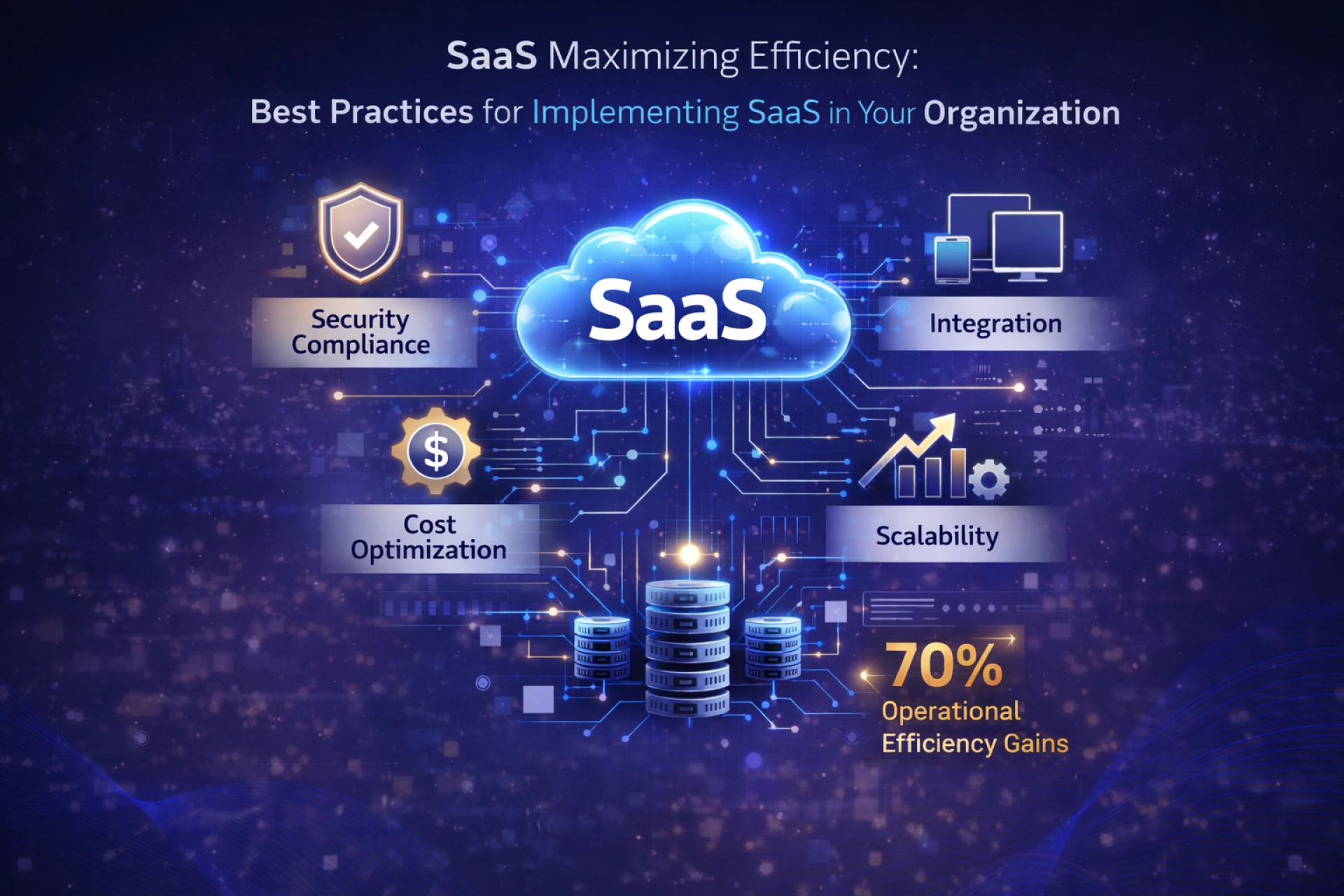
Conceptualized Architecture of SaaS and Efficiency of Implementation in an Organization
What Is SaaS?
Software as a Service is a software distribution model that is cloud-based. Providers host the applications, and they are generally approached via the Internet. Companies do not have to install or service applications. They subscribe to the service and use it only when needed.
This model benefits from an elimination of overhead on infrastructure, the reduction in the cost of maintenance, and the advantage of teams being able to utilize the technology anywhere, tailor-made for modern, distributed work environments.
How SaaS Supports Business Efficiency
These SaaS models enhance and accelerate various task processes, as they help in automation, enable team collaboration in real-time, and ensure the systems are always up to date. With that, the organisation can reap greater huge benefits in faster implementations, predictable costs, and the ability to level the scale as the need progresses for business.
How to Assess the Readiness of the Organization to Implement SaaS
What Is the Core Functionality of the Business?
Before deploying a SaaS solution, organizations are expected to decide on the exact problems they want to tackle. They can easily analyze inefficiencies in their current workflow, hurdles in operations, and areas where automation or collaboration in the process can prove benefits.
Business SaaS adoption will, thus, be aligned with business goals to ensure that the software delivers value to the users rather than sitting as an underutilized tool.
Review of Existing Systems and Infrastructure
Knowing who you are becomes crucial insofar as your technology landscape is concerned. Examine the current application software, data flows, and interfacing to other applications to figure out how a new saas development company could fit in among your other applications. This tends to reduce compatibility while making the change smoother.
Selecting the Best SaaS Solution
Selecting the best SaaS solution is much beyond feature-to-feature comparison, though that is not a bad starting point to help address potential solution inquiries. The main selection points should include:
- Level of usability
- Scalability
- Integration capabilities
- Network and data security and compliance standards
- Consider the vendor's record on service quality and support
- This choice prevents future costly migrations and aligns both current and future needs.
Comparing Vendors and Long-term Fit
Among the prominent factors facilitating long-term success are vendors' experience, roadmap, and support structure. To get their solutions customised, organised, and then tweaked through integration with various business processes, many companies partner with steady SaaS development companies.
Build a Systematic Strategy for SaaS Implementation
Designing a Map for the Implementation
A systematic map sets down timelines, checkpoints, the owner's roles, and desired outcomes. That will make clear to the person on the ground what their role in the project is and help push the solution forward.
Carefully constructed plans will drastically lower any potential mix-ups, reduce any sort of downtime, and improve on cross-team coordination during implementation.
Data Migration and Integration Planning
The data migration phase, oftentimes, is the most complex task in SaaS implementation. It is necessary to specify which data will be migrated, how data will be cleaned, and how it will integrate with other systems.
- Proper planning decreases data loss for the sake of downtime in the operation.
- Ensuring Security, Compliance, and Data Protection
- Understanding the Shared Responsibility Model
In a SaaS environment, security is shared between the vendor and the entities. While the providers maintain security of infrastructure, entities must look after user access, data governance, and internal security activities.
Implementing the Best Security Practices
- Best practices include:
- Role-based access control
- Multi-factor authentication
- Regular security audits
- Continuous monitoring of user activity
- Strong security measures to uphold the data balance and maintain customer trust.
- Encouraging User Adoption and Managing Change
Preparing Teams for SaaS Adoption
SaaS solutions can fail if employees do not accept and use them. Communication about benefits, along with change and leadership perspectives, helps everyone adapt.
If user anxiety is addressed first, resistance among employees is lessened, and launch success is assured.
Training and Onboarding Strategies
There should be job-specific training, and use cases should be in focus instead of genericities. Documentation, video instructions, and hands-on activities tend to build the user's confidence and experience.
Supporting Continuous Adoption
The best way to be continuous is to use user feedback to implement changes gradually. Since our product satisfies both our needs and user requirements, we should keep it flexible.
- Maximizing SaaS Performance and Operational Efficiency
- Monitoring Usage and Performance Indicator
An examination of usage patterns defines wasteful features, adoption blind spots, and optimization hopes. User engagement, task completion time, and system uptime indicators provide meaningful insights.
Process Automation for Greater Efficiency.
Workflow automation is often brought into an organisation through SaaS platforms, reducing manual work and errors. Process efficiency may be improved by adding the automation solution into staff off-the-shelf SaaS tools.
Depending on the scope of robotic process automation, organisations then partner with companies that are experienced and adept at helping streamline workflows, thus bringing about optimisation of the end-to-end processes.
SaaS Costs Management and ROI Optimization
Understanding SaaS Pricing Models
SaaS pricing follows a subscription model that could be pay-as-you-go and is invoiced based on usage, features, and user numbers. It is worth understanding the pricing model when it comes to what an organisation might expect and costs accordingly.
How to Control SaaS Spend
Regular audits will help prevent you from overspending on licensing and usage. Disengage all the unused accounts, negotiate to get a better rate, and pay only for what you use. Partnering with an mvp development company can also help ensure your investment in analytics tools and software is aligned with real business needs.
ROI should involve examining more than mere cost savings, with weight given to productivity gains, faster decision-making, and enhanced customer experience. Associating SaaS outcomes with business metrics will allow for stronger investment justification.
Integration and Compatibility Issues
With numerous SaaS tools in place, the data could be fragmented and cause inefficiency. The integration teams or the APIs will enable data to flow completely seamlessly throughout systems.
Low User Adoption
Resistance to change is the biggest challenge. Strong leadership, continuously updating training programmes, and constructive user-centric innovations can bring about the adoption changes.
Security and Compliance Concerns
The importance of protecting the organisation's information and reputation lies in taking actions toward proactive risk management, which, coupled with clear policies and regular audits, attempts to mitigate security and compliance risks, namely as they pertain to cloud-based systems.
Article Summary:
A SaaS deployment is not only a technological switch, but it is a major shift in the way the organisation functions. With clear goals, structured planning, total security practices, and active user adoption processes, SaaS can prove to be a highly effective promoter of increased efficiency and growth.
Through measuring performance continuously, optimising workflows, and aligning SaaS utilisation with business objectives, firms can achieve top value from their SaaS investment and create a scalable future digital ecosystem.


























Sign in to leave a comment.