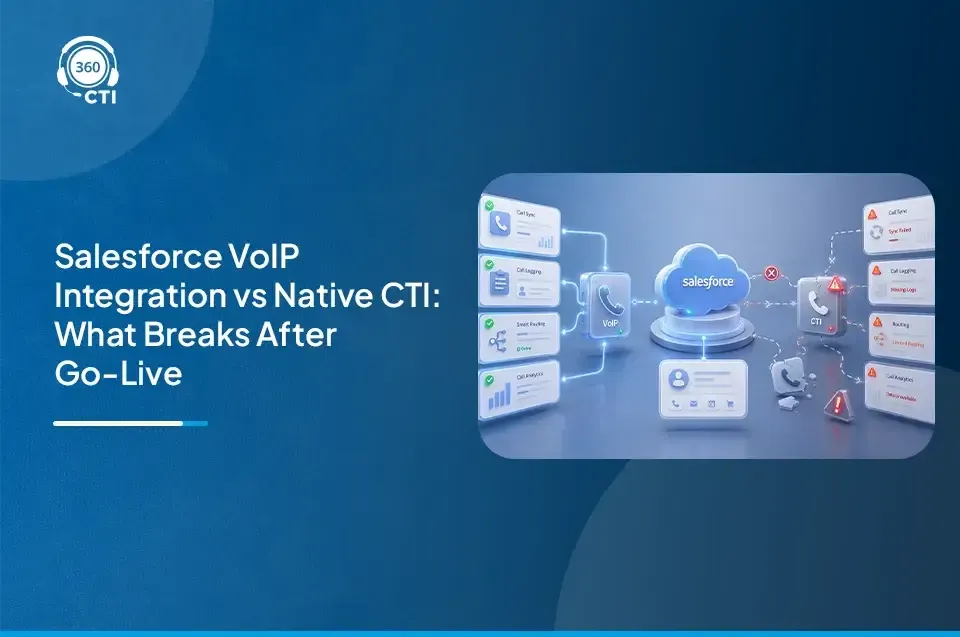

A sales manager asks for “Salesforce VoIP.” An admin buys a VoIP connector. Six months later, calls are logging inconsistently, routing is a mess, and nobody can explain why. This happens more often than you’d think, because “Salesforce VoIP” isn’t one thing. It’s a label vendors slap on wildly different products, and most teams don’t realize they’re comparing apples to a completely different category until they’re already stuck with the wrong one.
That category is native CTI. And knowing the difference before you sign a contract saves you the rework.
What VoIP Actually Is, and Why “VoIP Integration” Means Something Different to Every Vendor
VoIP just means voice over internet protocol. That’s it. It’s the transport layer, the thing that carries your call as data instead of over a copper phone line. On its own, VoIP has nothing to do with Salesforce.

A salesforce voip integration is what happens when a VoIP provider builds a bridge between their phone system and your CRM. Some of these bridges are thin. A click-to-dial button, maybe a call log that syncs an hour later. Some are thicker, with screen pops and basic reporting bolted on. But here’s the catch: every vendor calls this “Salesforce integration,” and the depth varies enormously.
Twilio, RingCentral, Aircall, Dialpad. All of them offer some flavor of salesforce voip integration. Some route through Salesforce’s Open CTI framework. Others use middleware that sits outside Salesforce entirely and pushes data in through APIs on a schedule. Neither is inherently bad. But neither is the same thing as a native app either, and that distinction is where most buying decisions go sideways.
What Native CTI Gives You That a VoIP Integration Cannot
Native cti salesforce apps are built to live inside Salesforce as a managed package, not bolted on from outside. The call center logic, the routing engine, the recording pipeline, all of it runs as part of your Salesforce org.
Why does that matter practically? A few reasons.
- Call data writes directly to Salesforce objects in real time, not on a sync delay
- Routing rules can reference actual Salesforce fields (owner, territory, case status, customer tier) without a middleware translation layer
- Admins configure IVR, call lists, and dispositions using Salesforce-native tools, not a separate vendor portal
- Reporting runs through standard Salesforce report and dashboard objects, so managers aren’t toggling between two systems to see the full picture
With a VoIP integration, you’re often stitching two systems together and hoping the sync holds. With native CTI salesforce architecture, there’s one system. That’s really the whole argument.
I’ve seen teams underestimate how much this matters until a rep pulls up a lead mid-call and the screen pop shows the wrong record, or shows nothing at all, because the match logic lives outside Salesforce and missed an edge case. It’s a small thing. It costs you credibility on the call.
Routing is usually where the gap shows up first. If your calls need to reach the right agent based on skill, region, or customer priority instead of just the next free line, take a look at how AI-driven call routing works inside a native setup.
How to Decide Based on Your Actual Salesforce Setup
Skip the vendor pitch decks for a second and ask three questions instead.
First: how many calls does your team actually make in a day, and does routing need to be smart or just functional? Second: does call data need to feed reports that leadership actually looks at, or is it mostly for record-keeping? Third: are you planning to scale this team in the next 12 months?
Conclusion
The real issue isn’t whether VoIP or CTI sounds more modern. It’s whether your call data lives where your team actually works. A native app keeps everything, routing, logging, reporting, inside the same system your reps already use. A VoIP integration keeps things separate and hopes the sync holds.
360 CTI is built as a native Salesforce app, not an Open CTI bridge or a middleware layer, which means call logging, routing, and reporting all run inside the same org your team already trusts.
Read more at..https://360cti.com/blog/salesforce-voip-vs-native-cti-what-most-teams-get-wrong-before-choosing/



























Sign in to leave a comment.