SAP Activate Methodology Certification, Worked Through: One C_ACT Roleplay From Brief to Debrief

Updated: November 14, 2026
What does the SAP Activate methodology certification actually ask you to do? It asks you to hold a project conversation. C_ACT, the SAP Certified - Project Manager - SAP Activate exam, is a two-hour Scenario Based Assessment with a 60% pass score. You talk through a business situation and defend your decisions.
Most C_ACT guides list the six phases and stop there. Knowing that Explore comes before Realize won't help much when a senior controller tells you to skip it.
Below is one practice scenario, start to finish, with a weak and a strong answer at each turn. The scenario is our own illustration. It is not an SAP exam task, and SAP has not published its scoring rubric.
Is C_ACT really a scenario-based assessment?
Yes. SAP's C_ACT page lists one activity, a Scenario Based Assessment, lasting 2 hours with a 60% pass score. You can do it as a roleplay with AI guidance or record a video for an SAP evaluator.
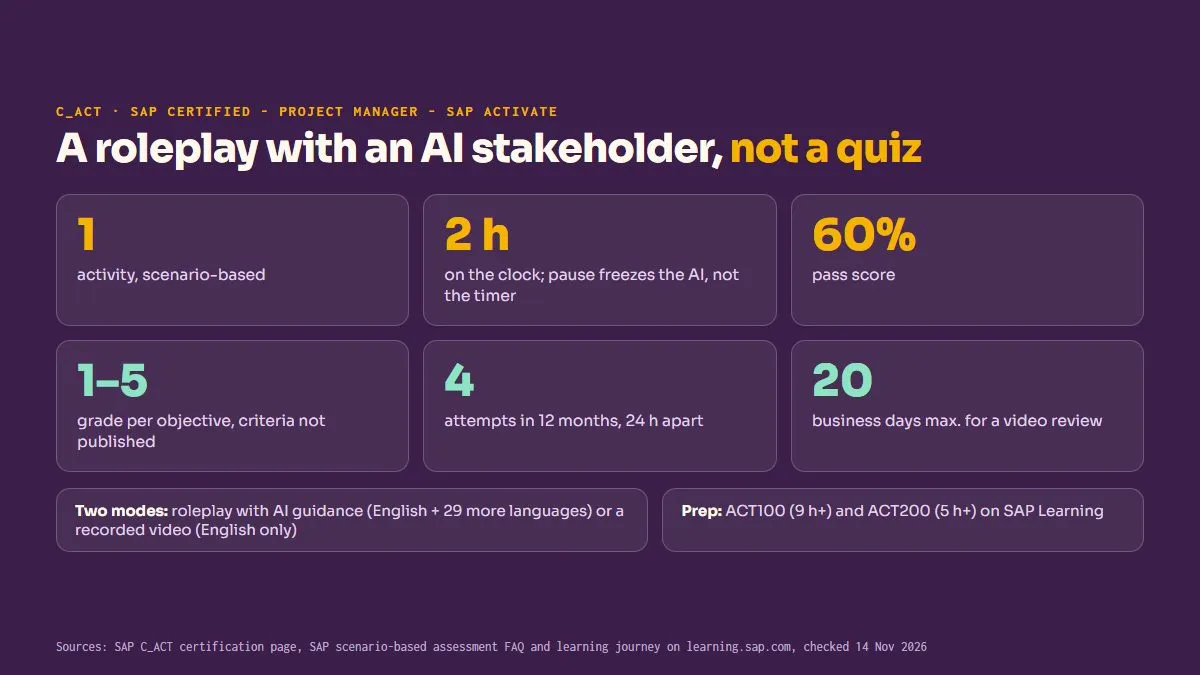
The SAP C_ACT certification page says the exam validates "business skills, communication, stakeholder management, change management, successful project transitions, and understanding of testing and quality management", all in the context of the SAP Activate methodology. That list matters later, because it is the closest thing to a published set of objectives.
A few other facts from SAP's own pages, checked on November 14, 2026:
- Format choice. The AI roleplay runs in English, Spanish, Italian, French, Japanese and 25 more languages. The recorded video is English only, and SAP's scenario-based assessment FAQ says evaluator review "may take up to 20 business days".
- Scoring scale. The same SAP SBA FAQ says each exam objective is graded from 1 (Insufficient) to 5 (Excellent) "based on criteria established by subject matter experts". The criteria themselves are not public.
- Attempts. Up to 4 attempts in 12 months, with 24 hours between them. A retake while time remains on the clock counts as one attempt.
- Pause. Pausing freezes the AI conversation but not the exam countdown.
- Preparation. SAP's C_ACT learning journey has two courses: ACT100 (9 hours plus) and ACT200 Agile Project Delivery (5 hours plus).
For the wider picture, see this earlier WriteUpCafe piece on the new SAP certification format.
What is the scenario?
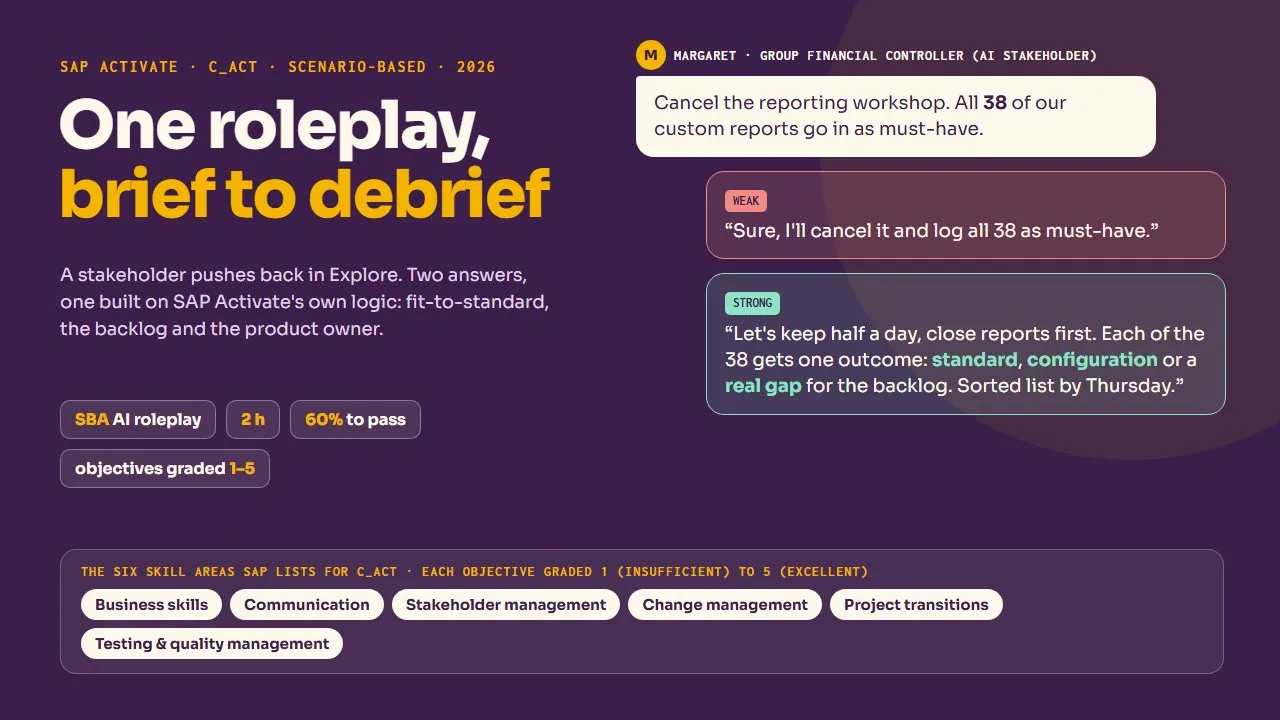
A private cloud SAP S/4HANA project in the Explore phase. The Group Financial Controller wants to skip the reporting fit-to-standard workshop and have the team rebuild all 38 of her old custom reports exactly as they are.
Brief: You are the project manager on a greenfield SAP S/4HANA implementation in a private cloud. The project is in the Explore phase, and finance fit-to-standard workshops are running in the starter system. Before tomorrow's reporting session, the Group Financial Controller, Margaret, calls you.
Margaret: My team has 38 custom reports in the old system. Month-end close depends on them. We don't need a workshop to tell us what we already know. Cancel the reporting session, put all 38 on the build list as must-haves, and let's save everyone a day.
Margaret is not being unreasonable. Her close process works and she answers for it. Her request, though, cuts across three things SAP Activate is built on: fit-to-standard, a prioritized backlog, and a clean core.
Before answering, a good candidate asks a clarifying question or two. For example: which of the 38 reports run at month-end close, and who owns them? Asking first is part of the job.
What does a weak answer sound like?
A weak answer agrees to everything to keep the stakeholder happy. It cancels the workshop, logs all 38 reports as must-have development items, and never mentions the product owner, the standard content or the cost of custom code.
Weak answer: Understood, Margaret. You know your reports best. I'll cancel tomorrow's session and ask the team to log all 38 as report objects in the backlog, all marked must-have. We'll build them in Realize.
It sounds cooperative, and it would leave the team building 38 reports nobody has checked against the standard.
The ACT200 Explore Phase Overview lesson on SAP Learning says the main purpose of Explore is a Fit-to-Standard Analysis that confirms whether the scoped solution meets business requirements. Cancelling the session removes the one step built to check whether standard reporting already covers some of the 38.
The same lesson names this exact failure as a risk: a poor backlog where "Most of the Backlog Items are Must Have with no proper ranking". And it says the product owner, not the project manager, validates deltas before they enter the Product Backlog. The weak answer skips that role entirely.
What does a strong answer sound like?
A strong answer acknowledges the close risk, keeps a time-boxed fit-to-standard session for reporting, sorts every report into standard, configuration or true delta, and sends only real deltas to the product owner for ranking.
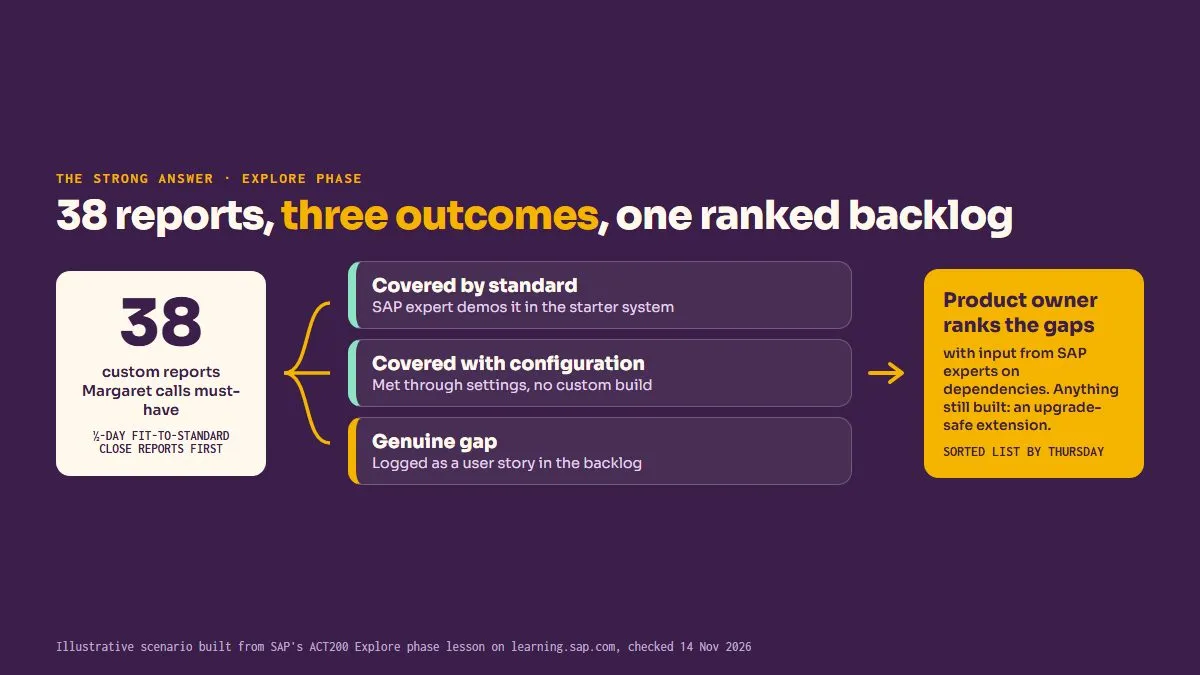
Strong answer: Margaret, month-end close can't break, so let's protect it. I'd like to keep tomorrow's session, cut to half a day, with your close reports first on the agenda. Our SAP expert will demo standard finance reporting in the starter system. For each of the 38 we agree one outcome: covered by standard, covered with configuration, or a genuine gap. Gaps go into the backlog as user stories with the business reason attached, and your product owner ranks them with our experts' input on dependencies. Whatever we still build, we build as an upgrade-safe extension. You'll have the sorted list of all 38 by Thursday, with each decision recorded in our project tool.
Margaret still gets her close reports looked at first, and she will probably end up with fewer custom ones to maintain after go-live.
It also makes a specific promise: the sorted list by Thursday. Remember Thursday; Margaret is about to test it.
What happens when the stakeholder pushes back again?
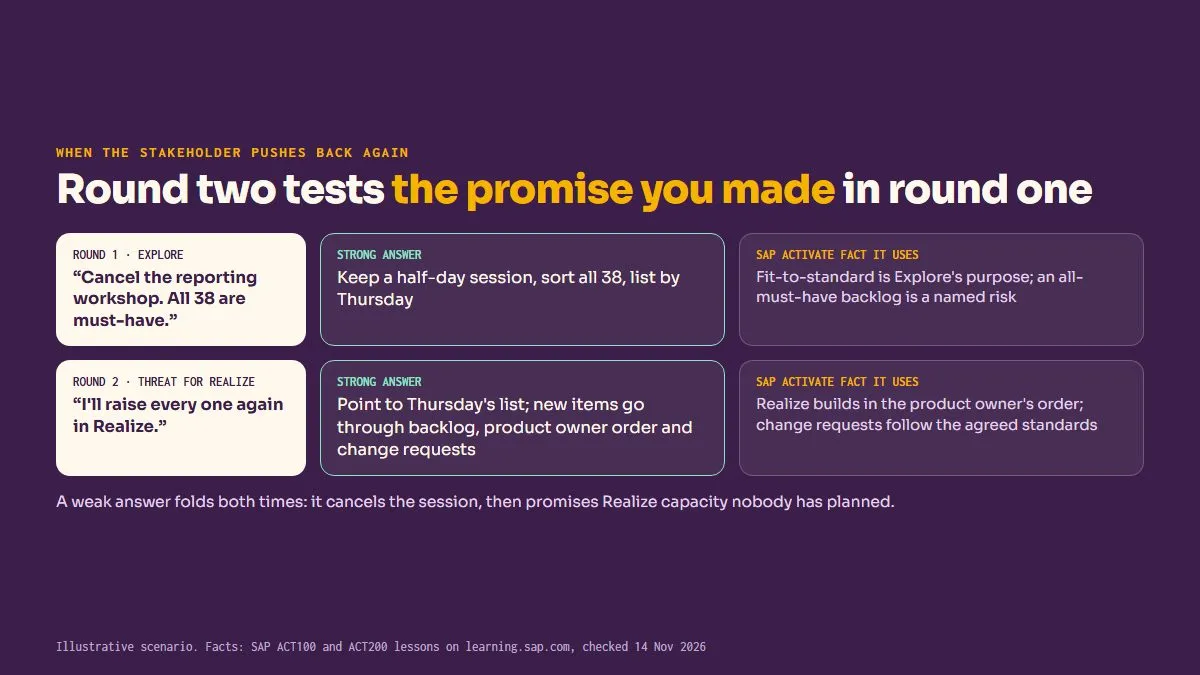
Margaret threatens to raise all 38 again in Realize. The strong answer points back to Thursday's sorted list and explains that new items enter Realize only through the product owner and the change process agreed in Prepare.
Her second message:
Margaret: Fine, run your session. But if I don't see my reports in the system, I'll raise every one of them again in Realize. You can't stop me adding scope then.
A weak second answer folds again: OK, we'll fit them into the sprints as they come up. That promises Realize capacity nobody has planned.
A strong second answer holds the line and stays friendly:
Strong answer: You can raise them, and you should if something is missing. On Thursday you'll have all 38 with a decision on each. In Realize, the team builds from the backlog in the order your product owner sets. A new report after that goes through the same door: logged, sized and ranked against everything else, using the change request process we agreed at the start. Nothing gets lost, and nothing jumps the queue without a reason.
This answer leans on two facts from SAP's ACT100 course. The ACT100 methodology foundation lesson says that in Realize the team builds iteratively and incrementally from the backlog, and that "This build follows the prioritization given by the product owner". And the ACT100 workstreams lesson says project standards define how incidents and change requests are processed, with sign-off through quality gates (QGates).
It also cashes in the Thursday promise, which is the kind of follow-through a second round of pushback is there to probe.
Why does the strong answer score better?
Because it shows the skills SAP lists for C_ACT: stakeholder management, change management and quality thinking, applied through the right phase logic. The weak answer shows goodwill but none of the method.
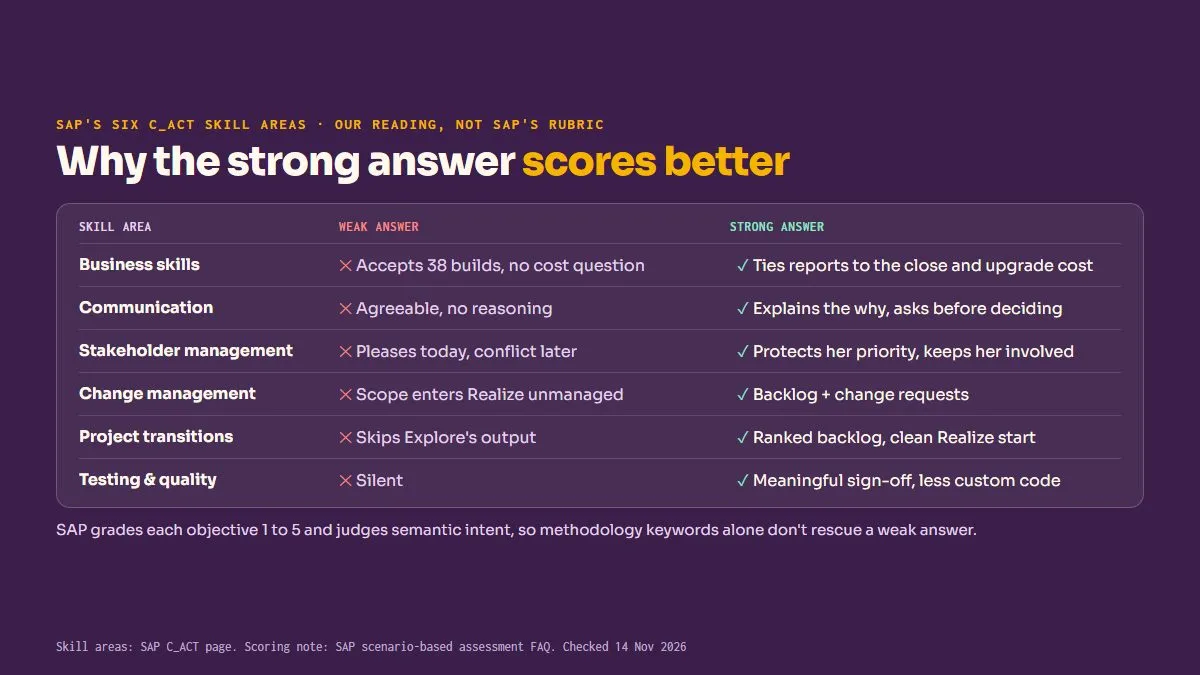
SAP grades each objective from 1 to 5 against criteria it does not publish. The table below is our reading, using the six skill areas named on SAP's C_ACT page. SAP's real rubric may weigh these areas differently.
| Skill area on SAP's C_ACT page | Weak answer | Strong answer |
|---|---|---|
| Business skills | Accepts 38 builds without asking about value or cost | Ties each report to the close process and to upgrade cost |
| Communication | Agreeable, no reasoning given | Explains the why in plain language and asks before deciding |
| Stakeholder management | Pleases Margaret today, sets up conflict in Realize | Protects her priority and keeps her involved |
| Change management | Lets scope enter Realize unmanaged | Routes new items through backlog and change requests |
| Project transitions | Skips the Explore output that Realize depends on | Delivers a ranked backlog so Realize can start cleanly |
| Testing and quality | Silent | Keeps the phase sign-off meaningful and limits custom code |
Nothing in the weak answer is factually wrong. It simply never uses the method, and SAP's FAQ says the AI judges "semantic intent", not keywords, so sprinkling methodology terms into a weak answer would not rescue it.
Which SAP Activate facts does the strong answer rely on?
Five: Explore's fit-to-standard purpose, product owner validation of deltas, a ranked Product Backlog, Realize building from that backlog, and the clean core reason to limit custom code. Each comes from SAP Learning.
Explore exists to test fit. Sven Denecken, an SAP Product and Topic Expert, wrote in July 2017, in his SAP Activate blog series on SAP Community:
"the purpose of Explore phase is to perform a fit to standard analysis to validate the solution functionality included in the project scope and to confirm that the business requirements can be satisfied".
The current ACT200 lesson uses almost the same words.
- Deltas go through the product owner. Per that ACT200 lesson, identified deltas are "validated by the product owner and, if approved, added to the Product Backlog to be implemented in the Realize phase". In private cloud projects, the workshop also identifies WRICEF work (workflow, report, interfaces, conversions, enhancements and exits, forms), which is where Margaret's reports would sit.
- The backlog must be ranked. The lesson says product owners pick top-priority items "using specific prioritization techniques" with SAP experts' input on dependencies. Its stated output is "the prioritized Product Backlog (from a business value perspective)".
- Realize builds in that order. The ACT100 methodology lesson describes Realize as an agile build from the backlog, with a full integration test and user acceptance test before Deploy.
- Custom code has a cost. The ACT100 clean core lesson says extensive development drives "an increased upgrade effort" and extra maintenance, and asks for extensions that are upgrade-stable.
Planning discipline sits behind all five. Jan Musil, also an SAP Product and Topic Expert, made the planning point in July 2017, in his Prepare phase post on SAP Community:
"Planning must occur at the start of the project to validate the core set of activities which must take place for optimal project efficiency to deliver the desired outcome per project scope statement".
In the same post he described the Prepare phase closing with a "formal quality gate", and SAP's workstreams lesson treats QGate sign-off as the check before any move forward. That is why the strong answer protects the Explore sign-off instead of rushing past it. As for where those decisions get recorded, the ACT100 workstreams lesson recommends SAP Cloud ALM (Application Lifecycle Management) for cloud projects, and an earlier WriteUpCafe piece covers the SAP Cloud ALM certification.
How can you rehearse a scenario like this before exam day?
Practice out loud against someone who pushes back. SAP offers an AI-powered try-out tool on the C_ACT page, and ERPPrep's Scenario Roleplay gives scored practice for SBA exams like C_ACT.
Under a two-hour clock, the strong answer has to come out of your mouth, not off a page. These habits help:
- Say the phase first. "We're in Explore, so..." anchors everything that follows.
- Name who decides. Product owner for priority, steering committee for budget, you for the process.
- Make one checkable promise. A list by Thursday, a decision log, a follow-up session. Then use it when challenged.
ERPPrep's Scenario Roleplay covers SBA exams only. An AI character plays the client stakeholder and the session runs in five steps: a scenario brief, your clarifying questions, your recommendation and defense, stakeholder pushback that refers back to what you committed to earlier (it never confirms or corrects your answers), and a graded debrief. The debrief gives each objective a band from 1 to 5, with explanations that quote your own words. The bands follow ERPPrep's own criteria rather than SAP's, so treat them as a study signal for your next attempt. The scenarios are original, and there is a free sample roleplay to try before buying anything.
For the topic map, the phase-by-phase notes and a free sample to test yourself, see ERPPrep's C_ACT study guide for the SAP Activate certification.
Is the SAP Activate project manager role worth certifying for?
Yes, if your projects run on SAP. The US Bureau of Labor Statistics reports a median of $102,320 for project management specialists in May 2025 and projects 7% growth from 2025 to 2035.
The BLS project management specialists profile also counts 1,094,300 jobs in 2025 and about 76,500 openings a year. These figures cover all industries. C_ACT is the SAP-specific layer on top: evidence that you can run SAP Activate with a real stakeholder pushing back.
Frequently asked questions
Is C_ACT a scenario-based assessment? Yes. SAP's C_ACT page lists one Scenario Based Assessment of 2 hours with a 60% pass score. You choose an AI-guided roleplay or a recorded video reviewed by an SAP evaluator.
Does SAP publish the C_ACT scoring criteria? No. SAP's SBA FAQ says each objective is graded from 1 (Insufficient) to 5 (Excellent) on criteria set by subject matter experts, but the criteria themselves are not public.
Is the scenario in this post a real C_ACT exam question? No. It is an original practice scenario. It uses real SAP Activate concepts but reproduces no SAP exam content.
How many times can I take the C_ACT exam? Up to 4 attempts in 12 months, 24 hours apart, per SAP's SBA FAQ. After four unsuccessful attempts you wait a year.
Can I pause the C_ACT roleplay? You can pause the AI conversation, but SAP says the exam countdown keeps running, so plan breaks carefully.
Which SAP Activate phase causes the most pushback scenarios? Explore is a common one, because fit-to-standard asks stakeholders to accept standard processes before custom work is approved.
How long does C_ACT preparation take? SAP's learning journey lists ACT100 at 9 hours plus and ACT200 at 5 hours plus. Add time for spoken practice with pushback.
The short version
Margaret got most of what she wanted. Her close reports came first, and every one of the 38 got a decision by Thursday. What she didn't get was a way around the product owner. Holding that line politely is the skill this scenario trains, so say it out loud a few times before the real two hours.







Sign in to leave a comment.