
Last updated: October 15, 2026
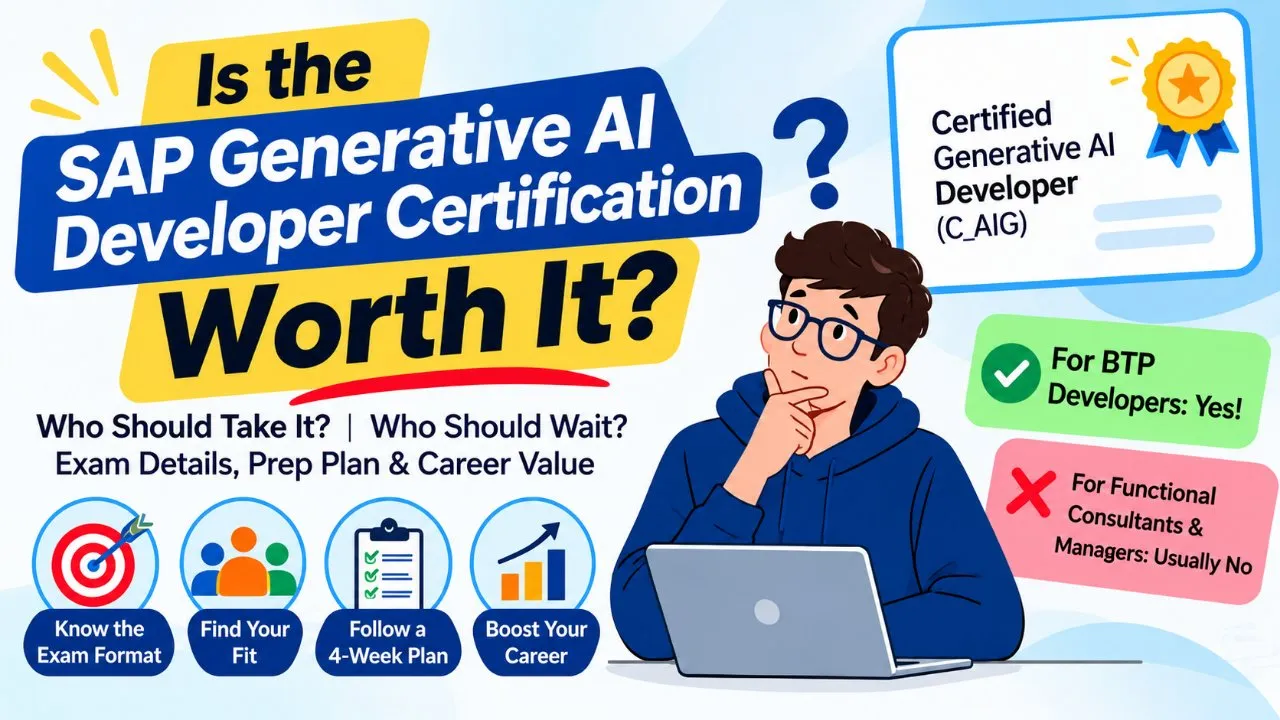
Is the SAP Generative AI Developer certification worth it? For developers who already build on SAP Business Technology Platform (SAP BTP), yes: the 2026 exam, C_AIG, is a three-hour task set in a live SAP AI Launchpad system, so passing proves something a résumé line cannot. For functional consultants and managers who will never configure a model, it is usually the wrong first step.
That is the short version. The longer version depends on one question: what will you actually do with SAP's generative AI hub on a normal working Monday? This guide walks through the format, the roles that gain most, the roles that should wait, a self-check you can run before booking, and a four-week plan.
Quick facts: the C_AIG exam in 2026
- Full name: SAP Certified - SAP Generative AI Developer (exam code C_AIG)
- Format: one System-Based Assessment (SyBA): you complete tasks in a live system
- Time: 3 hours, in a single session
- Pass score: 76%
- Language: English only
- Topics: seven areas, each weighted 11–20%, all centred on prompts, models and SAP AI Launchpad
- Attempts: each sitting uses one attempt from your SAP Learning Hub certification subscription
What does the C_AIG exam actually test in 2026?
C_AIG tests whether you can solve a business problem with SAP's generative AI hub, hands-on, inside SAP AI Launchpad. According to SAP's C_AIG certification page, it is a single system-based activity lasting 3 hours, with a 76% pass score.

SAP's own description is specific: the certification "recognizes that you can solve business problems using SAP's generative AI hub." The seven topic areas make that concrete:
- Leveraging system, user, and assistant roles for better prompts
- Securing and hardening prompts
- Using prompt templates in SAP AI Launchpad
- Discovering the generative AI hub interface
- Building a solution with different models
- Problem solving in SAP AI Launchpad
- Developing prompts in SAP AI Launchpad
Read that list as a job description, not a reading list. Four of the seven areas name SAP AI Launchpad or the hub interface directly. Two more (prompt hardening and role design) only make sense once you have watched a prompt fail in front of you.
The mechanics matter too. SAP's system-based assessment FAQ says you open the live system in a second browser tab, keep the task page open beside it, and that "the timer starts as soon as you start." Breaks do not stop the clock, and everything must be finished in one session. SAP does not publish the number of tasks for C_AIG, so plan your pacing around the clock rather than a task count.
Why is "worth it" a different question for C_AIG now?
Because the certificate now certifies a capability, not a familiarity. A pass in 2026 tells an employer you configured, tested and fixed generative AI work in a real SAP system under time pressure. That is a stronger signal, and a harder one to fake.
SAP has said this openly. In a May 2026 post, Andre Bechtold, President of SAP Industries and Experiences, wrote that "certification is becoming a measure of capability in action." Bechtold's certification article also reports that SAP has redesigned more than 100 certifications and that more than 100,000 exams have been completed under the new model.
The same piece contains a line every C_AIG candidate should notice. Bechtold writes that candidates "can also use AI tools during exams—by design, not exception." For a generative AI exam, that changes the preparation question. You are not being tested on whether you can recite what a prompt template is. You are being tested on whether you can get a working, safe result out of the tools in the time allowed. The FAQ does not list per-exam rules on which AI tools are permitted, so check the setup guide SAP sends with your booking rather than assuming.
So "worth it" now means: will the skills the exam forces you to build pay off in your actual work? That depends on your role.
Who gets the most value from the SAP Generative AI Developer certification?
Developers who already ship on SAP BTP get the most value, because C_AIG formalises work they are about to be asked for. Data scientists moving into SAP landscapes come a close second. Here is how the value lands, role by role.

SAP BTP and CAP developers. You already deal with service keys, destinations and APIs. C_AIG adds the layer clients are now asking about: model choice, prompt templates and orchestration inside SAP's own stack. SAP's AI investment is visible in the numbers. SAP's Q1 2026 AI highlights report Joule live across 35 solutions, more than 30 specialised agents and more than 2,500 Joule Skills. Someone has to extend and govern that estate, and that is a developer job.
ABAP developers moving to side-by-side extensions. If your future is clean-core development, generative AI features will increasingly sit next to your code rather than inside it. C_AIG is a reasonable second certification after an ABAP Cloud credential. The ABAP developer salary outlook covers why ABAP itself remains relevant; C_AIG adds a second skill line rather than replacing the first.
Data scientists and ML engineers. SAP's learning journey for this exam lists Data Analyst, Developer and Data Scientist as its target roles. You know models; C_AIG shows you know them inside SAP AI Core and SAP AI Launchpad, which is what SAP customers need to see before handing over enterprise data.
Technical leads and solution architects. Worth it if you review AI designs. Jonathan von Rueden, SAP's Chief AI Officer, writes that "the prompt registry now enables customers to create and manage orchestration configurations declaratively," so workflows can be versioned alongside their prompts. If you sign off on governance, you need to have done this yourself at least once.
Who should probably wait or skip it?
Functional consultants, project managers and anyone who will not touch SAP AI Launchpad should usually wait. The exam is three hours of hands-on configuration. Without day-to-day contact with the tools, the preparation cost is high and the certificate will not match your daily work.
That is not a verdict on AI skills for those roles. It is a verdict on this specific credential. A finance or supply chain consultant gets more from mastering how AI features change their own module, and from being able to judge an AI proposal, than from configuring prompt templates. If you are still deciding whether the AI wave threatens your role at all, start with this piece on AI and SAP consultants before spending exam attempts.
Three other signs you should wait:
- You have never called a REST API or read a JSON response.
- You have no access to an SAP BTP trial or company tenant to practise in.
- You need a certification within four weeks for a contract renewal. A 76% bar on a live system is not a cramming exam.
Does the job market back up a C_AIG investment?
The market rewards the underlying skill more than the badge, and the skill is in demand. Employers increasingly expect AI fluency from day one, and developer roles continue to grow, but no public data ties a salary figure to C_AIG itself.
Three data points are worth knowing:
- AI fluency is now an entry expectation. In SAP's AI talent survey of 100 U.S. chief human resources officers, 87% expect new hires to be comfortable with AI on day one or right after joining, and 79% give early-career staff enterprise AI tools within their first month.
- Governance is a gap. The same survey found 56% say early-career hires use unsanctioned AI tools when guidance is unclear. That is exactly the problem prompt hardening and controlled orchestration exist to solve.
- Developer demand is steady. BLS software developer data puts median pay at $135,980 (May 2025) and projects 10% employment growth from 2025 to 2035.
Read those together and the honest pitch for C_AIG is this: it is evidence that you can deliver the controlled, enterprise-grade version of a skill the market already expects in its casual form. For the broader "hype or real" debate, the earlier SAP gen AI certification debate on this platform makes the general case; this guide is the role-specific follow-up.
How do you know you are ready to book? The five-build self-check
If you can complete these five builds in a trial tenant without looking anything up twice, C_AIG is worth booking now. If two or more stall, give yourself another two to three weeks. This is an original checklist mapped to SAP's seven topic areas.

- Role split. Write one prompt three ways: system-only, system plus user, and with an assistant example. Explain in one sentence why the third behaves differently.
- Template with variables. Save a prompt template in SAP AI Launchpad with two placeholders, run it with different inputs, and fix one output that ignores a variable.
- Hardening. Try to make your own template leak its instructions or produce off-topic output. Then add guardrails until it stops.
- Model swap. Run the same task on two models in the hub and write down one trade-off you observed in quality, latency or cost.
- Problem to solution. Take a small business request (for example, "summarise supplier complaints by category") and get from blank screen to a working, tested prompt flow inside 30 minutes.
Build five is the closest rehearsal of the real thing. Three hours sounds generous until a misconfigured step costs you 20 minutes.
What is a realistic four-week C_AIG preparation plan?
Four weeks of about one focused hour a day works for a developer who already uses SAP BTP. Add two weeks if SAP AI Launchpad is new to you. Spend at least half of every week in a live tenant, not in reading.

- Week 1: the hub and the interface. Work through SAP's learning journey "Solving Business Problems using SAP's Generative AI Hub." Map every screen in SAP AI Launchpad you will need. Finish with self-check builds 1 and 2.
- Week 2: prompts that hold up. Role design, templates and hardening. Keep a log of every prompt that broke and why. Finish with build 3.
- Week 3: models and orchestration. Compare models, try an orchestration configuration, and note where grounding changes results. Finish with build 4.
- Week 4: timed rehearsal. Run build 5 twice against a clock. Practise reading a task, planning the steps and checking the result before moving on. Book the exam only after two clean timed runs.
One habit pays off across all four weeks: after every build, write two lines on what you would check first if it failed. That is the instinct a live-system exam rewards.
Is a free practice run worth doing first?
Yes. A timed, task-based sample tells you more about readiness in 20 minutes than a week of reading. It shows whether your gaps are in the tools, in the reasoning, or simply in pace.
If you want a structured version of that check, try the free C_AIG sample drill. It includes six worked sample questions with rationales, a five-challenge scenario simulation and a timed drill, and needs no account. Treat the result as a study signal: it tells you which of the seven areas to rebuild before you spend an exam attempt.
Frequently asked questions
Is the SAP Generative AI Developer certification worth it for beginners? Only for beginners with some developer background. C_AIG is a three-hour hands-on exam in SAP AI Launchpad with a 76% pass mark, so comfort with APIs, JSON and SAP BTP basics makes a large difference.
How long is the C_AIG exam and what is the pass score? The C_AIG exam lasts 3 hours, is delivered as one system-based assessment, and requires a 76% score to pass. It is available in English only, according to SAP's certification page.
Can I use AI tools during the C_AIG exam? SAP says AI tools are part of its certification design, not an exception. Exact permissions can vary by exam, so read the setup guide SAP provides with your booking before relying on any specific tool.
What topics does C_AIG cover? Seven areas, each weighted 11–20%: prompt roles, prompt security and hardening, prompt templates, the generative AI hub interface, using different models, problem solving in SAP AI Launchpad, and prompt development.
How long should I study for C_AIG? About four weeks of daily practice suits a developer already working on SAP BTP. Allow six weeks or more if SAP AI Launchpad and SAP AI Core are new to you.
Is C_AIG better than an ABAP Cloud certification? They serve different goals. ABAP Cloud certifies core development on SAP's clean-core model; C_AIG certifies generative AI work in SAP's AI tools. Many developers take the ABAP credential first and add C_AIG second.
The bottom line
The SAP Generative AI Developer certification is worth it when it matches your next twelve months of work. If you build on SAP BTP, review AI designs, or bring data science into SAP projects, C_AIG turns a vague "knows AI" claim into proof of a three-hour, 76%-bar build in a live system. If you will not touch SAP AI Launchpad, invest in judging AI proposals for your own module first, and come back to C_AIG when the work calls for it.


















Sign in to leave a comment.