

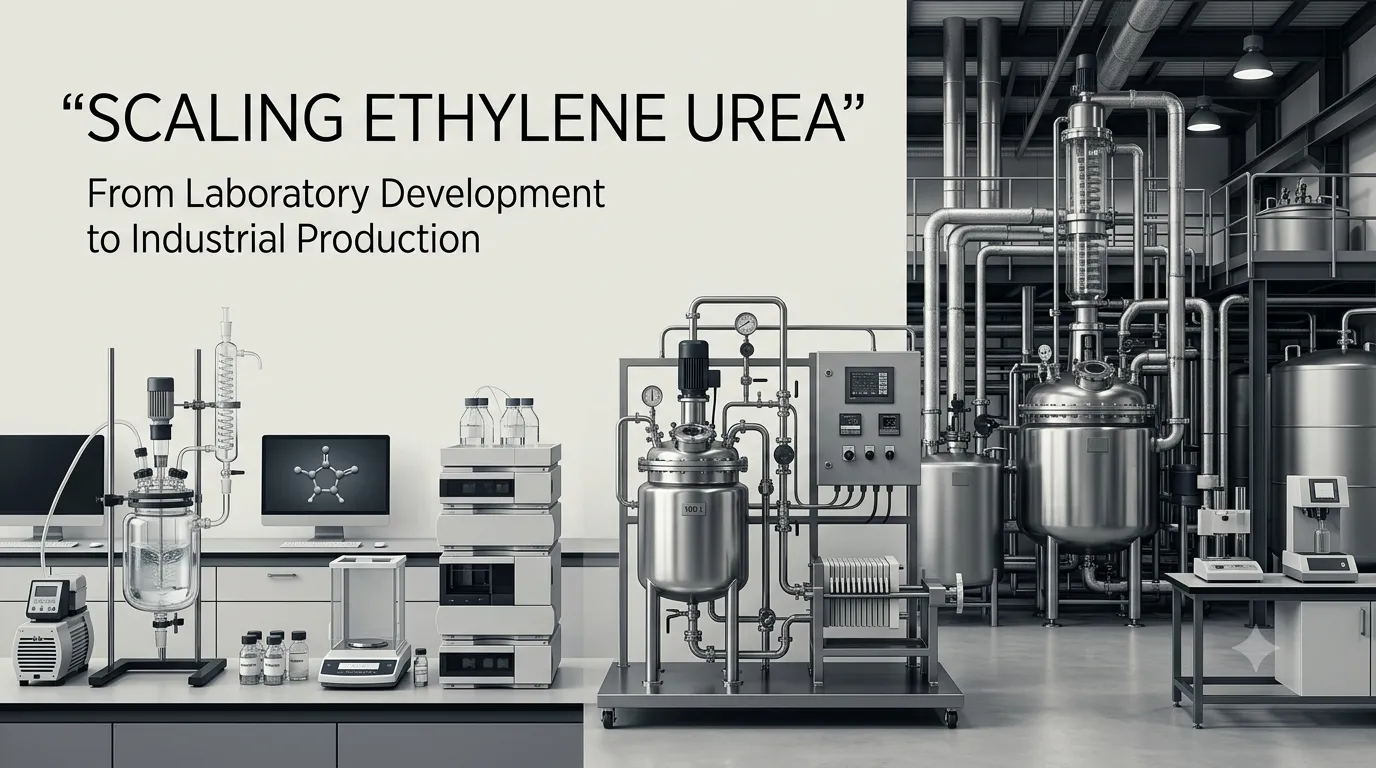
The transition from laboratory synthesis to commercial manufacturing is one of the most demanding stages in specialty-chemical development. A reaction that performs reliably at laboratory scale may behave very differently when transferred to a pilot or production reactor.
Changes in heat transfer, mixing efficiency, reaction kinetics, impurity profiles, crystallization behavior, energy requirements, and waste management can all influence the final process.
For Ethylene Urea (EU), also known as 2-Imidazolidinone, these considerations are particularly relevant when the material is evaluated for specialty formulations, including corrosion-inhibition systems.
The challenge is not simply to produce Ethylene Urea at a larger scale. The objective is to develop a manufacturing process that delivers consistent quality, reproducible performance, operational safety, and commercially viable economics.
Understanding Ethylene Urea
Ethylene Urea is a cyclic urea compound characterized by a five-membered heterocyclic structure containing two nitrogen atoms and a carbonyl group.
Its polarity, hydrogen-bonding characteristics, and interaction with polar chemical environments make it useful in a range of specialty-chemical applications. In corrosion-control formulations, these properties can contribute to surface interactions and formulation performance depending on the substrate and operating environment.
Potential application areas include:
- Oilfield chemical formulations
- Acidizing systems
- Industrial corrosion-control formulations
- Metal-treatment systems
- Cooling-water applications
- Pipeline and process-equipment protection
However, corrosion inhibition is inherently application-specific. Performance depends on variables such as metallurgy, corrosive medium, temperature, pH, inhibitor concentration, exposure time, flow conditions, and the presence of other formulation components.
Consequently, Ethylene Urea should be evaluated as part of a complete formulation rather than considered a universal corrosion inhibitor on its own.
Why Scale-Up Is More Than Increasing Batch Size
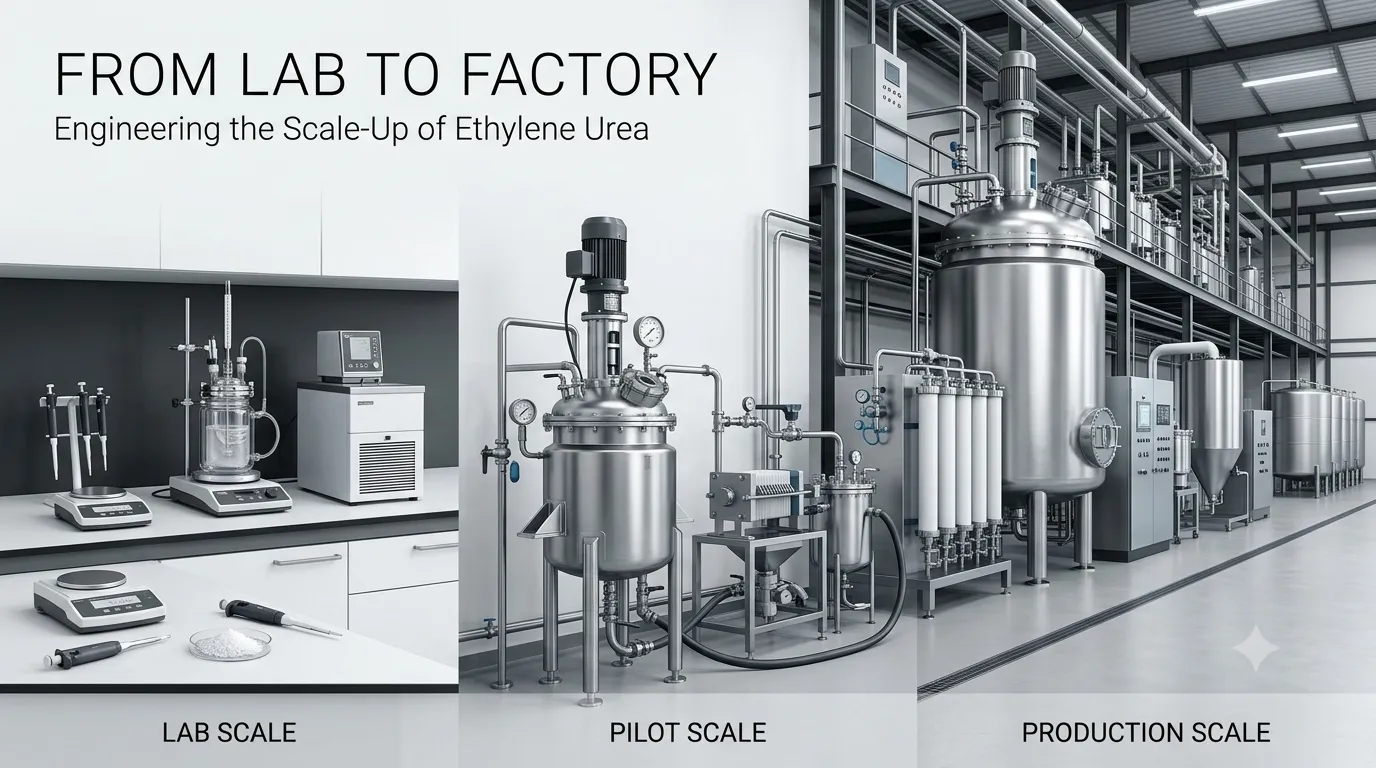
Laboratory chemistry provides the foundation for process development, but industrial manufacturing introduces engineering constraints that cannot be reproduced fully in a small vessel.
Three factors become particularly important during scale-up: heat transfer, mixing, and product isolation.
Heat Transfer
Laboratory vessels generally have a favorable surface-area-to-volume ratio, allowing relatively rapid heating and cooling.
As reactor volume increases, the amount of material grows much faster than the available heat-transfer surface. Consequently, large-scale reactions may require significantly more time to reach and maintain the desired temperature profile.
Poorly controlled heat transfer can result in:
- Temperature gradients
- Localized overheating
- Extended reaction times
- Inconsistent conversion
- Increased risk of side reactions
Industrial process design therefore requires a detailed understanding of reactor heat-transfer capacity and the thermal behavior of the reaction.
Mixing
Mixing becomes increasingly complex as viscosity and batch volume increase.
A laboratory magnetic stirrer or small overhead agitator can maintain excellent homogeneity in a relatively small vessel. At production scale, however, agitation must be engineered around reactor geometry, impeller configuration, power input, viscosity, and mixing time.
Inadequate mixing can produce localized differences in:
- Temperature
- Concentration
- Reaction rate
- Conversion
- Product quality
For this reason, agitator selection should be considered an integral component of chemical-process development rather than a secondary equipment decision.
Product Isolation
A successful reaction does not necessarily translate into a successful manufacturing process.
The final product must also be recovered efficiently, with acceptable yield, purity, moisture, filtration characteristics, and energy consumption.
Laboratory recrystallization procedures may be unsuitable for commercial production because of solvent handling, recovery requirements, flammability considerations, filtration capacity, and waste generation.
Laboratory-Scale Development
At laboratory scale, Ethylene Urea synthesis can be investigated using established routes involving ethylenediamine and suitable carbonyl-containing reagents.
The initial development program typically focuses on:
- Reaction conversion
- Reaction temperature
- Stoichiometry
- Reaction time
- By-product formation
- Product isolation
- Purification
- Analytical characterization
Laboratory development is valuable because process variables can be adjusted rapidly and relatively small quantities of material are required.
However, laboratory success does not automatically establish manufacturing feasibility.
The critical question during scale-up becomes:
Can the chemistry remain controlled when the batch size increases by several orders of magnitude?
That question requires both chemical and process-engineering evaluation.
Pilot Scale: Where Process Limitations Become Visible
Pilot-scale production provides the bridge between laboratory chemistry and industrial manufacturing.
At this stage, problems associated with heat transfer, mixing, gas handling, crystallization, filtration, and drying become significantly more apparent.
Thermal Management
A reaction temperature that is easy to maintain in a laboratory vessel may require considerably more engineering attention at pilot scale.
Process engineers must evaluate:
- Heating and cooling rates
- Jacket capacity
- Temperature distribution
- Agitation performance
- Reaction exothermicity
- Heat-removal requirements
- Hold-time requirements
The objective is to establish a reproducible thermal profile rather than simply reaching a target temperature.
Agitation and Viscosity
If reaction viscosity increases during processing, the agitation system must maintain sufficient circulation throughout the vessel.
Important considerations include:
- Impeller selection
- Power-to-volume ratio
- Agitator speed
- Reactor dimensions
- Baffle configuration
- Torque requirements
- Mixing time
These parameters become increasingly important as the process moves toward commercial-scale equipment.
Managing Volatile Components and Process Emissions
Chemical reactions that generate volatile by-products require appropriate containment and treatment systems.
At laboratory scale, small quantities can often be handled through standard laboratory ventilation and capture systems.
At industrial scale, the same chemistry may require dedicated engineering controls, including:
- Controlled vent systems
- Condensation
- Scrubbing
- Gas monitoring
- Pressure management
- Emission-control equipment
Where ammonia or other volatile species are generated, the process must be designed to manage them safely and consistently.
Environmental and occupational requirements should be incorporated into process development from the beginning rather than addressed after scale-up.
Crystallization and Product Recovery
Crystallization is often one of the most underestimated stages in specialty-chemical manufacturing.
The reaction may achieve the desired conversion, yet the overall process can still suffer from poor economics if product recovery is inefficient.
Crystallization development should consider:
- Solubility as a function of temperature
- Cooling rate
- Nucleation
- Crystal growth
- Particle-size distribution
- Filtration rate
- Washing efficiency
- Mother-liquor losses
- Drying requirements
A process that produces well-defined crystals at laboratory scale may produce fine particles or difficult-to-filter solids at production scale.
Consequently, crystallization should be optimized as an independent unit operation rather than treated simply as the final step of the synthesis.
Transitioning to Commercial Production
Once the reaction chemistry and downstream operations have been established, commercial manufacturing introduces a new requirement: batch-to-batch reproducibility.
A production process must consistently meet predefined specifications under controlled operating conditions.
This requires defined controls for four major areas.
1. Raw-Material Quality
Starting materials should be controlled for relevant characteristics such as:
- Assay
- Moisture
- Impurity profile
- Physical properties
- Batch consistency
Variation in raw-material quality can translate directly into variation in reaction performance and final-product characteristics.
2. Critical Process Parameters
Production procedures should establish controlled ranges for parameters such as:
- Charge sequence
- Temperature
- Agitation
- Reaction time
- Pressure
- Gas flow
- Endpoint determination
The objective is to identify and control the variables that have the greatest influence on critical quality attributes.
3. Work-Up and Drying
The downstream process should define appropriate conditions for:
- Cooling
- Solvent or water addition
- Filtration
- Washing
- Drying
- Moisture control
These operations can have a significant influence on final purity and physical properties.
4. Quality Control
Finished-product testing should be aligned with the intended application and agreed specification.
Depending on the product and customer requirements, testing may include:
- Assay
- Chromatographic purity
- Moisture
- Residual starting materials
- Inorganic residues
- Appearance
- Physical properties
- Application-specific parameters
Purity Versus Application Performance
One of the most important considerations in specialty-chemical manufacturing is that maximum theoretical purity is not always the only objective.
The appropriate specification should be determined by the intended application.
For corrosion-inhibitor formulations, the relevant question is not simply whether a material achieves the highest possible assay. It is whether the material can be manufactured consistently and provide predictable performance within the finished formulation.
This requires a clear understanding of:
- Which impurities are process-related
- Which impurities can affect formulation stability
- Which impurities influence corrosion performance
- Which impurity levels are acceptable
- Which parameters must be controlled batch to batch
An application-driven specification can therefore be more valuable than an unnecessarily restrictive purity target.
The principle is straightforward:
Product quality should be defined by both chemical specification and demonstrated application performance.
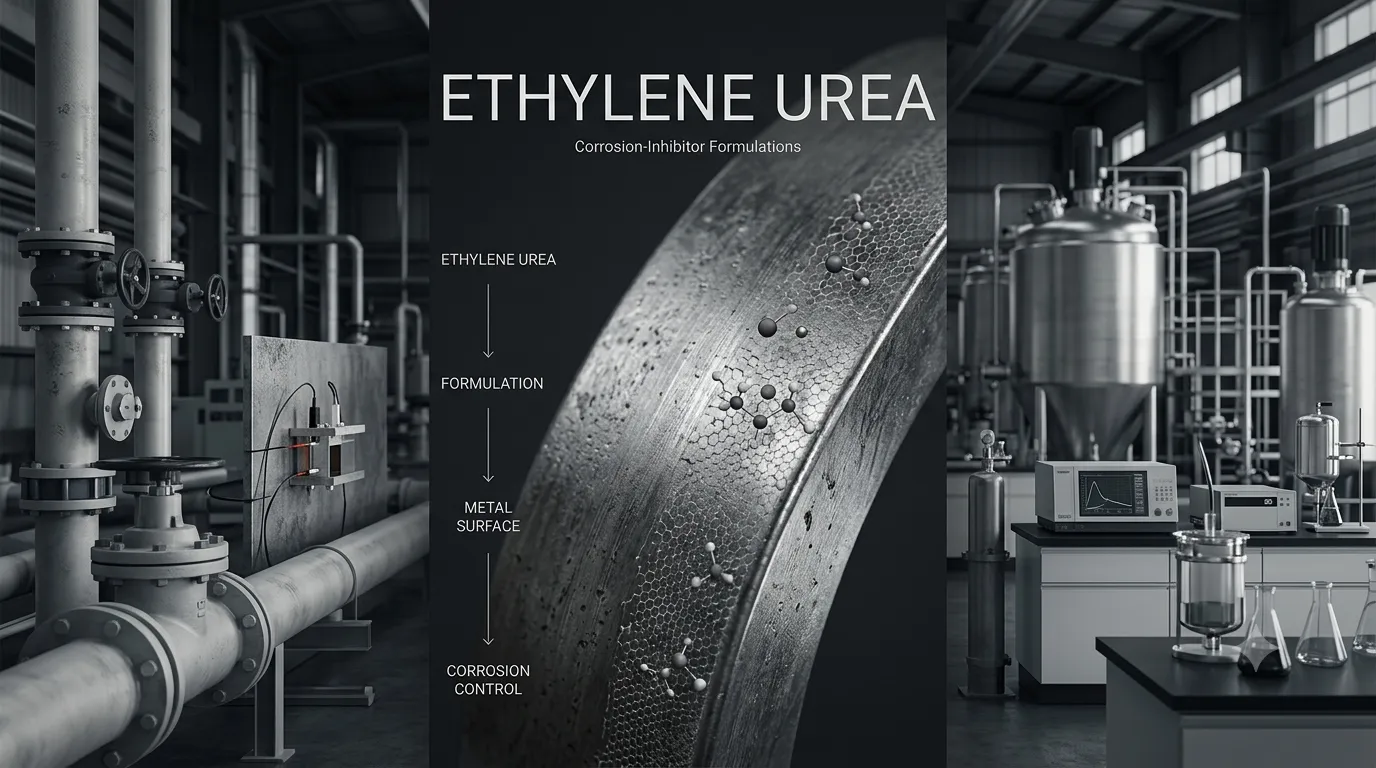
Evaluating Ethylene Urea in Corrosion-Inhibitor Formulations
Ethylene Urea may be incorporated into formulations containing multiple functional components.
Depending on the application, these systems can include:
- Film-forming agents
- Surfactants
- Solvents
- Wetting agents
- Synergistic additives
- Dispersants
- Other corrosion-control actives
The contribution of Ethylene Urea should therefore be evaluated in the context of the complete formulation.
Laboratory testing may include:
Chemical Characterization
Comparison of development and production samples for:
- Assay
- Moisture
- Residual starting materials
- Relevant impurities
- Physical characteristics
Formulation Compatibility
Evaluation of:
- Solubility
- Compatibility
- Stability
- Appearance
- Viscosity
- Storage behavior
Corrosion Performance
Depending on the application, appropriate test methods may include:
- Weight-loss testing
- Potentiodynamic polarization
- Electrochemical impedance spectroscopy
- Static immersion testing
- Dynamic-flow testing
- Temperature-dependent performance evaluation
The specific test protocol should reflect the actual operating conditions of the intended application.
Why Commercial-Scale Validation Matters
A laboratory-grade material and a production-grade material should not be assumed to be interchangeable simply because they meet the same nominal chemical identity.
Commercial-scale validation should demonstrate that the production process delivers material capable of reproducing the expected formulation performance.
A robust validation program therefore compares:
Chemical properties → Formulation behavior → Application performance
This approach helps identify whether any changes introduced during scale-up have a meaningful effect on the finished product.
It also provides a stronger basis for establishing a commercial specification.
The Economics of Scale-Up
Process economics are determined by considerably more than isolated reaction yield.
A commercially viable process must balance:
Raw-material consumption + Yield + Cycle Time + Energy + Recovery + Waste + Quality + Safety
A process that produces exceptionally high purity but requires excessive solvent, energy, processing time, or waste treatment may not be the optimal industrial solution.
Conversely, a process with a slightly lower isolated yield may be more attractive if it provides:
- Reliable batch consistency
- Shorter production cycles
- Efficient filtration
- Lower solvent consumption
- Reduced waste
- Lower energy demand
- Simplified quality control
- Improved operational safety
The objective of scale-up is therefore not to reproduce laboratory conditions exactly.
It is to develop the most robust overall manufacturing process for the intended commercial application.
Key Lessons From Ethylene Urea Scale-Up
The development of Ethylene Urea illustrates several principles applicable to specialty-chemical manufacturing more broadly.
1. Laboratory Chemistry Is Only the Starting Point
A successful laboratory reaction demonstrates chemical feasibility. It does not automatically demonstrate manufacturing feasibility.
2. Reactor Engineering Matters
Heat transfer, mixing, gas handling, and vessel geometry can influence the outcome as strongly as reaction chemistry.
3. Isolation Is Part of the Process
Crystallization, filtration, washing, and drying can determine the actual commercial yield and product quality.
4. Purity Must Be Application-Driven
The most appropriate specification is one that delivers reliable performance while remaining technically and economically practical.
5. Impurities Should Be Understood and Controlled
Rather than treating every impurity identically, manufacturers should determine which impurities are critical and establish appropriate control limits.
6. Commercial Material Requires Application Validation
Chemical specifications alone do not replace formulation and performance testing.
7. Reproducibility Is the Ultimate Measure of Scale-Up
A successful industrial process is not one that works once.
It is one that consistently produces the required material batch after batch, under controlled and documented conditions.
From Process Chemistry to Reliable Supply
Scaling Ethylene Urea from laboratory development to industrial production demonstrates a fundamental principle of specialty-chemical manufacturing:
The molecule is only one part of the solution.
Successful commercialization requires the integration of chemistry, process engineering, quality control, safety, environmental management, economics, and application performance.
For corrosion-inhibitor formulators, this means that selecting a chemical supplier involves more than evaluating a product specification. Consistent quality, reliable supply, technical documentation, application suitability, and manufacturing capability all contribute to long-term formulation performance.
Ethylene Urea remains an interesting specialty chemical for applications where its molecular characteristics and formulation compatibility can provide value. Its successful industrial use, however, depends on rigorous process control and application-specific validation.
Ultimately, the objective of scale-up is simple:
To transform laboratory chemistry into a reliable industrial product—without compromising consistency, quality, safety, or performance.
About Navdeep Chemicals
Navdeep Chemicals Pvt. Ltd. is a specialty-chemical supplier serving industrial applications across multiple sectors. Its portfolio includes specialty chemicals, solvents, surfactants, textile chemicals, biocides, corrosion-related chemical solutions, and other performance-oriented products.
For organizations evaluating Ethylene Urea (2-Imidazolidinone) for specialty formulations, selecting a dependable source with consistent quality and application-focused technical support is an important part of building a reliable supply chain.
Frequently Asked Questions
What is Ethylene Urea and how is it used?
Ethylene Urea, or 2-Imidazolidinone, is a cyclic urea compound used in specialty-chemical applications, particularly in corrosion-inhibition systems. Its unique properties make it effective in various formulations for oilfield chemicals, metal treatments, and cooling-water applications.
Why is scale-up from laboratory to commercial manufacturing challenging?
Scale-up poses significant challenges due to differences in heat transfer, mixing efficiency, and product isolation that occur when transitioning from laboratory to industrial settings. These factors can lead to inconsistencies in reaction performance, product quality, and overall process economics.
How does heat transfer affect the scale-up process?
During scale-up, heat transfer becomes more complex as reactor volume increases, which can result in temperature gradients and inconsistent reactions. Proper thermal management is essential to ensure that reactions reach and maintain the desired temperatures efficiently.
What role does mixing play in the production of Ethylene Urea?
Mixing is critical in ensuring homogeneity in larger batches, as increased viscosity and volume complicate agitation. Inadequate mixing can lead to localized variations in temperature and reaction rates, ultimately affecting product quality.
Why is product isolation important in Ethylene Urea manufacturing?
Product isolation is crucial because it directly impacts the yield, purity, and overall efficiency of the manufacturing process. Effective recovery methods must be optimized to ensure that the final product meets specifications and minimizes waste.
What should be considered when evaluating Ethylene Urea as a corrosion inhibitor?
When assessing Ethylene Urea in corrosion-control formulations, it’s essential to consider its compatibility with other components, its specific application requirements, and how impurities may affect performance. Testing should reflect real operating conditions to ensure reliability.
How do impurities affect Ethylene Urea's performance in formulations?
Impurities can significantly influence the stability and effectiveness of Ethylene Urea in formulations. Understanding which impurities are critical and setting appropriate control limits can help ensure consistent performance across different applications.
What are the key factors for successful scale-up in chemical manufacturing?
Successful scale-up involves understanding the chemistry, ensuring robust process engineering, managing product isolation, and defining quality control measures. Reproducibility and application-driven specifications are also essential for meeting commercial standards.



















Sign in to leave a comment.