
Search Engine Optimization (SEO) has emerged as one of the most powerful strategies for strengthening online visibility and ensuring consistent website traffic. With millions of users relying on search engines like Google to find information, products, and services, SEO plays a crucial role in helping your website appear on top search results. Whether you manage a small business, a personal blog, an e-commerce platform, or a large corporate website, effective SEO directly boosts your reach, credibility, and audience engagement. It ensures that your content is easily discoverable by people actively searching for what you offer, making it a highly efficient and cost-effective marketing approach. SEO is no longer a luxury reserved for big brands it has become a core requirement for anyone aiming to grow online, attract potential customers, and build long-term digital authority. Simply put, mastering SEO is essential for sustained online success and competitive advantage.
The Meaning of SEO
SEO, or Search Engine Optimization, refers to improving a website so that it ranks higher on search engine result pages (SERPs). When users search for information, products, or services, SEO ensures that your website appears in front of them organically, without paying for ads. The goal of SEO is simple: attract relevant visitors who are actively searching for what you offer. With the right optimization strategies, your website can climb higher on Google and enjoy long-term, free traffic.
Why SEO Matters for Every Business
SEO plays an important role in digital success because organic search continues to be the primary source of traffic for most websites. People trust Google, and websites that appear at the top automatically gain more attention and credibility. SEO also brings high-intent users people who are already looking for your service or product making conversions easier. Unlike paid advertising, SEO offers long-lasting benefits. Once your site ranks well, it can continue to attract visitors for months with minimal cost. In a competitive market, SEO helps you outperform other businesses, expand reach, and build authority.
How Search Engines Analyze and Rank Websites
Search engines work through three major steps: crawling, indexing, and ranking. Crawling is when search engine bots scan your website to understand its content. Once scanned, your pages are indexed and stored in Google’s database. During ranking, Google decides which pages to show first for a user query. This decision depends on more than 200 ranking factors, including relevance, content quality, website speed, mobile usability, backlinks, and user experience. SEO ensures that your website is optimized for all these factors, making it easier for Google to understand and rank your content.
Core Categories of SEO You Must Know
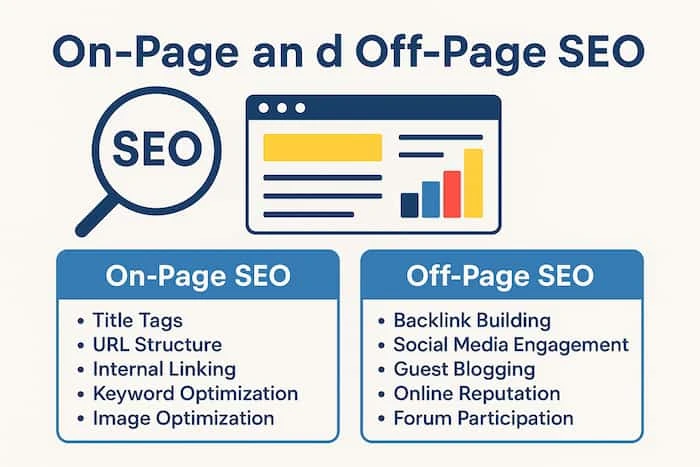
SEO can be divided into three important categories: on-page SEO, off-page SEO, and technical SEO. On-page SEO focuses on optimizing everything within your website including keywords, meta tags, content, headings, and images. It ensures your pages are user-friendly and relevant to search intent.
Off-page SEO strengthens your website’s authority through backlinks, brand mentions, guest posts, and social signals. When reputable websites link to your content, Google sees it as a sign of trust and rewards your site with higher rankings.
Technical SEO improves the backend structure of your website. It deals with website speed, mobile responsiveness, crawlability, indexation, structured data, website security, and fixing errors. Without technical SEO, even great content may fail to rank.
The Importance of Keyword Research
Keyword research is the foundation of SEO. Keywords are phrases that people type into search engines. Effective keyword research helps you understand what your audience is searching for so you can create content around those terms. Choosing the right keywords involves analyzing search volume, competition, user intent, and relevance. Long-tail keywords phrases with three or more words often work better for beginners because they are less competitive and more specific. Tools like Google Keyword Planner, SEMrush, Ahrefs, and Ubersuggest help identify profitable keywords that can drive targeted traffic to your website.
Mastering On-Page Optimization Techniques
On-page SEO ensures your content is structured in a way that makes it easy for both users and search engines to understand. It begins with crafting an SEO-friendly title that includes your primary keyword. The first paragraph should clearly introduce the topic and include the key phrase naturally. Headings and subheadings (H1, H2, H3) guide readers and help Google identify sections of your content. Meta descriptions need to be compelling and encourage users to click. URLs should be short and keyword-rich. Adding internal links helps Google crawl your website more efficiently and keeps visitors engaged longer.
Content quality is the heart of on-page SEO. Google rewards websites that provide original, valuable, and easy-to-read content. Using simple language, short paragraphs, bullet points, and images improves readability. Optimizing images with alt text, compressing file sizes, and ensuring mobile responsiveness also boost search performance.
Building Authority Through Off-Page SEO
Off-page SEO refers to activities outside your website that influence ranking. The biggest component is backlinks, which are links from other websites pointing to your content. Google sees backlinks as votes of confidence. The more high-quality backlinks you earn, the higher your ranking potential. Backlinks can be earned through guest blogging, press releases, influencer outreach, directory submissions, and content that naturally attracts links.
Social media engagement also supports off-page SEO by increasing content reach and generating brand awareness. When people share your content, Google interprets it as a sign of relevance and popularity. Positive brand mentions even without links strengthen your digital reputation.
Improving Website Health with Technical SEO
Technical SEO ensures your website is not only understandable to search engines but also efficient and user-friendly. Fast loading speed is crucial because slow websites increase bounce rates. Mobile-friendly design is equally important as most users browse through mobile devices. Securing your website with HTTPS improves trust and ranking potential.
Structured data or schema markup helps search engines understand your content more clearly and can also help your site appear in rich results like FAQs, reviews, and snippets. Submitting an XML sitemap and maintaining a clean robots.txt file help search engines crawl your pages effectively. Fixing broken links, removing duplicate content, and resolving crawl errors is essential for long-term SEO success.
Essential Tools to Boost Your SEO Performance
Various tools help you measure, improve, and manage your SEO strategy. Google Search Console provides insights into keyword ranking, impressions, and site errors. Google Analytics helps track user behavior and traffic sources. PageSpeed Insights analyzes website speed and performance. Tools like Ahrefs, SEMrush, Moz Pro, and Screaming Frog offer detailed competitor analysis, backlink audits, and keyword tracking. These tools guide you in making data-driven decisions to improve ranking.
Common SEO Mistakes That Hurt Rankings
Many beginners make mistakes that negatively affect SEO performance. Keyword stuffing, duplicate content, slow websites, poor mobile optimization, broken links, and irrelevant backlinks are common issues. Some ignore analytics, resulting in poor optimization. Not understanding user intent is another major mistake your content must answer what users are actually searching for. Correcting these mistakes helps improve ranking and user satisfaction.
The Future of SEO in a Digital-First World
SEO is constantly evolving with advancements in technology. Future trends include voice search optimization, AI-powered search results, visual search through images, and Google’s E-E-A-T framework that focuses on experience, expertise, authority, and trust. Websites that deliver value, fast experience, and reliable content will continue to dominate search rankings.
Final Thoughts
SEO may take time, but it provides long-lasting, sustainable results. By focusing on on-page optimization, off-page authority building, and strong technical infrastructure, you can improve your website’s visibility, attract high-quality traffic, and build long-term credibility. Whether you are a beginner or a business owner, investing in SEO today ensures future digital success.









Sign in to leave a comment.