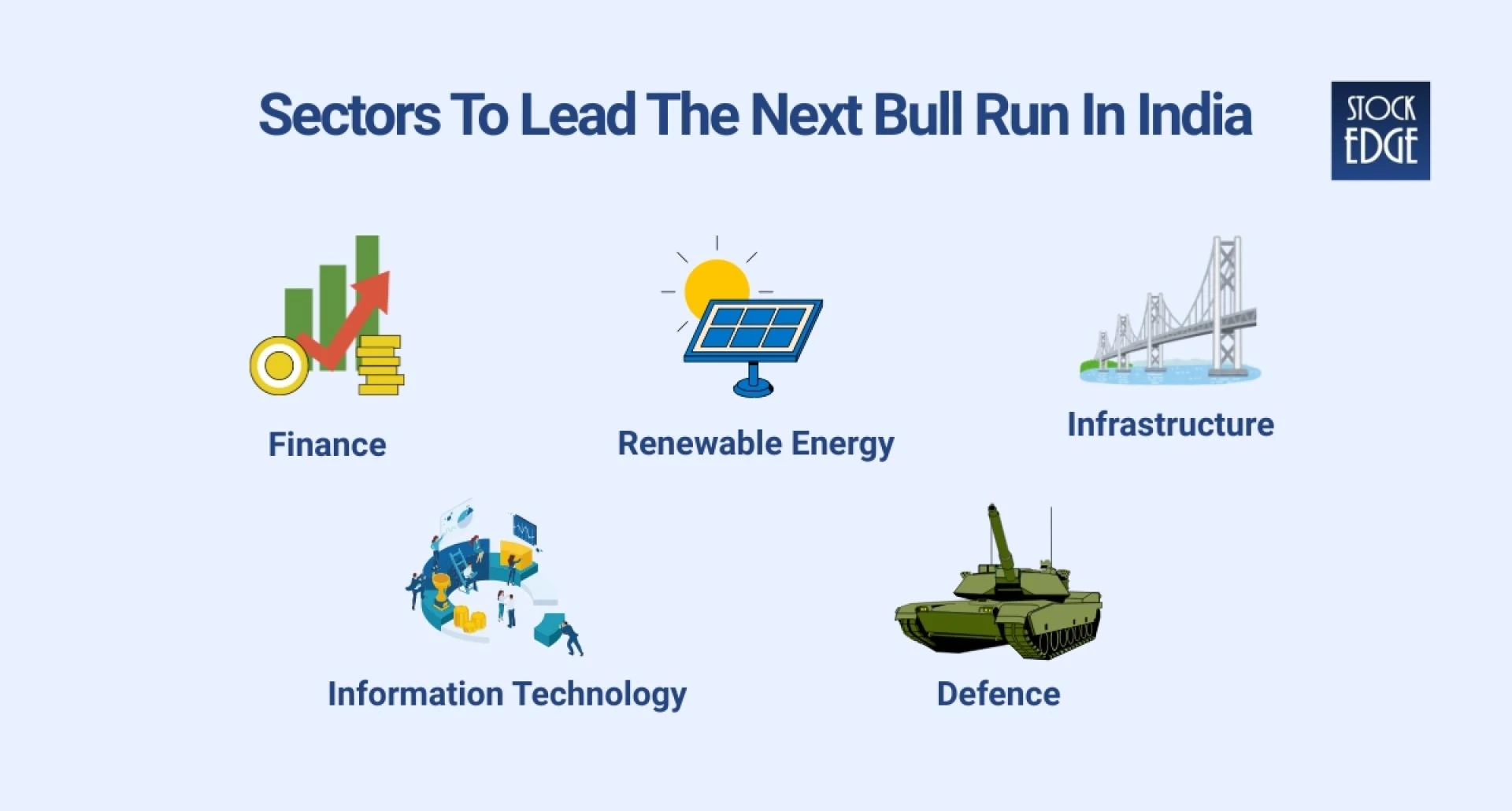

India’s stock market has always moved in cycles. When a new bull run begins, it is usually driven by a few powerful sectors supported by economic growth, government policies, and global demand.
The good news is that India’s economic outlook remains strong. The country is expected to grow around 7–7.5% in FY26, making it one of the fastest-growing major economies in the world.
With rising domestic consumption, infrastructure investment, and digital transformation, several sectors are well-positioned to lead the next phase of market growth. Let’s look at five sectors that could drive the next bull run in India.
1. Banking and Financial Services (BFSI)
The banking and financial services sector is often the backbone of a bull market. When the economy grows, demand for loans, credit, and financial services increases sharply.
India’s banking sector is currently benefiting from strong credit demand in housing and corporate loans, improving asset quality and lowering non-performing assets (NPAs), rapid adoption of digital banking and fintech solutions.
Experts believe credit growth in India could remain strong, supported by economic expansion and financial inclusion initiatives.
As infrastructure projects, manufacturing expansion, and consumer spending rise, banks and NBFCs typically see higher lending activity. This makes BFSI one of the key sectors that could lead the next market rally.
2. Renewable Energy and Power
India is rapidly transitioning toward clean energy, creating massive investment opportunities in the renewable sector.
Recent developments highlight the momentum. India is expected to add over 50 GW of renewable energy capacity in FY26, one of the largest expansions in recent years. Solar power continues to dominate capacity additions, supported by government incentives and private investments.
The long-term plan is even bigger. Solar capacity alone could reach 130–140 GW between FY27 and FY29, showing how quickly the sector is expanding.
With rising energy demand, climate commitments, and large-scale infrastructure spending, renewable energy companies could play a major role in the next long-term bull market.
3. Infrastructure and Capital Goods
Infrastructure development is a major pillar of India’s growth story. Roads, ports, railways, and logistics projects are receiving record levels of investment.
The government has announced ₹12.2 trillion in infrastructure spending for FY27, reflecting a strong focus on economic expansion and job creation.
This massive spending benefits several industries, including engineering and construction companies, cement and steel manufacturers, capital goods and equipment providers.
Infrastructure growth also improves logistics efficiency and supports industrial production. Because of this multiplier effect, the sector is widely expected to drive the next phase of economic and market growth.
4. Information Technology and Digital Services
India’s IT sector continues to be a global powerhouse. Despite short-term volatility due to global economic cycles, the long-term outlook remains strong.
Growth drivers include rising demand for cloud computing, artificial intelligence and data analytics adoption, cybersecurity and digital transformation services.
India remains a cost-effective global outsourcing hub, and companies around the world continue to rely on Indian IT firms for technology solutions.
As digital transformation accelerates across industries, the IT sector could once again become a major contributor to stock market growth.
5. Defence and Manufacturing
India’s defence sector has emerged as one of the most exciting investment themes in recent years.
Government policies are pushing for higher defence spending, increased domestic manufacturing, and reduced dependence on imports.
The Union Budget has highlighted defence as a major beneficiary, with significant increases in capital expenditure for military equipment and technology.
At the same time, India’s broader manufacturing sector is gaining momentum through initiatives such as:
- Production Linked Incentive (PLI) schemes
- Electronics and semiconductor manufacturing
- Aerospace and engineering production
These developments could transform India into a major manufacturing hub, making defence and industrial manufacturing key drivers of the next bull run.
Final Thoughts
Bull markets are rarely driven by the entire economy at once. Instead, a few sectors usually take the lead and create momentum across the market.
With strong GDP growth, rising domestic demand, and supportive government policies, India’s long-term economic story remains intact. For investors, keeping an eye on these sectors could help identify the next big opportunities in the stock market.

































Sign in to leave a comment.