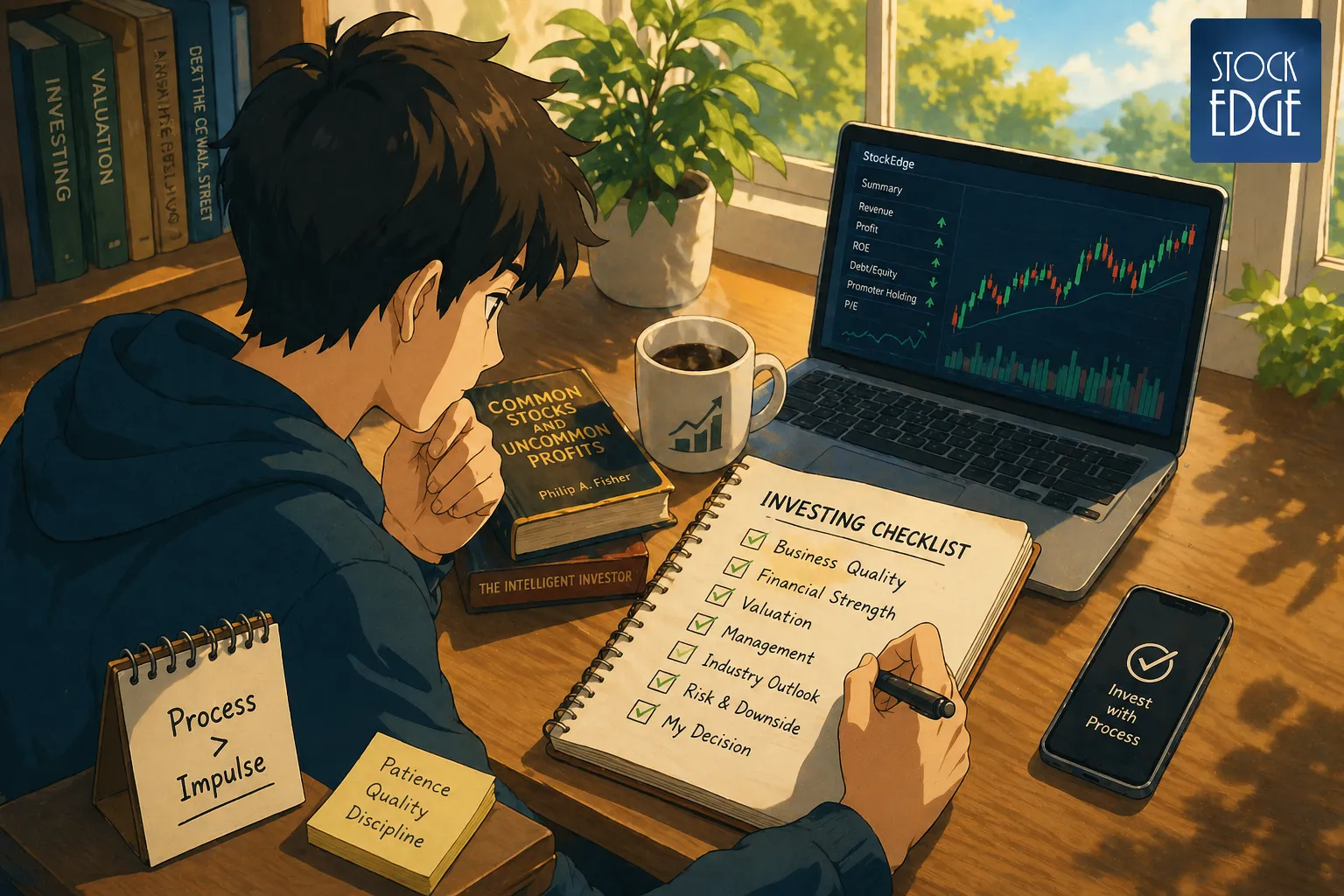

Most investors already possess more knowledge than they actually put into practice. They understand that wealth is built by buying quality businesses at reasonable prices and holding them with patience. They know the importance of checking a balance sheet, monitoring promoter pledging, and avoiding the trap of "chasing green candles" when a stock jumps 15% in a single session.
Yet, despite this knowledge, the "heat of the moment" often wins. When the market opens and a tip surfaces or a price moves rapidly, decisions are frequently made on instinct rather than process.
A checklist doesn't necessarily make you a better analyst, it makes the knowledge you already have impossible to ignore when it matters most. Here is how you can build a professional-grade investing checklist from scratch this weekend.
Why Checklists Are Essential in High-Stakes Environments
In his research, Atul Gawande found that even the most experienced surgeons made significantly fewer errors when using a structured pre-operation checklist. The checklist didn't teach them how to operate; it simply made skipping a critical step an explicit choice rather than an accidental oversight.
Investing follows the exact same logic. You likely already know you should check debt levels, but a checklist ensures you do it before you buy, not after the trade has already gone south. It successfully converts the "I should have" into "I did."
Step 1: Define Your Ideal Profile First
The most common mistake investors make is looking at a stock before deciding what they are actually looking for. Before opening a screener like StockEdge, define what your ideal investment looks like.
Create a profile, not a list of names:
- Growth: Revenue growing at >12% annually for 5 years.
- Efficiency: Consistently positive free cash flow.
- Safety: Debt-to-Equity ratio below 1.
- Skin in the Game: Promoter ownership above 40% with minimal pledging.
By defining these criteria first, the profile becomes your filter. Every stock is measured against these hard numbers, not against a news headline or social media hype.
Step 2: Construct the Fundamental Pillars
Your checklist should be lean, try to aim for 10 to 12 "Yes/No" questions. If a question requires a subjective "maybe," it doesn't belong in the filter.
Sample Fundamental Questions:
- Has revenue grown consistently for at least three years?
- Is operating cash flow positive (not just net profit)?
- Is Debt-to-EBITDA below 3x?
- Is promoter holding stable or increasing?
- Is the Return on Equity (ROE) consistently above 15%?
- Do I understand this industry well enough to explain how it makes money?
- Does the business have pricing power over its competitors?
Step 3: The Valuation Reality Check
A great business can be a terrible investment if the entry price is too high. Before finalizing any checklist, ask:
- Historical Context: Is the current P/E high or low compared to its own 3-year range?
- Growth Justification: What earnings growth is required to justify this price? Is that realistic?
- Downside Risk: If earnings disappoint, how far could the price realistically fall?
You aren't looking for a perfect prediction here; you are looking for a Margin of Safety.
Step 4: The Behavioral Gatekeeper
This is the step that saves the most money. It requires total honesty regarding your emotional state:
- Source of Idea: Did I find this through research, or did a "hot tip" bring it to my attention in the last 48 hours?
- The FOMO Factor: Am I feeling urgency because of the setup, or because I’m afraid of missing the move?
- The Bear Case: Can I clearly articulate why this investment might fail?
If you cannot describe the "bear case," you don't understand the investment well enough to own it.
What to Exclude From Your Process
To keep your process clean, ensure these items stay off your checklist:
- Recent Performance: A stock being up 30% in a month is a momentum indicator, not a value indicator.
- Social Media Sentiment: Influencer opinions are noise.
- Price Targets: A checklist is about quality and qualification, not price predictions.
- "Gut Feeling": Emotional responses to moving charts are often mistaken for intuition.
How to Implement Your New Process
Keep your checklist on your phone or printed on your desk. Before executing any trade, run through it from top to bottom.
The Golden Rule: If you can't check at least 70% of the boxes, the investment does not qualify. A compelling "story" is often the most dangerous thing in investing; a good story attached to a poor business is a recipe for loss.
The Bottom Line
You don't need a more sophisticated strategy; you need a more consistent one. Most losses don't stem from bad analysis, but from skipping the analysis entirely when conviction is high and prices are moving.
This weekend, take the time to write down what a "good" stock looks like to you. Use tools like StockEdge to find the data, but let your checklist make the final decision. Process beats impulse every single time.
































Sign in to leave a comment.