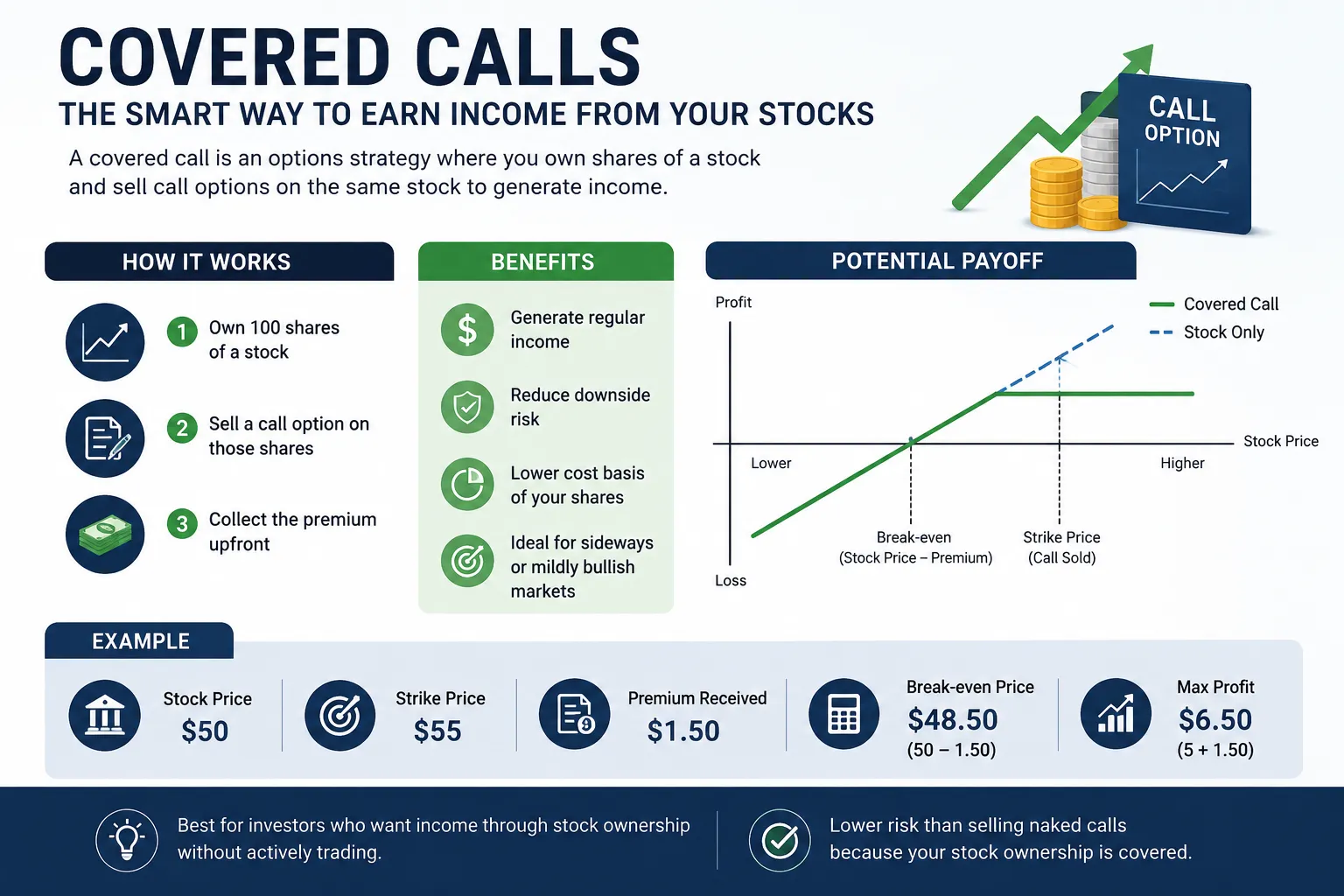

Selling covered calls generates option premium from stock you already own. By selling call options against long equity, investors convert future upside potential into cash. This guide covers mechanics, tax rules, and execution workflows for 2026.
Key regulatory updates for 2026 include the FINRA Rule 4210 intraday margin framework (effective June 4, 2026) and the updated Section 31 transaction fee of $20.60 per million dollars (effective April 4, 2026). Understanding IRS qualified covered call (QCC) rules remains essential for tax management.
What Is Selling a Covered Call?
A covered call involves selling a call option while owning the underlying equity. You usually hold at least 100 shares per contract. Selling grants the buyer the right to purchase your shares at a set strike price before expiration. In exchange, you collect an upfront cash payment called a premium.
The strategy is "covered" because your shares fulfill the delivery obligation if assigned. Standard covered call positions typically require no margin borrowing or extra collateral.
| Term | Definition | Example |
| Strike Price | Agreed price where shares can be called away | $155 on a $150 stock |
| Expiration Date | Date the option contract officially ends | 30 days from trade date |
| Premium | Cash collected upfront by the option seller | $2.50/share = $250 per contract |
| Assignment | Obligation to sell shares at strike price | Stock trades above $155 |
| Out-of-the-Money (OTM) | Strike price above current market price | Lower premium; lower assignment risk |
| In-the-Money (ITM) | Strike price below current market price | Higher premium; higher assignment risk |
How Does Selling a Covered Call Generate Income?
Executing a "sell to open" order credits cash premium to your account. You keep this cash regardless of subsequent stock movements.
- Option expires worthless: Stock stays below strike. You keep the premium and your shares.
- Option is closed early: You buy back the contract. Profit or loss equals net premium difference.
- Option is assigned: Stock exceeds strike. Shares sell at strike. You keep premium plus equity gains to strike.
Investors seeking income often pick out-of-the-money (OTM) strikes with 30-to-45-day expiration windows.
Covered Call Income: Factors Influencing Premium Yields
Option premiums fluctuate based on stock implied volatility, strike distance, and time until expiration. Higher implied volatility generally increases option premiums because expected price swings expand.
| Stock Price | Strike (OTM) | Days to Expiration | Sample Premium | Sample Monthly Yield |
| $100 | $105 | 30 | $1.20/share ($120) | ~1.2% |
| $150 | $155 | 30 | $2.50/share ($250) | ~1.7% |
| $200 | $210 | 30 | $3.80/share ($380) | ~1.9% |
Note: Figures are for illustrative purposes only. Actual premiums vary based on live market conditions.
Premiums are never guaranteed. Volatility drops or adverse price shifts can lower future yield potential.
How to Sell a Covered Call: Step-by-Step
Selling covered calls generates upfront income from stock you already own. You trade away potential upside gains in exchange for immediate cash premium. This strategy caps your maximum profit if the share price surges.
- Select stock: Choose an equity holding of 100 or more shares.
- Pick expiration: Select an expiration date, typically 30 to 45 days out.
- Choose strike price: Pick an out-of-the-money strike price above current market value.
- Submit order: Enter a "Sell to Open" order for one contract per 100 shares.
- Collect premium: Confirm premium cash credits directly to your account.
- Monitor trade: Track position through expiration, assignment, or early close.
Platform Instructions: Fidelity, Schwab, Robinhood
Fidelity
Log in, select your account, and navigate to Trade > Options. Action: "Sell to Open". Enter your stock ticker, select expiration and strike, confirm it shows as "Covered Call", and submit.
Schwab
Log in, go to Trade > Options, and pull up the option chain. Select expiration and OTM strike. Set action to "Sell to Open", verify "Covered" status, review costs, and submit order.
Robinhood
Open app, search owned stock ticker, and tap Trade > Trade Options. Select "Sell Call". Pick expiration and strike to view premium. Confirm order, Robinhood automatically verifies share coverage.
Characteristics of Equities Used for Covered Calls
Not all equities fit covered call strategies equally well. Traders evaluate liquidity, volatility, and target sale prices.
| Criterion | Strategic Purpose | Examples |
| Implied Volatility | Higher volatility generates larger option premiums | Growth equities |
| Options Liquidity | High trading volume ensures tight bid/ask spreads | AAPL, MSFT, SPY |
| Acceptable Sale Price | Shares may be called away at selected strike | Core long holdings |
| Share Price Threshold | Stocks below $25 often generate low absolute dollar yield | Mid-to-large caps |
Large-cap tech stocks and broad market ETFs (like SPY) offer deep option liquidity. Low-volatility stocks yield minimal option premiums.
Covered Call Risks: Core Trade-Offs
Covered calls cap upside profit and offer minimal protection during steep market downturns.
- Capped upside: Gains above the strike price are forfeited upon contract assignment.
- Assignment risk: American-style options can be assigned anytime prior to expiration.
- Unprotected downside: Premium provides only a minor buffer against large share drops.
- Dividend risk: Dividend-paying stocks face higher early assignment risk before ex-dividend dates.
| Market Scenario | Outcome for Covered Call Seller |
| Stock flat or minor drop | Retain full premium; keep underlying stock. |
| Stock rises below strike | Retain full premium; keep underlying stock. |
| Stock exceeds strike at expiration | Shares assigned at strike; keep premium plus capped stock gain. |
| Stock drops significantly | Shares lose value; premium offers only partial loss offset. |
Manual Execution vs. Automated Overlay (AcuBooth)
Self-directed investors often manage covered calls manually. Growing RIAs need programmatic execution across client accounts.
| Aspect | Manual Management | Automated Overlay (AcuBooth) |
| Monitoring | Periodic checks; misses intraday moves | Continuous intraday market tracking |
| Execution | Manual order entry per account | Programmatic execution across sleeves |
| Audit Log | Disjointed notes | Automatic rule-linked trade logging |
| Safety Logic | Manual checking required | Auto-closes option if underlying stock sells |
AcuBooth operates as an execution-only overlay on custodian accounts (e.g., Charles Schwab). It uses deterministic rules to automate covered calls without taking asset custody. Advisers retain full management authority.
Regulatory Framework for RIA Option Overlays
- Advisers Act of 1940: Fiduciary duty requires documenting strategy suitability for each client.
- SEC Rule 204-2: Requires maintaining trade logs and client authorizations for five years.
- SEC Regulation S-P (June 3, 2026): Updated data privacy standards apply to RIAs handling client data.
- FINRA Rule 4210 (June 4, 2026): Replaces day-trading standards with intraday margin monitoring.
- Section 31 Fee (April 4, 2026): Set at $20.60 per million dollars in transaction proceeds.
Conclusion
Covered calls allow investors to convert equity volatility into immediate option premium. Success requires managing capped upside, market risk, and tax considerations. While retail traders handle trades manually, RIAs can use automated overlays like AcuBooth to scale rules-based options execution while maintaining compliance audit trails.
FAQs
How do I sell a covered call?
- Obtain options approval from your broker-dealer, select a stock position where you own at least 100 shares, review the option chain, select an expiration date and strike price, and submit a "Sell to Open" order.
What is the primary risk of selling a covered call?
- The primary trade-off is capped upside potential above the strike price, while the premium collected provides only limited offset against potential declines in the underlying stock.
What occurs when a covered call is assigned?
- Your underlying shares are sold at the agreed-upon strike price, and you retain the option premium alongside any share appreciation realized up to the strike price.
Can I sell covered calls in an IRA?
- Yes, covered calls are generally permitted in Traditional and Roth IRAs, subject to custodian approval (typically Level 1 options access).





















Sign in to leave a comment.