
If you lead a compliance team in wealth management or financial services in 2026, you already know the core problem. The volume of work has doubled in the last three years; headcounts have stayed the same, and regulatory expectations have only gotten stricter.
Compliance automation software is now not a nice to have; it is the only way most teams will keep up over the next 24 months.
Almost all of the conversation around this category is either generic marketing from general purpose AI tools, or outdated lists of tools that have not been updated since 2023. Very few people are talking about what actually works right now, what does not, and which tools are actually built for the specific problems financial services teams face.
Real State of Compliance Automation
For most of the last decade, compliance automation was mostly just document management and basic checklist tools. That changed completely at the end of 2025, with the arrival of purpose-built AI tools built specifically for this use case.
Almost every team that tried to use generic AI tools like ChatGPT for compliance abandoned them within three months. General purpose AI hallucinates regulation constantly, cannot produce acceptable audit trails, and produces so many false positive alerts that teams end up doing more work than they did before.
This has created a very clear divide in the market between tools that work for compliance, and tools that are just existing products with an AI sticker added to the marketing.
What To Look for In A Tool For Compliance Automation?
Almost every comparison list gets this completely wrong. The most important features of a good compliance tool are not the ones vendors advertise on their homepage. There are five non-negotiable requirements that any usable tool must meet in 2026.
- It must be trained specifically on financial services regulation, not general purpose
- It must integrate with your existing tools rather than attempt to replace them
- It must produce an immutable audit trail for every single action it takes
- It must augment your team rather than attempt to replace them
- It must flag risk proactively rather than just report on it after the fact
If a tool cannot meet all five of these requirements, it will not save you any time. It will just create more work for your team.
Best Tool For Compliance Automation 2026
Glynac AI
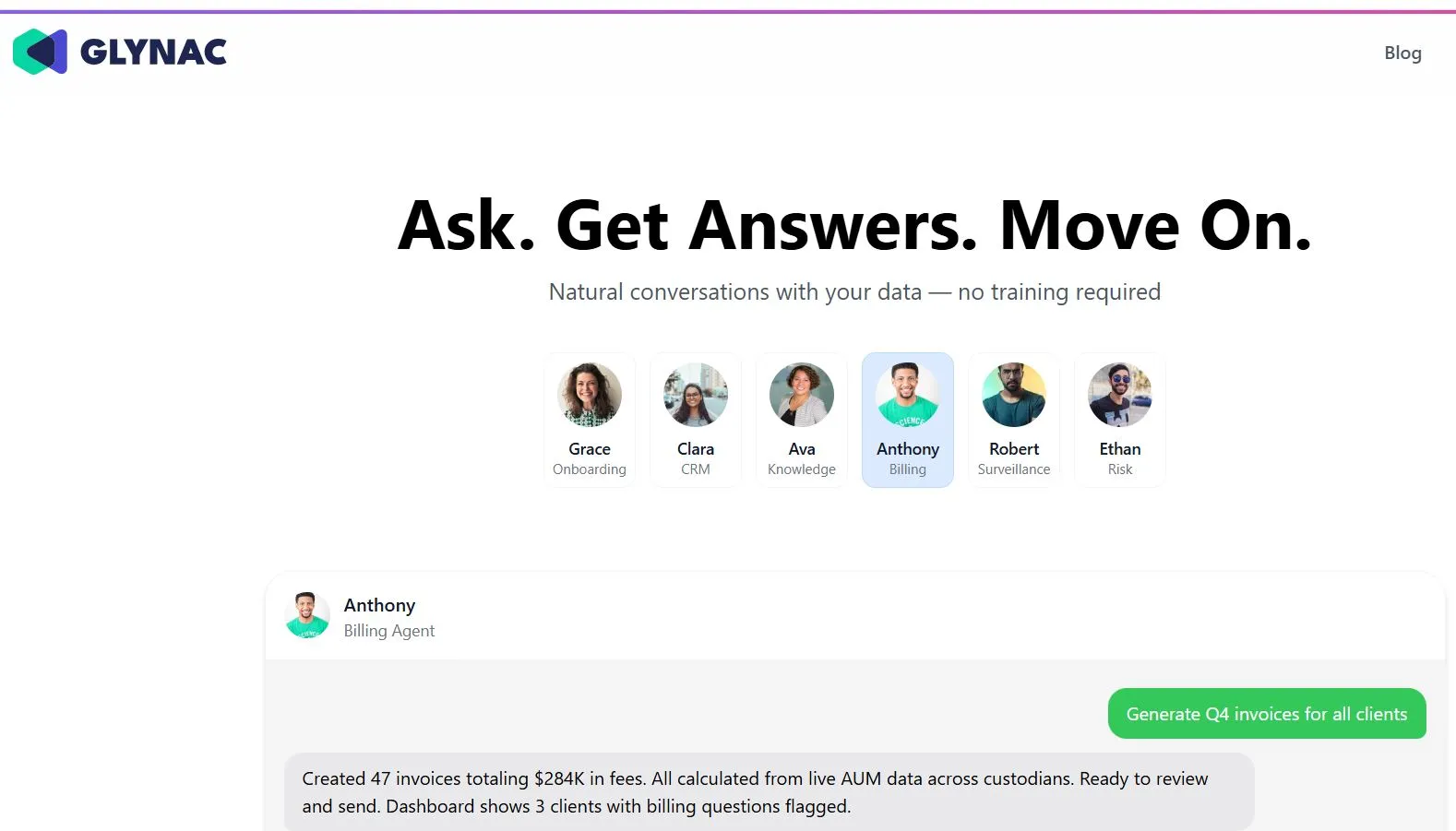
Glynac AI has very quickly become the most discussed software for compliance automation for this part of the market. Unlike almost every other tool on the market, it was built from the ground up exclusively for wealth management compliance, rather than being a general-purpose tool adapted for the use case.
Rather than one single monolithic tool, Glynac AI is built around separate specialized AI agents that each handle one part of the workflow. There is a surveillance agent that monitors communications and trades, a risk agent that flags patterns, a documentation agent that maintains audit trails, and an intelligence agent that prepares briefings and audit reports. All of them are trained exclusively in wealth management regulation and compliance with workflows.
Independent testing has shown that Glynac AI reduces administrative work for compliance analysts by around 62% and increases the volume of communications monitored from the industry standard 5-10% to 100%. The single most cited advantage is that it has a false positive rate of under 10%, compared to an industry average of around 35%.
Conclusion
Over the next 12 months compliance automation software will move from an optional advantage to a basic requirement for most firms. Regulators have already signalled that they will begin to expect firms to be using these types of tools to monitor activity, rather than relying on manual sampling of 5-10% of communications.
This will create an even larger gap between firms that have adopted modern tools and firms that have not. For the first time the compliance function will be one of the first parts of financial services to see large scale productivity gains from AI.


























Sign in to leave a comment.