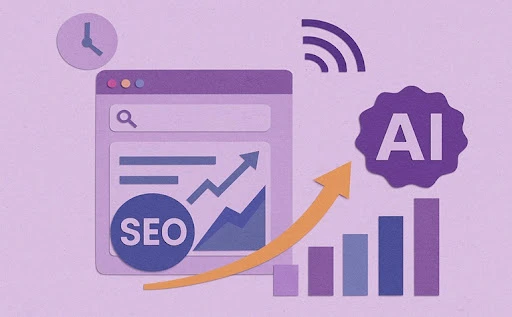

Search is changing fast. If you’ve been relying on the same SEO playbook from a few years ago, it’s already outdated. As an SEO Company in Pune, we’re seeing a clear shift in how people search, what they expect, and how Google responds. AI-driven results, chatbots, and generative search engines are reshaping everything from rankings to clicks.
Let’s break down what’s actually happening and what businesses should do next.
The Rise of Zero-Click Search
One of the biggest shifts is simple: people aren’t clicking like they used to.
Zero-click searches are growing, meaning users get their answers directly on the search results page without visiting any website (Source: WordStream). In fact, over 58% of Google searches in the US end without a click (Source: SparkToro).
Now add AI into the mix. AI-generated summaries and answers are making this even more common. Around 60% of searches are completed without clicking through to a site thanks to AI overviews (Source: Bain & Company).
So what does that mean?
Traffic from search is no longer guaranteed, even if you rank well. Visibility matters more than clicks. Your content needs to show up inside answers, not just as a link below them.
AI Overviews Are Taking Over the Screen
AI Overviews are showing up in nearly half of search results (Source: Botify). On mobile, they can take up more than 75% of the screen space (Source: Botify).
That’s huge.
It pushes traditional organic listings further down. Even ads only appear in about 20% of search results (Source: The Verge), which means organic competition is tighter than ever.
At the same time, Google is still massive. It handles around 99,000 searches per second (Source: SEO.AI) and accounts for over 90% of global search traffic (Source: StatCounter). But it’s no longer the only place people look.
AI tools and chat-based search engines are gaining traction quickly. Some platforms reached a million users in just five days (Source: Statista). That kind of growth changes user behavior fast.
Organic Search Still Matters (A Lot)
Despite all this change, organic search is still the backbone of online traffic.
Organic accounts for 53% of all trackable website traffic, while social media contributes just 5% (Source: BrightEdge).
That’s a big gap.
Even more interesting, 70% of people who see something on social media still go to Google to research it further (Source: Google). So search remains the decision-making stage.
From a Digital Marketing Company in Pune perspective, this reinforces one thing: SEO is not dying. It’s evolving.
AI Is Changing How SEO Works
AI is not just affecting search results. It’s also changing how marketers do SEO.
61% of marketers using AI for SEO say it’s effective (Source: SEMRush), and 83% of larger companies report improved performance after adopting AI tools (Source: SEO Clarity/Wordstream).
Most SEO professionals are leaning into this shift:
- 82% plan to invest more in AI (Source: SEO Clarity)
- 75% believe AI will positively impact their blogs (Source: HubSpot)
- 59% say AI is already influencing their strategy (Source: Aira)
What does this look like in practice?
- Faster keyword research
- Better content optimization
- Smarter internal linking
- Automated technical audits
But there’s a catch. AI can generate content, but it doesn’t guarantee quality or trust. That’s still your job.
Search Behavior Is Getting More Complex
People are searching in new ways.
Every day, 15% of Google searches are completely new queries (Source: Google). That means users are asking more specific, conversational, and unpredictable questions.
Voice search is also growing. Around 20% of users already rely on it (Source: DemandSage), and Gen Z is leading the shift. By 2027, nearly 64% of Gen Z users are expected to use voice search regularly (Source: EMARKETER).
Visual search is another big trend. It has grown 70% year-over-year (Source: EMARKETER), and tools like Google Lens now handle billions of searches each month.
For SEO, this means:
- Keywords are becoming longer and more natural
- Content needs to answer real questions clearly
- Images and videos matter more than before
Local SEO Is More Important Than Ever
If you run a local business, this part matters a lot.
21% of consumers search for a local business every single day (Source: Statista). “Near me” searches have doubled globally (Source: Google), and 42% of users click results in the Google Maps pack (Source: Backlinko/LocaliQ).
Trust is also tied closely to visibility:
- Businesses with 4+ star ratings rank higher (Source: LocaliQ/FreshChalk)
- Negative reviews can turn away 63% of customers (Source: BrightLocal/LocaliQ)
- Google, Maps, and business websites are the top trusted sources (Source: BrightLocal)
For any SEO Company in Pune, local SEO is no longer optional. It’s a core part of strategy.
Is Content Still The King?
Content is not going away. In fact, it’s becoming more important.
Companies with blogs generate 67% more leads per month (Source: DemandMetric), and nearly 60% of B2B marketers say blogs are their most valuable channel (Source: DemandMetric/Wordstream).
But here’s the twist.
Google often rewrites content elements:
- 61% of meta titles get rewritten (Source: Zyppy)
- 63% of meta descriptions are changed (Source: Ahrefs)
That means you can’t rely only on technical tweaks. Your actual content needs to be clear, useful, and aligned with user intent.
Also, top-ranking pages tend to be older. The average page in the top 10 is over two years old (Source: Ahrefs). SEO takes time.
Technical SEO Still Matters, Just Differently
Technical SEO is not dead, but expectations are shifting.
A strong technical campaign can deliver up to 117% ROI (Source: FirstPageSage). However, results take time. Around 44% of experts say it can take up to three months to see impact (Source: Aira).
Common challenges include:
- Technical debt (28% of marketers cite it as a major risk) (Source: Aira)
- Link building difficulty (41% say it’s the hardest part) (Source: MediaPost)
- Link decay, with 66% of older links becoming inactive (Source: Ahrefs)
At the same time, AI is helping automate many of these tasks, making it easier to manage large websites.
The Budget Reality
Here’s something many businesses overlook.
Marketing budgets are shrinking. In 2024, CMOs reported budgets at just 7.7% of revenue (Source: Gartner). That means less room for trial and error.
SEO spending varies widely, from $500 to $7,500 per month (Source: WebFX). Yet, 71% of small businesses investing in SEO are satisfied with results (Source: LocaliQ).
Interestingly, 61% of small businesses still don’t invest in SEO, though many plan to start soon (Source: LocaliQ).
This gap creates opportunity. Businesses that act early can gain an edge.
So, What Should You Do Now?
From our experience as a Digital Marketing Company in Pune, here’s what actually works in this AI-driven search landscape:
- Focus on answers, not just keywords
Write content that directly solves problems. - Optimize for AI visibility
Structure content clearly so it can be picked up in summaries. - Invest in local SEO
Reviews, maps, and local listings matter more than ever. - Use AI tools, but don’t rely on them blindly
Combine automation with human insight. - Think beyond Google
People are exploring chat-based search and other platforms. - Be patient
SEO still takes time, even with AI.
Final Thoughts
AI isn’t killing SEO. It’s forcing it to grow up.
Search is no longer just about ranking links. It’s about being part of the answer. Businesses that adapt to this shift will stay visible. Those that don’t will slowly disappear from the conversation.
As an SEO Company in Pune, we see this as a turning point. The rules are changing, but the goal remains the same: help users find what they need, quickly and clearly.
Do that well, and you’ll stay ahead, no matter how search evolves.


























Sign in to leave a comment.