
Most accounting firms are sold on SEO with vague promises and no real timeline. Then three months in, rankings haven't moved, and the firm's owner assumes the strategy failed. In most cases, it didn't. It just hasn't had time to work yet.
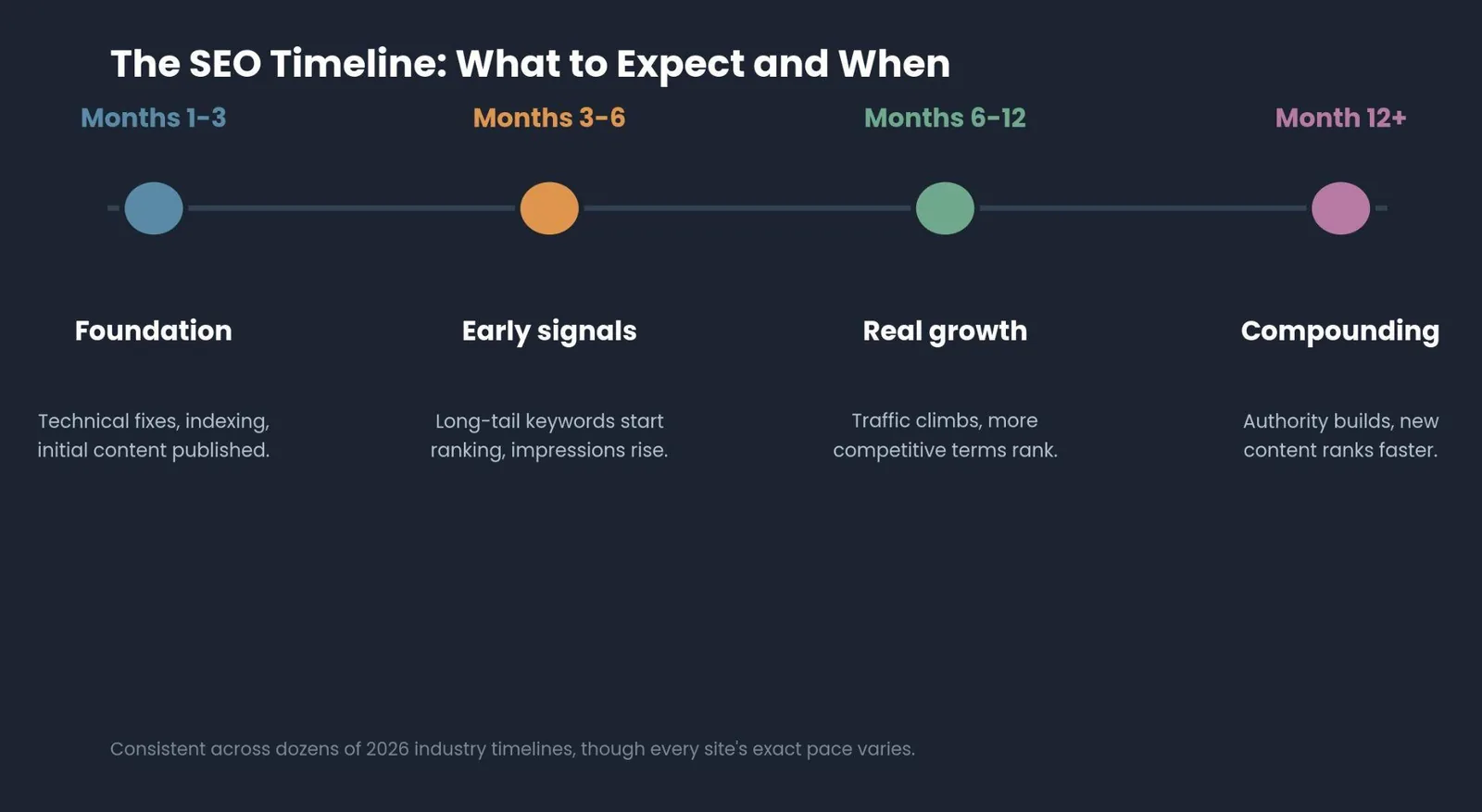
In most cases, a CPA or accounting firm should expect early SEO signals within 60 to 90 days, measurable ranking movement in 4 to 6 months, and durable, compounding growth between months 6 and 12. Highly competitive terms in major metros, like “CPA firm near me” in a large city, can take 12 to 18 months to fully mature. This article breaks down what actually happens at each stage, why accounting SEO specifically runs on this schedule, and how to know whether your firm is on track or off it.
Key Takeaways
- Google's own guidance puts the standard SEO timeline at 4 to 12 months before a business sees the potential benefit of a well-executed strategy, and accounting firms are not an exception to this.
- Local SEO (Google Business Profile, reviews, Map Pack visibility) tends to move faster than organic content rankings, often within 60 to 120 days, because it relies on different, faster-moving trust signals.
- Keyword competitiveness is the biggest variable. Long-tail, low-competition terms (a niche service in a smaller market) can rank in 1 to 3 months. Head terms in competitive metros can take 12 to 18 months or longer.
- New domains face a slower start. A brand-new firm website with no search history typically needs longer to build the trust signals Google rewards, regardless of content quality.
- A site redesign or migration resets part of the clock. Expect a temporary dip and a 3 to 6 month recovery window before rankings stabilize again.
- Organic search consistently ranks as one of the largest client-acquisition channels for accounting firms, which is why the wait is worth managing correctly rather than abandoning early.
How Long Does SEO Really Take for an Accounting Firm?
There's no single number that applies to every firm, but there is a well-documented range. Google's own guidance, delivered by former Google Search spokesperson Maile Ohye, states that most businesses need four months to a year to implement SEO improvements and start seeing the potential benefit. That guidance wasn't written for accounting firms specifically, but the underlying mechanics apply directly: Google has to crawl your site, index new or updated pages, evaluate them against every competitor already ranking for the same terms, and then decide where you belong.
Google's Search Advocate John Mueller has also drawn a useful distinction: small technical tweaks, like updating a page title or fixing metadata, tend to get reprocessed and reflected in rankings relatively quickly. Larger strategic changes, like a new service page structure, a content overhaul, or a full site migration, take considerably longer to fully show up in rankings because Google needs more time and more signals to re-evaluate the site as a whole.
For an accounting firm, that means the timeline depends heavily on where you're starting from and what “SEO” actually involves for your practice. A firm updating existing, indexed service pages will see movement faster than a brand-new firm launching its first real website.
The Realistic SEO Timeline, Month by Month
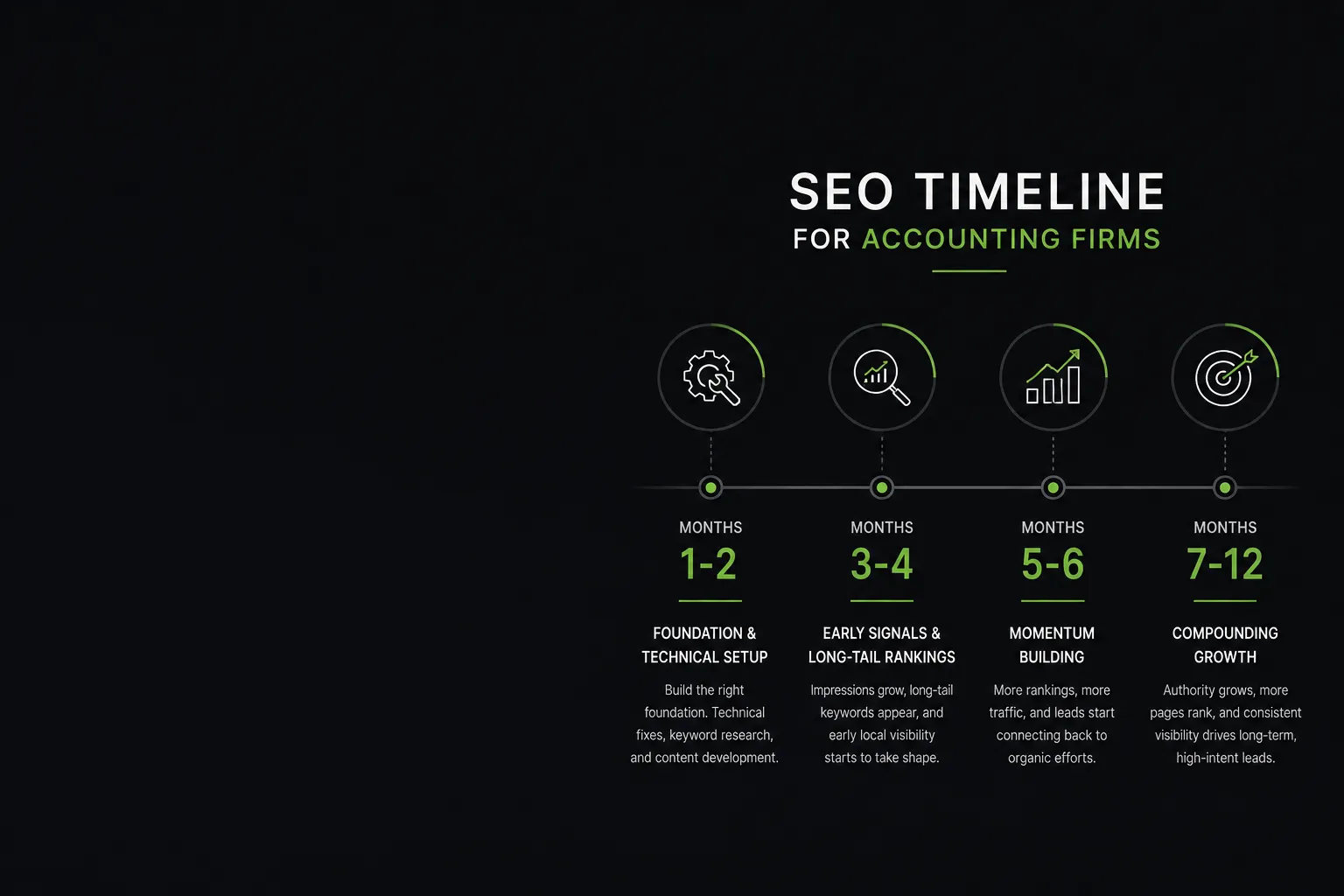
Months 1-2: Foundation and Technical Setup
This phase is invisible to clients and often frustrating for firm owners because there's little to show yet. Work in this window typically includes technical SEO fixes (site speed, mobile usability, crawlability), Google Business Profile setup or cleanup, keyword research mapped to actual client search behavior, and the first round of service page and content development. Indexing of new or updated pages usually happens within days to a couple of weeks, but indexing is not the same as ranking.
A focused SEO for Accounting Firms strategy helps establish the technical and content foundation needed for sustainable growth.
Months 3-4: Early Signals and Long-Tail Rankings
This is typically when firms start seeing the first real movement: impressions rising in Google Search Console, long-tail keyword rankings appearing (think “cost segregation study for restaurant owners” rather than “CPA”), and early Google Business Profile traction if local SEO work has been consistent. Rankings at this stage are often volatile: a page might sit at position 14 one week and position 8 the next. That instability is normal; Google runs new and recently updated pages through a testing period before rankings settle.
Months 5-6: Momentum Building
By month five or six, a well-executed strategy should show a clearer pattern: multiple keyword clusters ranking on page one or two, more consistent non-brand organic clicks, and a visible link between organic traffic and inbound leads or consultation requests. This is generally the point where moderately competitive accounting keywords, meaning service-specific terms in a mid-size market, start to show real traction.
Months 7-12: Compounding Growth
This is where accounting firm SEO tends to separate itself from other industries. Because prospective clients research extensively before trusting someone with their finances, authoritative content built over the first six months starts compounding: more pages ranking, more topical authority signals, and a growing base of earned backlinks and citations. Firms competing for high-intent local terms like “small business accountant [city]” or “CPA firm near me” in a competitive metro area typically need this full window, and sometimes longer, before consistently owning page one.
Beyond Year One: Authority and Defensibility
SEO doesn't have a finish line. Past month 12, the goal shifts from “get ranked” to “stay ranked and expand.” Firms that keep publishing, keep earning reviews, and keep their technical foundation clean tend to widen the gap between themselves and competitors who treat SEO as a one-time project rather than an ongoing channel.
What Affects How Fast Your Firm's SEO Timeline Moves
- Domain age and history. An established domain with a clean track record has a head start over a brand-new website, even with identical content quality.
- Keyword competitiveness. Keyword difficulty for terms like “CPA firm” or “tax accountant” in major metros commonly falls in the 40 to 70 range on a 100-point difficulty scale, meaningfully harder than niche, long-tail service terms.
- Market size. A firm in a mid-size city faces far less competition than one competing in a top-20 metro for the same head terms.
- Content consistency. Firms that publish and update content on a regular cadence move through the early phases faster than firms that publish once and stop.
- Backlink profile. Referral mentions, professional directories, local press, and industry publications all contribute trust signals that speed up authority-building.
- Google Business Profile completeness. Complete profiles with an accurate primary category, services, hours, and regular activity are rewarded with materially more visibility than sparse ones.
- Site history and technical debt. A migration, rebrand, or platform switch introduces a reset period before Google fully re-evaluates the site.
Timeline by Situation: What to Expect
| Firm Situation | Typical Timeline to Meaningful Traction | Notes |
|---|---|---|
| New firm website, no search history | 8-14 months | Needs time to build baseline trust signals from zero |
| Established firm, long-tail/niche service terms | 1-3 months | Lowest competition, fastest wins |
| Established firm, moderately competitive local terms | 4-9 months | Most common scenario for mid-size market firms |
| Established firm, high-competition metro head terms | 12-18 months | Requires sustained content and authority building |
| Local/Map Pack visibility (Google Business Profile) | 60-120 days | Faster-moving than organic content rankings |
| Post-redesign or site migration | 3-6 month recovery, then normal trajectory resumes | Temporary dip is expected, not a failure signal |
Why Accounting Firm SEO Runs on This Schedule
Accounting is a research-intensive, high-trust purchase decision. Prospective clients rarely choose the first result they see. They compare credentials, read reviews, check service pages, and often visit a firm's site multiple times before ever making contact. That behavior is exactly what Google's ranking systems are designed to reward over time: consistent, substantive content; genuine engagement; and accumulated trust signals rather than one-time optimization.
This is also why local search carries outsized weight for most practices. A large majority of “CPA near me” style searches trigger Google's Map Pack, and the top three local positions capture a disproportionate share of clicks. For firms serving a defined geographic area, Google Business Profile optimization (accurate categories, complete service listings, and a steady stream of reviews) often produces visible results faster than organic blog and service-page rankings alone, which is worth factoring into how you sequence your SEO investment.
Best Practices to Stay on Track
- Set a 6-month checkpoint, not a 6-week one. Judge early-stage SEO on leading indicators (indexing, impressions, keyword variety), not final rankings.
- Prioritize service pages before blog volume. A tax preparation page or bookkeeping services page targeting real search intent typically outperforms generic blog posts for lead generation.
- Treat Google Business Profile as a first-priority asset, not an afterthought. It's frequently the fastest-moving piece of the timeline.
- Publish consistently rather than in bursts. A steady monthly cadence builds authority more reliably than a large batch of content followed by silence.
- Track Search Console data in 90-day windows. Weekly or even monthly fluctuations are normal noise; the 90-day trend tells the real story.
- Build genuine backlinks and citations. Professional directories (AICPA, state CPA societies), local business associations, and legitimate press mentions all compound over time.
Common Mistakes That Stall the Timeline
- Expecting page-one rankings within 30 days. If a vendor promises this, it's either an unrealistically easy keyword or a tactic that risks long-term site health.
- Making reactive changes after every ranking dip. Constant strategy pivots reset progress more than they accelerate it.
- Neglecting Google Business Profile while focusing only on the website. For local-service firms, this leaves the fastest available win on the table.
- Publishing thin, generic content that doesn't reflect real expertise or answer the specific questions a prospective client is asking.
- Redesigning the site without an SEO migration plan, which can erase months of accumulated progress unnecessarily.
- Abandoning the strategy at month 3 or 4, right before the phase where most firms start seeing real movement.
How to Track Progress While You Wait
Watch four signals in Google Search Console and Google Business Profile insights: total impressions (are more searches showing your firm at all), average position trend over a 90-day window (not week to week), click-through rate on ranking pages, and Map Pack impression/action data if local search matters to your practice. Movement in impressions before movement in rankings is a normal, healthy early pattern. It means Google is testing your pages against more queries before deciding where they belong.
Conclusion
SEO for accounting firms isn't slow because it's broken. It's slow because it's earning something durable: trust signals that Google, and increasingly AI search platforms, use to decide who deserves visibility. A firm that understands the real timeline, tracks the right leading indicators, and stays consistent through the first two quarters is the firm still gaining ground at month 12, while competitors who expected a 30-day miracle have already moved on to the next unproven tactic. MYCPE ONE helps accounting firms take a structured, long-term approach to building their online visibility, supporting sustainable SEO growth rather than chasing short-term results.
Frequently Asked Questions
How long does SEO take to work for a CPA firm?
Most firms see early signals within 60 to 90 days, measurable ranking movement by month 4 to 6, and consistent, compounding growth between months 6 and 12. Highly competitive terms in large metros can take 12 to 18 months.
Why isn't our accounting firm's SEO showing results after three months?
Three months is typically still within the foundation and early-signal phase. Check Search Console for impressions and long-tail keyword movement rather than judging solely by head-term rankings, which usually take longer to mature.
Can a firm get faster results with paid ads instead of SEO?
Paid search can generate leads immediately, but that traffic stops the moment spend stops. SEO takes longer to build but produces a compounding, lower-cost-per-acquisition channel over time. Many firms run both simultaneously during the SEO ramp-up period.
Does a website redesign reset our SEO progress?
Not entirely, but it does typically cause a temporary 3 to 6 month dip while Google re-crawls and re-evaluates the new site structure. A proper SEO-aware migration plan minimizes this disruption.
How long before local SEO helps our firm show up in the Google Map Pack?
Local visibility often moves faster than organic content rankings. Many firms see meaningful Map Pack traction within 60 to 120 days when Google Business Profile is fully optimized and reviews are being actively earned.
Is SEO worth it for a small or solo CPA practice?
Yes, particularly for local search. Solo and small practices often compete more effectively in local, long-tail search than in broad, high-competition terms, which means a realistic strategy can produce results faster than firms chasing national keywords.
How often should we publish content to stay on a normal timeline?
Consistency matters more than volume. A steady monthly cadence of well-researched, service-specific content generally outperforms sporadic large batches, both for rankings and for AI-powered search visibility.



























Sign in to leave a comment.