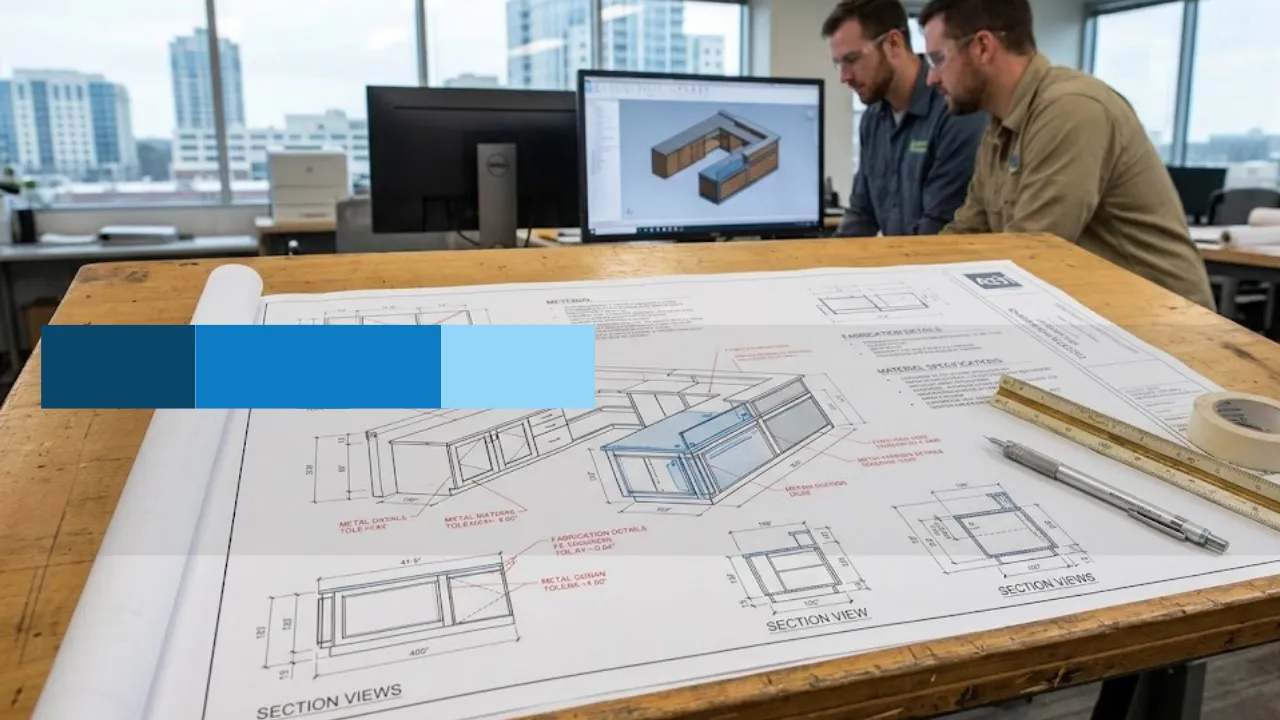

In the construction world, there is often a massive, expensive gap between what an architect designs on paper and what a contractor can actually build on-site.
An architectural drawing shows the vision: the beautiful sweeping lines of a custom ceiling, the sleek flow of a commercial reception desk, or the complex integration of a glass facade. But an architectural drawing doesn't tell a fabricator exactly where to drill a bolt, how a specific joint will handle structural load, or how a piece of millwork will fit around a hidden HVAC duct.
That is where shop drawings come in. They are the true backbone of the construction phase, serving as the definitive bridge between design intent and physical reality.
What Exactly Is a Shop Drawing?
Unlike general architectural blueprints, shop drawings are highly detailed, specialized diagrams typically required for pre-fabricated components. They are produced by contractors, subcontractors, manufacturers, or specialized drafting firms before any material is cut or installed.
Think of them as the ultimate instruction manual. A comprehensive shop drawing includes:
- Exact dimensions, manufacturing conventions, and fabrication details.
- Clear notes on materials, finishes, hardware, and connection points.
- Explicit instructions for the installation crew on-site.
Whether it’s structural steel, mechanical ductwork, or custom cabinetry, nothing goes into production without an approved shop drawing.
Looking for Flawless Technical Execution?
If you need to turn complex design concepts into precise, constructible blueprints, explore our dedicated Shop Drawing Services to streamline your next fabrication and installation process.
3 Reasons Why High-Quality Shop Drawings are Non-Negotiable
Investing in professional drafting services isn’t just an administrative checkbox it is a critical risk-mitigation strategy for any commercial or high-end residential project.
1. Eliminating Rework and Material Waste
The most expensive phrase in construction is "It doesn't fit." When a custom-fabricated piece arrives on-site and clashes with existing plumbing or structural columns, the project grinds to a halt. Rework costs money, eats into margins, and blows up schedules. A precise shop drawing catches these spatial conflicts virtually, long before any raw material is wasted.
2. Protecting Your Profit Margins
When a fabrication team has clear, unambiguous drawings, they can optimize material layouts and speed up assembly lines. On the flip side, install crews can move significantly faster when they aren't scratching their heads trying to interpret how a component is supposed to attach to the building's substructure. Clear drawings translate directly to reduced labor hours.
3. Establishing Clear Accountability
Shop drawings require an approval workflow. They are submitted to the architect and engineering team for review before manufacturing begins. Once stamped and approved, they act as a mutual agreement. If a component is fabricated exactly to the approved shop drawing, the fabricator is legally protected, establishing a clear line of accountability across the project ecosystem.
The Millwork and Casework Hurdle
While shop drawings are vital across all trades, they are arguably most critical in architectural millwork and casework. Interior finishes are what people see and touch. A millimeter of misalignment in a custom kitchen cabinet, a retail display unit, or wall paneling is immediately noticeable to the naked eye.
Furthermore, millwork must seamlessly wrap around the imperfections of poured concrete, MEP (mechanical, electrical, and plumbing) runs, and drywall. A skilled drafting team doesn't just draw the woodwork; they carefully analyze the surrounding building conditions to ensure a flawless fit.
Elevating Your Next Project
In an industry where schedules are shrinking and material costs are volatile, you cannot afford to guess your way through fabrication. Treating shop drawings as a priority rather than an afterthought is what separates profitable, smooth-running jobs from chaotic, delayed projects.
By partnering with a technical team that understands both the nuances of local building codes and the realities of the shop floor, you protect your vision, your timeline, and your bottom line.




























Sign in to leave a comment.