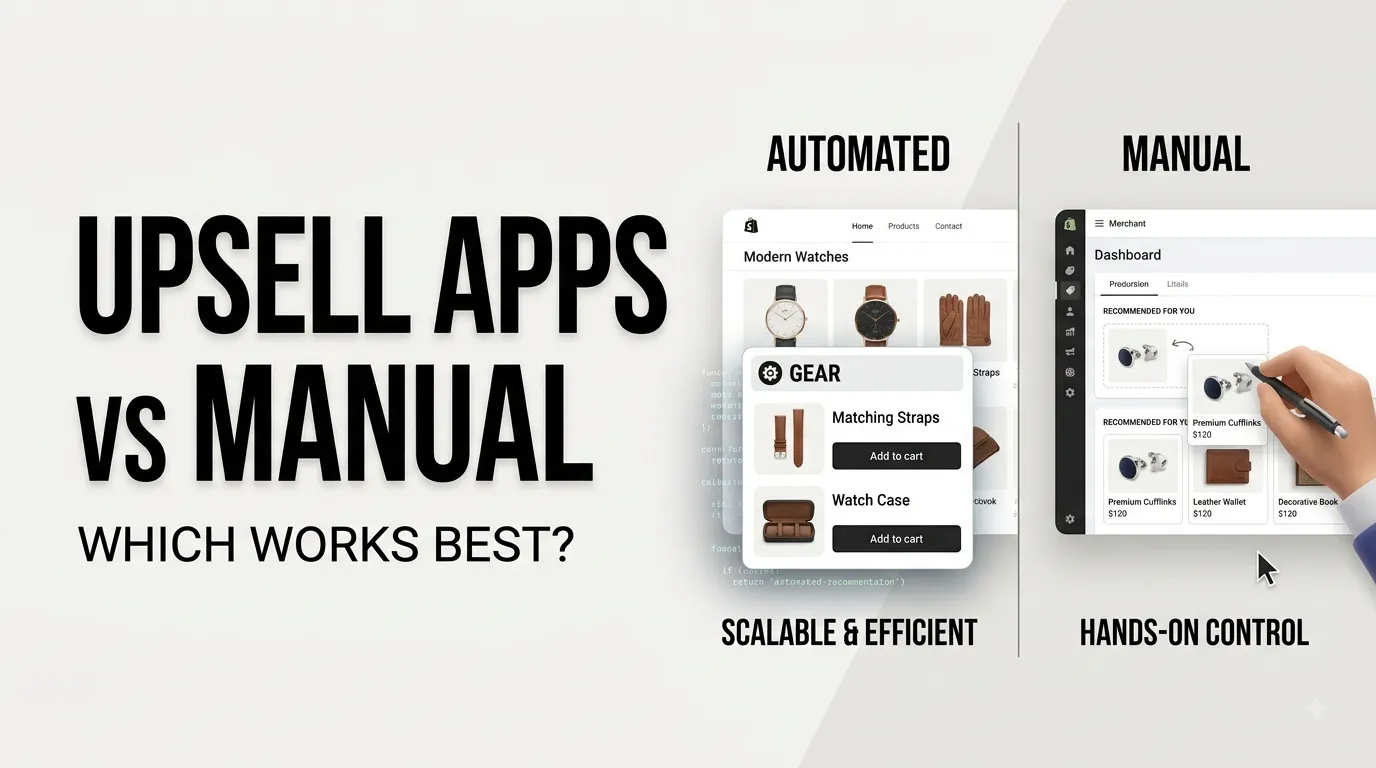

When it comes to increasing average order value on Shopify, merchants generally have two paths available: manually curating product recommendations throughout their store, or relying on a dedicated app to automate and optimize the process. Both approaches can work, but they differ significantly in terms of effort, scalability, and long-term results. Here's an honest comparison of Shopify upsell apps versus manual product recommendations, and how to decide which approach makes sense for your store.
What Manual Product Recommendations Look Like
Manual product recommendations typically involve a merchant hand-selecting which items to feature as "you might also like" suggestions, bundling specific products together based on personal judgment, or manually editing product pages to highlight complementary items. For smaller stores with a limited catalogue, this approach can work reasonably well, since the merchant likely has an intimate understanding of which products naturally pair together.
This method requires no additional software cost and gives merchants complete creative control over exactly which products are recommended and how they're presented. For very small catalogues, this level of hands-on curation can even outperform automated systems, since a human eye can catch nuanced pairings that an algorithm might miss.
The Limitations of Manual Recommendations
The challenges with manual recommendations become apparent as a store grows. Updating recommendations across dozens or hundreds of product pages by hand is time-consuming and difficult to maintain consistently. Seasonal changes, new product launches, and shifting customer preferences all require ongoing manual updates, which can quickly become unsustainable for a growing store with limited staff time.
Manual recommendations also lack the ability to adapt based on real customer behaviour. A merchant might assume two products pair well together, but without data showing actual conversion rates, there's no reliable way to know whether that assumption is actually driving sales or simply taking up valuable page space without meaningful impact.
What Shopify Upsell Apps Offer
A dedicated Shopify upsell app automates much of this process, using rules, algorithms, or manual configuration options to display relevant offers at key moments throughout the shopping journey, on product pages, at checkout, and especially on the post-purchase thank you page. These apps typically include built-in analytics, allowing merchants to see exactly which offers are converting and adjust accordingly, without needing to manually track performance through spreadsheets or guesswork.
Beyond automation, many upsell apps also support one-click post-purchase offers, allowing customers to add a recommended product to their order without re-entering payment information. This kind of frictionless upsell experience is difficult, if not impossible, to replicate manually, since it requires backend integration with the checkout and payment system.
Thankify is one example of a Shopify upsell app that focuses specifically on this post-purchase moment, allowing merchants to configure one-click upgrade and add-on offers directly on the thank you page without writing custom code.
Comparing Time Investment
Manual recommendations require ongoing, hands-on time investment that scales with your catalogue size and how frequently you want to update offers. A Shopify upsell app requires an upfront setup investment, but ongoing maintenance is typically far lighter, since the app handles offer placement and, in many cases, testing and optimization automatically once configured.
Comparing Cost
Manual recommendations are effectively free from a software cost perspective, though the time investment carries its own hidden cost, especially for merchants who could be spending that time on other parts of the business. Shopify upsell apps typically come with a monthly subscription fee, but for stores generating meaningful order volume, the incremental revenue from improved upsell performance often outweighs the app's cost many times over.
Comparing Scalability
This is where the gap between the two approaches becomes most obvious. Manual recommendations become increasingly difficult to maintain as a catalogue grows, while a Shopify upsell app scales naturally, applying the same rules and logic across an expanding product range without requiring additional manual work for each new item added to the store.
Comparing Personalization
Modern Shopify upsell apps often support personalized recommendations based on browsing history, cart contents, or past purchase behaviour, a level of dynamic personalization that's essentially impossible to replicate through static, manually configured recommendations. This means an app can show a different, more relevant offer to each individual customer, while manual recommendations typically show the same suggestion to every visitor regardless of their specific behaviour.
When Manual Recommendations Still Make Sense
For very small stores with a handful of products, or brand-new stores still testing which products resonate with their audience, manual recommendations can be a reasonable starting point before investing in a dedicated app. In these early stages, the overhead of manually updating a small number of product pages is minimal, and a merchant's direct knowledge of their limited catalogue can be just as effective as an automated system.
When a Shopify Upsell App Becomes the Better Investment
As a store grows in catalogue size, order volume, or overall complexity, the case for a dedicated Shopify upsell app becomes significantly stronger. The combination of automated placement, built-in analytics, one-click post-purchase functionality, and reduced ongoing manual effort typically delivers a stronger return than the time investment required to maintain manual recommendations at scale.
Final Thoughts
Manual product recommendations can work for very small, early-stage stores, but they quickly become difficult to maintain and optimize as a business grows. A dedicated Shopify upsell app, like Thankify, offers automation, personalization, and frictionless one-click functionality that manual methods simply can't match at scale. For most growing Shopify merchants, transitioning from manual curation to an automated upsell app is one of the more straightforward, high-return decisions available for increasing revenue without additional traffic.

























Sign in to leave a comment.