

In recent years, the Indian real estate sector has witnessed a transformative shift with the emergence of SM REITs (Small & Medium Real Estate Investment Trusts) and InvITs (Infrastructure Investment Trusts). These innovative financial instruments offer retail investors an accessible entry point into commercial real estate and infrastructure projects, traditionally dominated by institutional players. As fractional ownership platforms gain SEBI regulation—like PropShare Celestia—interest in SM REITs is surging, driven by their potential to democratize real estate investment.
This comprehensive guide aims to demystify SM REITs, explain how they work under SEBI guidelines, compare them with traditional REITs, and provide actionable insights on how to invest in this promising asset class. Whether you're a seasoned investor or just starting, understanding SM REITs can help diversify your portfolio and generate consistent income streams.
What is a REIT and How Does it Differ from an SM REIT?
What is a REIT?
A Real Estate Investment Trust (REIT) is a company that owns, operates, or finances income-generating real estate across various sectors such as commercial offices, retail malls, warehouses, and hospitality. REITs pool investors’ money to invest in large-scale properties, offering investors a way to earn a share of the income produced without directly owning or managing the properties.
What is an SM REIT?
An SM REIT (Small & Medium REIT) is a variation tailored for smaller-scale properties and investors, focusing on fractional ownership of commercial real estate in India. Unlike traditional REITs, which often involve large assets and institutional investors, SM REITs are designed to be more accessible to retail investors, with lower ticket sizes and regulatory frameworks suited to smaller assets.
SM REIT vs. Traditional REIT
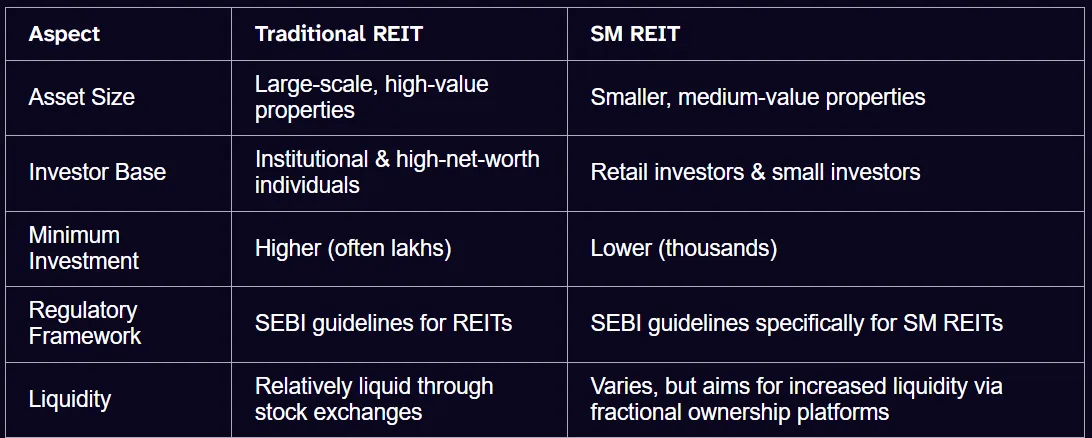
The key difference lies in accessibility and scale—SM REITs open up the lucrative Indian commercial real estate market to a broader investor base.
How Does SM REIT Work?
The Regulatory Framework
SEBI (Securities and Exchange Board of India) introduced guidelines for SM REITs to regulate smaller-scale real estate investments, ensuring transparency, investor protection, and efficient market functioning. These guidelines facilitate the listing, trading, and management of SM REITs on stock exchanges or through fractional ownership platforms.
The Investment Process
Property Identification & Acquisition: Developers or sponsors acquire commercial properties—office spaces, retail outlets, warehouses—in targeted cities.
Structuring the SM REIT: The properties are transferred into a trust, which issues units to investors, allowing fractional ownership.
Raising Capital: Investors buy units at a predefined price, with the minimum investment often as low as Rs. 10,000 to Rs. 50,000.
Income Generation: The REIT earns rental income from tenants, which is distributed periodically as dividends to unit holders.
Exit & Liquidity: Investors can exit through secondary markets or buy back units, subject to SEBI regulations and platform policies.
Benefits for Investors
Lower Ticket Sizes: Accessibility for retail investors.
Steady Income: Regular rental income distributions.
Portfolio Diversification: Exposure to commercial real estate without large capital outlay.
Transparency & Regulation: Governed by SEBI, ensuring investor protection.
Does SM REIT Have a Regulatory Framework?
Yes. SEBI (Securities and Exchange Board of India) has laid down specific guidelines for SM REITs, ensuring they operate transparently and are compliant with Indian securities laws. These guidelines cover aspects such as:
Minimum asset size and net worth
Disclosure norms
Valuation standards
Investor protections
Listing and trading procedures
This regulatory clarity boosts investor confidence and fosters growth in this nascent asset class.
Top 3 REITs in India
While SM REITs are still emerging, here are some notable players in the Indian real estate REIT space:
Indiabulls Real Estate REIT: Focuses on office spaces and commercial properties.
Mindspace Business Parks REIT: Known for premium office parks in Mumbai and Hyderabad.
Brookfield India Real Estate Trust: Features high-quality office assets in key metro cities.
As the SM REIT segment matures, more small-scale projects will join the ranks, offering diversified options for retail investors.
How to Invest in SM REITs?
Step-by-Step Guide
Research & Due Diligence: Use platforms like EquityLogy, PropShare, and others to identify regulated SM REITs.
Understand the Offer: Review the project details, asset quality, rental yields, and exit options.
Open an Investment Account: Register on a fractional ownership platform or stock exchange where the SM REIT is listed.
Invest Minimum Capital: Start with the minimum ticket size—often Rs. 10,000 to Rs. 50,000.
Monitor & Manage: Track rental income, dividends, and market developments. Use SEO & GEO strategies to stay updated on market trends.
Exit or Hold: Decide whether to hold for income or exit based on market conditions and platform policies.
Why Choose EquityLogy?
EquityLogy stands out as a trusted platform for investing in SM REITs and fractional ownership projects. With its user-friendly interface, comprehensive research tools, and adherence to SEBI regulations, EquityLogy empowers retail investors to participate confidently in this emerging asset class.
The Future of SM REITs & InvITs in India
The Indian government’s push for REITs and InvITs as alternative investment avenues signals a bright future. The focus on fractional ownership and regulatory clarity under SEBI will likely lead to increased adoption, higher liquidity, and more diversified offerings.
With low keyword difficulty and high search volume, SM REITs are poised to become a mainstream investment option for retail investors seeking passive income, portfolio diversification, and exposure to commercial real estate.
Final Thoughts
SM REITs represent a revolution in Indian real estate investment, bringing transparency, accessibility, and regulated growth to retail investors. By understanding what is SM REIT, how it works under SEBI guidelines, and how to invest in SM REIT, you can unlock a new avenue for wealth creation.
Stay ahead in the game by leveraging platforms like EquityLogy, which are committed to promoting fractional ownership, AIO (All-In-One) investment solutions, and GEO strategies to maximize your returns.
Ready to Dive Into SM REITs?
Explore SM REITs today and redefine your investment portfolio. Remember, knowledge and strategic investment are your best tools in navigating this promising new asset class.
Disclaimer: Always conduct thorough research or consult financial advisors before investing in any financial products.






















Sign in to leave a comment.