
Introduction
In our highly connected digital enterprise landscape, the volume and sophistication of cyberattacks are scaling at an unprecedented rate. For modern organizations, safeguarding corporate networks has transformed into an engineering obstacle that requires around-the-clock vigilance. While traditional firewalls and consumer antivirus applications provided baseline coverage historically, stopping advanced threat actors demands real-time inspection, monitoring, and response capability. Building a fully equipped, internal Security Operations Center (SOC) remains financially prohibitive for most organizations due to exorbitant infrastructure and talent overhead. Consequently, progressive corporate leadership teams are leveraging professional SOC as a Service (SOCaaS) models to fortify their systems.
This comprehensive guide breaks down how outsourced security operations centers continuously scan infrastructure parameters, identify hidden malicious indicators, and minimize exposure gaps before they trigger systemic operational disruptions.
What is SOC as a Service (SOCaaS)?
SOC as a Service (SOCaaS) is a cloud-native subscription security model that delivers comprehensive threat detection, engineering, and incident response capabilities. Instead of allocating vast capital to purchase localized hardware servers, analytical software, and specialized parsing licenses, organizations securely outsource their environmental monitoring to an expert third-party provider. This dedicated defense partner coordinates a unified team of certified security analysts and engineers who monitor your endpoints, cloud containers, hybrid databases, and network traffic from a centralized external position. By deploying cloud-based Security Information and Event Management (SIEM) systems alongside extended detection capabilities, the service translates raw infrastructure telemetry into actionable intelligence, ensuring no unauthorized behavior slips past your network perimeter.
Why Businesses Are Overhauling Defense Frameworks with SOCaaS
Relying on standard, fragmented internal alerts is no longer sufficient to secure modern distributed networks. Implementing outsourced monitoring ensures enterprise data assets remain protected via expert oversight.
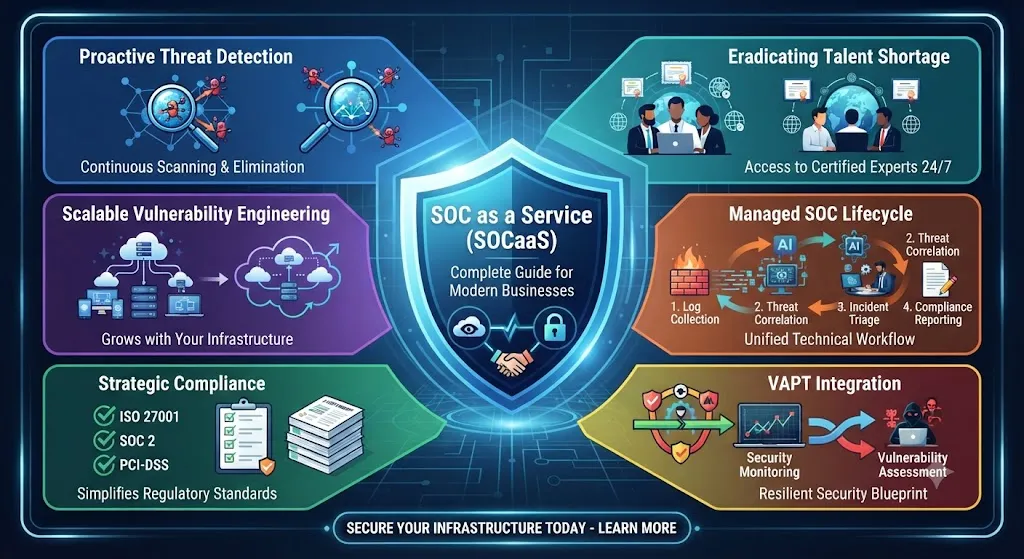
- Proactive Threat Detection and Elimination
Waiting for a critical system alarm to sound before reacting to an intrusion is an expensive business strategy. Utilizing an expert partner enables your IT leadership to establish early detection controls. Analysts systematically trace active behaviors across endpoints, discovering lateral movements before adversaries establish a strong foothold. This proactive vigilance shifts an organization's defensive strategy from chaotic, damage-control recovery toward structured, predictable risk management.
- Eradicating the Security Talent Shortage
Recruiting, training, and retaining high-tier cybersecurity professionals remains an ongoing operational challenge globally. A fully functional internal security operations center requires a minimum headcount across multiple shifts to provide true 24/7 coverage. Managed security operations eliminate this human resource bottleneck completely, granting immediate access to tier-3 response engineers without the overhead of long-term recruiting pipelines.
- Scalable Vulnerability Engineering
As an enterprise adds remote employee infrastructure, cloud databases, and software integrations, its surface area for potential exploitation grows exponentially. A cloud-managed SOC seamlessly scales its monitoring software alongside your infrastructure expansion, eliminating the risk of unmonitored blind spots developing over time.
Core Capabilities of a Managed SOC Lifecycle
A structured security partnership functions through a multi-tiered technical workflow to guarantee complete clarity over system anomalies:
· • Log Collection and Aggregation: Continuous data ingestion across firewalls, cloud architecture, and database endpoints feeds the core correlation engines.
· • Threat Correlation and Artificial Intelligence: Advanced analytics parse hundreds of thousands of events daily, isolating legitimate system anomalies from standard network background noise.
· • Incident Triage and Response: Certified engineers isolate infected endpoints, kill unauthorized active tasks, and block attacker IP channels instantly upon validation.
· • Strategic Compliance Reporting: Detailed audit trails trace incident lifecycles, proving control efficacy to external auditing teams during regulatory reviews.
How SOCaaS Drives Strategic Compliance Standards
Beyond mitigating active network intrusions, regular external monitoring provides the exact technical proof required to navigate complex global data privacy frameworks. Major compliance structures like ISO 27001, SOC 2, and PCI-DSS explicitly mandate that organizations implement continuous tracking and audit trail retention mechanisms over sensitive consumer data environments. Managed services fulfill these requirements by generating time-stamped log registries and detailed incident response histories, turning regulatory validation into a predictable process.
VAPT and SOCaaS: The Blueprint for Resilient Security
To build a bulletproof organizational posture, continuous security monitoring must always be paired with periodic technical validation. Consulting a comprehensive VAPT for businesses guide ensures your management team understands how to properly scope independent security assessments. While your outsourced SOC monitors system events in real time, engineers actively simulate targeted attacks to uncover systemic flaws. Testing internal configurations against the top security vulnerabilities found during VAPT empowers your software teams to patch vulnerabilities like broken access control and unpatched systems before they turn into real-world alerts.
Furthermore, aligning your defensive operations with documented penetration testing guide principles keeps your codebases resilient against injection techniques. Auditing network architectures against the CISA Cybersecurity Standards ensures that perimeter configurations remain hardened against automated scanning exploits. Executing a regular network security audit eliminates baseline misconfigurations that can lead to public cloud data exposures. Ultimately, introducing an expert, holistic cybersecurity assessment into your long-term roadmap feeds into a highly dependable vulnerability management strategy, keeping your corporate digital infrastructure protected and compliant year-round.
Conclusion
Defending a modern enterprise requires moving away from traditional, siloed security parameters. As infrastructure disperses across multi-cloud networks, maintaining visibility and response capability is paramount to operational resilience. Implementing SOC as a Service grants your enterprise the engineering expertise, sophisticated tooling, and constant vigilance needed to preemptively block advanced digital adversaries.
Instead of waiting for a catastrophic data breach to expose systemic gaps in your internal monitoring frameworks, take control of your digital perimeter today. Partner with certified cyber defense experts to establish continuous security visibility and keep your enterprise thoroughly secured.
Secure Your Business Infrastructure Today
Do not let hidden cyber threats compromise your corporate infrastructure. Contact our certified technical engineering team today to schedule a detailed security operation consultation tailored to your organizational needs.
Frequently Asked Questions
What is SOC as a Service (SOCaaS)?
SOC as a Service (SOCaaS) is a cloud-based security model that provides organizations with continuous threat detection, monitoring, and incident response capabilities. It allows companies to outsource their cybersecurity needs to a specialized third-party provider, eliminating the need for significant investments in hardware and software.
How does SOCaaS improve threat detection for businesses?
SOCaaS enhances threat detection by utilizing a team of certified security analysts who monitor network traffic and endpoints 24/7. This proactive approach allows businesses to identify and address potential threats before they escalate into serious incidents, shifting their focus from reactive damage control to structured risk management.
Why should companies consider outsourcing their security operations?
Outsourcing security operations through SOCaaS helps organizations overcome challenges like the cybersecurity talent shortage and the high costs of maintaining an internal security team. It provides immediate access to experienced professionals and scalable monitoring solutions without the overhead of hiring and training.
What are the core capabilities of a managed SOC?
A managed SOC typically includes continuous log collection, advanced threat correlation using artificial intelligence, incident triage and response, and strategic compliance reporting. These capabilities ensure that organizations can effectively monitor their security posture and address vulnerabilities in real-time.
How does SOCaaS help with regulatory compliance?
SOCaaS aids in regulatory compliance by providing the necessary audit trails and documentation required by standards like ISO 27001 and PCI-DSS. Continuous monitoring and detailed incident response records help organizations maintain compliance with data privacy requirements and simplify audits.
What is the relationship between VAPT and SOCaaS?
Vulnerability Assessment and Penetration Testing (VAPT) and SOCaaS complement each other by ensuring that organizations not only monitor for threats in real-time but also assess their security posture through simulated attacks. This combination helps identify and remediate vulnerabilities before they can be exploited.
Is SOCaaS suitable for small businesses?
Yes, SOCaaS is particularly beneficial for small businesses that may lack the resources to build and maintain an in-house security operations center. It allows them to access advanced security capabilities and expertise at a fraction of the cost, ensuring they can protect their digital assets effectively.


























Sign in to leave a comment.