
Every established enterprise has a software application everyone is terrified to touch.
It might be a fifteen-year-old inventory system running on an on-premise server, an old custom CRM built in PHP 5 that only one senior engineer understands, or a massive database monolith where making a simple schema change breaks four unrelated modules.
You cannot simply turn these legacy systems off. They process daily orders, hold years of historical customer records, and handle core operational accounting.
Replacing a legacy monolith with a complete "rip-and-replace" rebuild is notoriously risky. Over 70 percent of total legacy rewrite projects run over budget or fail entirely.
This is why working with a skilled software developer company in Noida requires an agency that understands modern, incremental refactoring strategies rather than pitching expensive ground-up rebuilds.

The Strangler Fig Pattern: Incremental Refactoring
Smart engineering teams do not destroy legacy software; they gradually replace it.
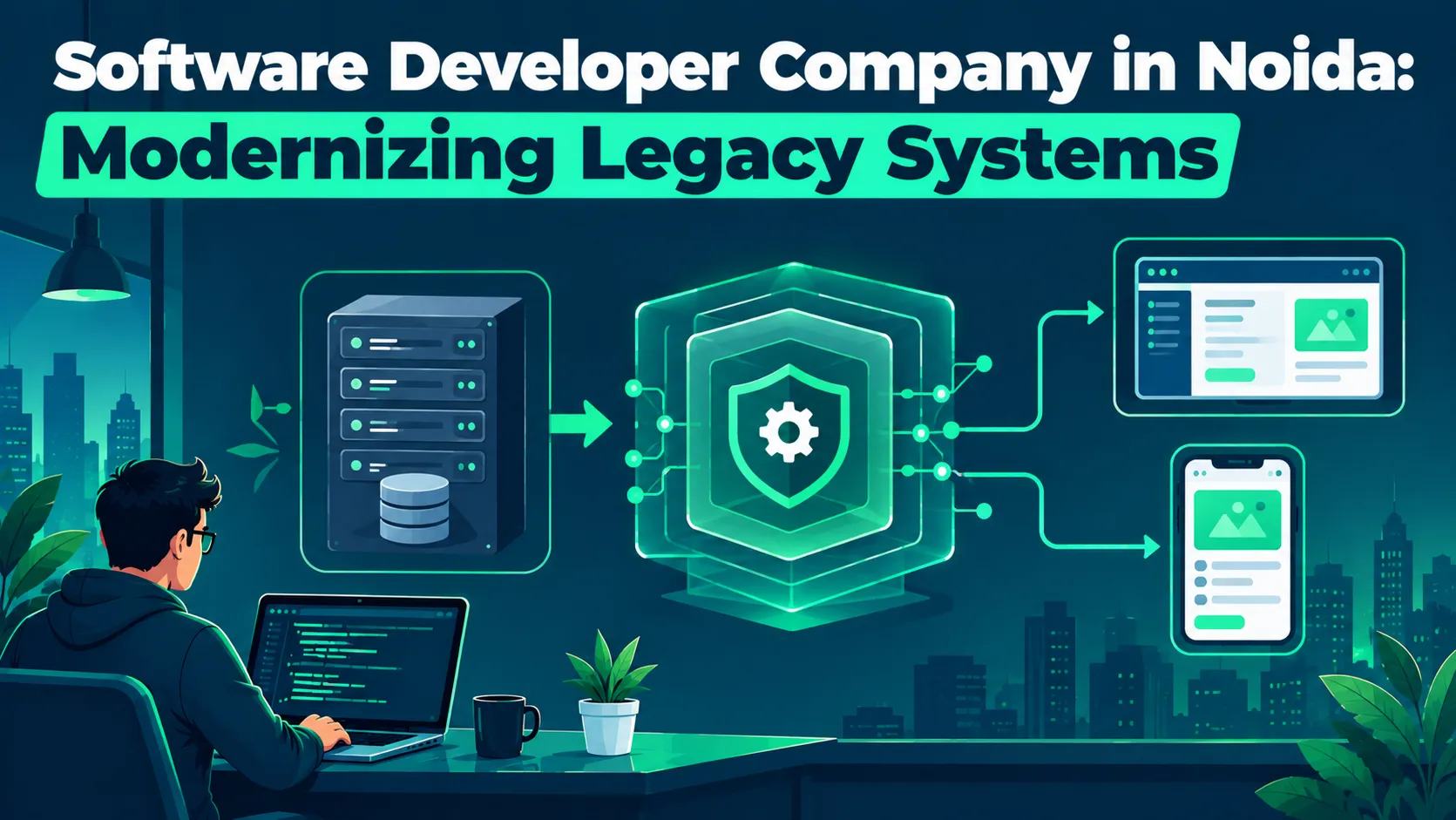
The Strangler Fig pattern involves building an API gateway in front of your legacy system. New features are developed as clean, independent microservices behind the gateway, while old requests continue routing to the legacy monolith.
Over time, as individual modules (like user authentication, payment processing, or reporting) are rewritten as modern cloud-native services, the legacy monolith shrinks until it can be safely decommissioned.
This approach delivers immediate value:
- The business gets a modern web or mobile interface within weeks rather than waiting two years for a full rewrite.
- Operational risk is distributed. If a newly refactored module fails, traffic can immediately fail back to the legacy system.
Core business operations continue running without downtime during development.
Wrapping Legacy Databases in RAG and Natural Language Layers
One of the fastest ways to extract value from legacy enterprise databases is adding an intelligent query layer.
Legacy ERPs and CRMs often hold rich historical data, but accessing that information requires writing complex SQL queries or running slow, rigid static reports.
Noida engineering studios are building Retrieval-Augmented Generation (RAG) wrappers around legacy databases. By creating secure, read-only data sync pipelines that feed indexed vector databases, employees can query historical business records using simple natural language. For example: "Show me all purchase orders from industrial suppliers in Sector 80 that had delivery delays over ten days last quarter."
Learning about choosing a software company for data engineering helps founders build safe, scalable pipelines between fragile legacy databases and modern analytics systems.
An experienced software developer company in Noida can deliver these modern AI query layers without risking the integrity of your underlying core database.
Modernizing Legacy Tech in Greater Noida and Pune Industrial Belts
Industrial manufacturing corridors across Greater Noida, the Yamuna Expressway, and Pune’s Chakan industrial belt run on legacy enterprise software.
Factories operate custom inventory, shop-floor scheduling, and supply-chain tools built a decade ago. These systems work reliably for basic accounting, but lack mobile access, real-time analytics, and modern cloud security features.
Software teams working with these manufacturing clients build hybrid integration layers. They install local edge gateway software on factory floor servers to read machine data, push summarized records to cloud API layers, and give plant managers real-time mobile dashboards without disrupting legacy core ERPs.
Frequently Asked Questions
What is legacy software modernization?
Legacy software modernization is the process of updating, refactoring, or transforming outdated business applications to modern programming languages, cloud infrastructure, microservice architectures, and modern user interfaces without losing historical business data.
Why do rip-and-replace software rewrites often fail?
Complete rewrites fail because legacy systems contain years of hidden edge-case rules, undocumented bug fixes, and deep business logic that nobody fully remembers. Rebuilding everything from scratch takes far longer than planned and frequently introduces severe operational bugs.
What is the Strangler Fig pattern in software engineering?
The Strangler Fig pattern is an architectural strategy where new features are built as modern microservices around an existing legacy monolith. Over time, features are gradually migrated to the new system until the legacy monolith can be safely retired.
Can an AI layer be added to an old legacy database?
Yes. Developers build read-only data pipelines that extract, clean, and index legacy database records into modern vector databases, allowing staff to query historical enterprise data using conversational AI interfaces.
How much does it cost to modernize a legacy enterprise application?
Costs depend on whether you choose incremental refactoring or a full rebuild. Incremental modernization allows companies to spend budget over time on high-priority modules ($15,000 to $40,000+), delivering immediate value without large upfront capital risk.
How do dev teams ensure zero data loss during legacy database migration?
Engineering teams use continuous dual-writing and database replication pipelines. Data is written to both the legacy and modern databases simultaneously and audited for consistency for weeks before any legacy system is decommissioned.
























Sign in to leave a comment.