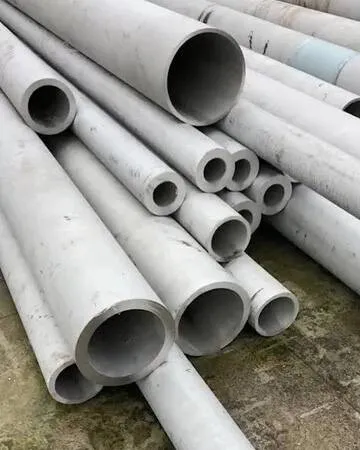

Stainless steel welded pipes form the backbone of fluid transport, structural frameworks, and process pipelines across oil refineries, food processing lines, and municipal water treatment plants. Global demand for industrial stainless steel welded pipes has crossed 14 million metric tonnes in recent years, and welded variants lead that figure. Manufacturers produce them by roll-forming flat-rolled strip stock into a tubular shape, then fusing the seam through TIG, laser, or high-frequency electric resistance welding. Unlike seamless pipes, which extrude from solid billets and suit pressures above 2,500 PSI, welded pipes cost 15 to 30 percent less and ship faster because standard grades like 304, 316, and 316L stay readily available.
Types of Stainless Steel Welded Pipes
ERW Stainless Steel Welded Pipes
Electric Resistance Welded (ERW) pipe uses high-frequency current passed through the strip edges to generate the heat needed for fusion. No filler metal enters the weld zone. ERW lines run at high speed, which keeps per-unit cost low and dimensional tolerances tight. Wall thickness typically ranges from 0.5 mm to 12.7 mm, with OD from 21.3 mm up to 610 mm. These pipes are used in heat exchangers, general process piping, pressure vessels rated below 1,500 PSI, and structural frameworks. Most grades from 304 through 317L weld cleanly on ERW lines.
Longitudinal Welded Pipes
Longitudinal welded pipe carries the seam along the pipe's length and covers a broader production range than standard ERW. Where ERW uses resistance heating alone, longitudinal SAW (submerged arc welded) pipes for heavier walls use filler wire in a flux environment. This allows wall thicknesses up to 25 mm in diameters from 168 mm to over 1,000 mm. Refineries specify these for above-ground process lines, transfer headers, and manifold systems where a larger bore reduces velocity and pressure drop across long pipe runs.
Large Diameter Welded Pipes
In water treatment, desalination, and power plant cooling systems, pipe diameters regularly exceed 600 mm. Large diameter stainless welded pipe, produced by spiral or longitudinal SAW processes, handles these installations. A 900 mm diameter 316L pipe running seawater cooling at a coastal power station needs to resist chloride pitting at the weld zone and in the HAZ. Post-weld pickling and passivation address that. These pipes also appear in LNG terminal infrastructure and offshore platform risers where diameter and wall combination determines pressure containment.
Decorative and Structural Stainless Steel Pipes
Not every SS welded pipe carries a fluid. Architectural firms specify 304 and 316 grade polished-finish tubes for balustrades, handrails, curtain wall supports, canopy structures, and facade cladding. Surface finish matters here: No. 4 brushed finish suits most commercial interiors, while mirror-polished 316 grade handles coastal installations where salt air is a factor. Structural stainless pipes also appear in modular support frames, machine guards, and food industry equipment where cleanability requirements rule out painted carbon steel.
Key Advantages of SS Welded Pipes
Stainless steel welded pipes resist oxidation, chloride attack, and most dilute acid environments without protective coatings. Grade 316L, with 2 to 3 percent molybdenum, handles chloride concentrations up to approximately 1,000 ppm in continuous service. Internal surfaces on welded pipe can be electropolished to Ra values below 0.4 microns, which satisfies pharmaceutical and dairy industry cleanliness standards. Fabrication is straightforward. Welded SS pipe cuts, bends, and joins using standard TIG, MIG, or plasma processes without preheat in most grades. Dimensional consistency from coil-fed production also means fitups on flanged joints land accurately, reducing site rework. Service life in non-aggressive environments regularly exceeds 25 years with no maintenance beyond routine inspection.
Common Applications of Stainless Steel Welded Pipes
Oil and Gas Industry
Upstream gathering lines and downstream transfer headers both use industrial stainless steel welded pipes where H2S content or produced water chemistry would corrode carbon steel within months. Duplex 2205 welded pipe handles sour service applications where standard 316L lacks the pitting resistance equivalent (PRE above 40 required). Processing plants use SS welded pipe in heat exchanger shells, reboiler return lines, and amine treating circuits.
Chemical and Petrochemical Plants
Chemical transfer lines carrying nitric acid, caustic soda, or chlorinated solvents require a material that resists attack at operating temperatures up to 120°C. Grade 316L welded pipe handles dilute HNO3 and most caustic concentrations. For more aggressive acids, Hastelloy C-276 or 904L pipes step in. Navrang Steel stocks these specialty grades alongside standard 304 and 316 to cover a full range of chemical service requirements.
Water Treatment Facilities
Municipal water distribution systems increasingly specify 304 and 316 SS welded pipe as a replacement for aging ductile iron mains. The pipes carry no taste or odour compounds into drinking water, resist tuberculation, and require no lining. Wastewater treatment uses 316L pipe for chlorine dosing systems and effluent transfer lines where chloride concentrations spike above 500 ppm.
Food and Beverage Industry
Dairy plants, breweries, and pharmaceutical fermentation lines run SS 316L welded pipe throughout their hygienic process sections. The bore gets electropolished to prevent biofilm adhesion, and the pipe is specified to ASME BPE standards for sanitary service. CIP (Clean-in-Place) cycles use caustic and acid at up to 85°C, a condition that 316L handles without sensitisation or stress corrosion cracking in normal service.
Construction and Infrastructure
Structural SS welded pipe holds up canopy roofs, exterior facades, public transport shelters, and glass curtain wall systems. Architects prefer 316 grade as the marine environment in Mumbai, Chennai and other coastal cities threatens to tea-stain and surface-pit 304 in two to three years.
Automotive and Manufacturing Industries
Automotive exhaust manifolds and tail pipe assemblies use 409 and 441 ferritic SS welded pipe to withstand thermal cycling from below zero to over 700°C repeatedly. Process piping in automotive paint shops and chemical dosing systems for battery manufacturing also uses 316L welded pipe where contamination from iron corrosion products is not acceptable.
Why Choose a Reliable Stainless Steel Welded Pipes Supplier?
Navrang Steel manufactures, stocks, and exports SS welded pipes in grades from 304 through 317L, duplex 2205, and a range of nickel alloys, all produced to ASTM A312, ASME SA312, DIN, and JIS standards with full material traceability and third-party test reports. Pipes leave the warehouse with dimensional checks, hydrostatic or eddy-current testing, and proper end protection. Custom dimensions, non-standard lengths, and specific surface finishes including No. 4, 2B, and mirror-polish are available on request. As an established stainless steel welded pipes supplier to fertilizer plants, pharmaceutical manufacturers, chemical processors, and infrastructure contractors, we maintain ready stock across common sizes for immediate dispatch.
Conclusion
Stainless steel welded pipes cover an extraordinary range of service conditions, from sanitary dairy lines to sour-gas offshore headers to coastal architectural structures. The four pipe types discussed here (ERW, longitudinal welded, large diameter, and decorative structural) each address a distinct set of dimensional, mechanical, and surface requirements. The consistent thread across all applications is the need for material integrity, dimensional accuracy, and verifiable certification. Buying stainless steel welded pipes from a trusted supplier like Navrang Steel ensures that each batch of pipes comes with the documentation, traceability and tested performance that industrial and infrastructure projects demand.

























Sign in to leave a comment.