

A newly opened diagnostic lab in a tier-2 city and a 40-branch national diagnostic chain are, on paper, doing the same basic work — collecting samples, running tests, delivering results. But the software each one actually needs to run well looks meaningfully different, and a lot of the confusion in India's lab software market comes from treating these as the same buying decision with the same priorities.
A single-location startup lab evaluating software is usually optimizing for something very different than what a 40-branch chain's IT and operations team is solving for — and vendors that market themselves identically to both audiences often end up serving neither particularly well. This article breaks down where those needs genuinely diverge, and what each type of lab should actually be prioritizing.
Why This Distinction Actually Matters
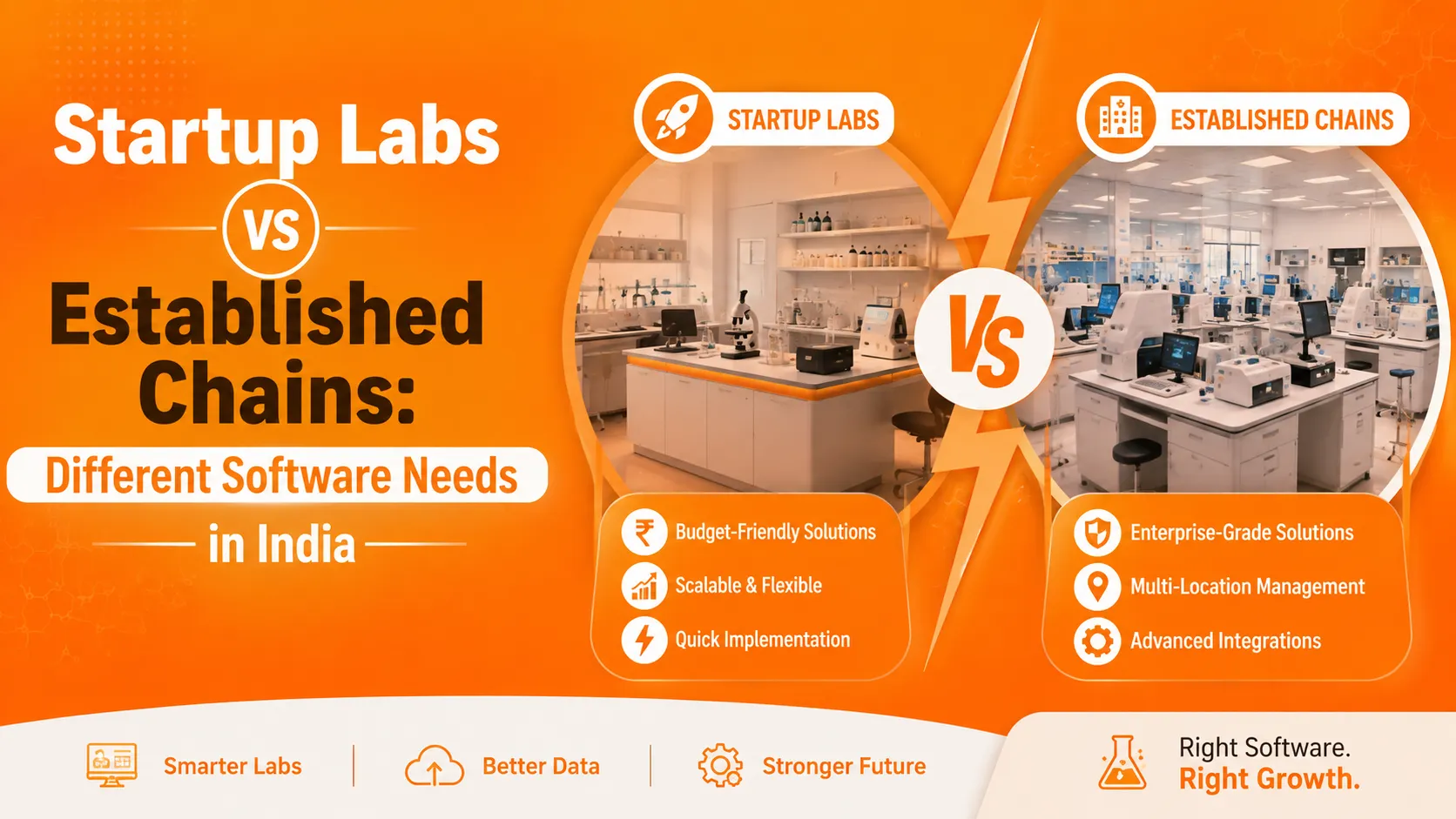
It's tempting to assume "more features is always better" regardless of lab size, but that's not how this plays out in practice. A startup lab paying for and trying to configure enterprise-grade multi-branch inventory reconciliation tools it doesn't need yet is wasting budget and onboarding time on complexity that doesn't serve its actual operation. Conversely, an established chain trying to run 40 branches on a lightweight tool built for a single-location startup will hit real operational walls — inconsistent data across branches, no centralized oversight, no ability to standardize pricing or reporting across locations.
Matching software complexity to actual operational scale isn't just a cost consideration — it's what determines whether a lab actually adopts and benefits from the tool, or ends up fighting it.
What a Startup Lab Actually Needs
Fast, Low-Friction Onboarding
A new lab typically doesn't have a dedicated IT team, and every week spent on a complicated software rollout is a week of lost operational time during a critical early period when the business is still establishing itself. Startup labs need software that can be configured and live within days, not months — with straightforward setup that a lab owner or office manager can largely manage without extensive technical support.
Affordable, Predictable Pricing
Cash flow discipline matters enormously in a lab's first year or two. Startup labs need pricing that's transparent and scales gradually with actual usage, rather than enterprise-tier contracts with large upfront commitments that assume a scale the lab hasn't reached yet.
Core Workflow Coverage Without Excess Complexity
At this stage, a lab mainly needs the fundamentals handled well: sample registration, structured result entry, report generation, and basic billing — without needing multi-branch inventory synchronization, complex approval hierarchies, or enterprise reporting dashboards built for coordinating dozens of locations.
Professional-Looking Output From Day One
Even a small, new lab needs reports that look credible and build trust with referring physicians and patients — customizable, professionally formatted reports matter disproportionately for a startup still establishing its reputation, since a sloppy-looking report can undermine confidence regardless of how accurate the underlying testing actually is.
Room to Grow Without Re-Platforming Later
While a startup lab doesn't need enterprise features immediately, choosing software with zero path to scale creates a real problem later — forcing a full platform migration exactly when the lab is busy growing and least able to absorb that disruption. The right starting platform should be lightweight now but capable of scaling functionality as the lab adds volume, staff, or locations.
What an Established Chain Actually Needs
Centralized, Multi-Branch Visibility
A chain operating multiple locations needs real-time oversight across all of them from a single dashboard — comparing turnaround times, sample volumes, and revenue across branches, rather than each location operating as an isolated island with no aggregated view for leadership.
Standardized Workflows Across Locations
Consistency matters enormously at scale — the same test should be processed the same way, priced the same way, and reported in the same format regardless of which branch a sample came from. Software needs to enforce this standardization systematically, rather than relying on each branch manager to independently maintain consistency through informal coordination.
Robust Role-Based Access Across a Larger Staff Base
With many more staff across multiple locations, access control needs real granularity — different permission levels for branch managers, technicians, billing staff, and central administration, with the ability to audit exactly who accessed or modified what, across the entire organization, not just a single location.
Deeper Integration With Existing Enterprise Systems
Established chains are more likely to already run separate accounting, HR, or enterprise resource planning systems, and need lab software that integrates cleanly with that existing infrastructure rather than operating as a disconnected island requiring manual reconciliation.
Advanced Analytics for Strategic Decision-Making
Beyond day-to-day operations, chain leadership needs aggregated analytics — which branches are underperforming on turnaround time, which test categories are most profitable, where demand is trending — to inform real strategic and expansion decisions, not just operational dashboards for individual branch managers.
Rigorous, Demonstrable Compliance at Scale
While every lab in India needs to address NABL and DPDP Act compliance, the stakes and complexity scale substantially for a chain — a compliance gap discovered during an audit isn't isolated to one location's reputation, it reflects on the entire chain's brand and every branch operating under it. This raises the bar for how systematically compliance needs to be enforced and documented across the whole organization, not managed ad hoc per branch.
Where the Needs Genuinely Overlap
It's worth being clear that this isn't a complete divergence — both startup labs and established chains fundamentally need accurate sample tracking, reliable billing, and reports that meet the same underlying quality and compliance bar. The difference isn't in whether these things matter, but in the scale and complexity at which the software needs to deliver them, and how much configuration, standardization, and oversight tooling wraps around those same core functions.
The Risk of Choosing the Wrong Fit for Your Stage
A startup lab overbuying enterprise complexity often ends up under-using most of what it's paying for, spending unnecessary onboarding time configuring features irrelevant to a single-location operation, and diverting scarce early-stage budget toward capability that won't matter for years.
An established chain underbuying with lightweight, single-location-oriented software typically hits a much more painful failure mode — inconsistent data and reporting across branches, no real centralized oversight, and staff at different locations effectively working with disconnected, poorly synchronized versions of what should be one unified operation. This kind of gap tends to surface exactly when leadership needs reliable, aggregated data most — during an expansion decision, an audit, or a moment of real operational stress.
What This Means for Evaluating the Best Laboratory Management Software in India
Rather than searching generically for the best laboratory management software in India without first being clear about your own stage, the more useful starting point is being explicit about where your lab actually sits: a single-location operation prioritizing fast, affordable, low-friction setup, or a multi-branch chain needing centralized oversight, standardization, and enterprise-grade compliance tooling. That self-assessment should drive the evaluation far more than any generic "best of" ranking, since the right answer genuinely differs by stage.
It's also worth evaluating whether a candidate platform can actually grow with you — a lab that's currently a startup but has real growth ambitions should specifically ask whether the software's architecture supports scaling into multi-branch functionality later, rather than assuming that question doesn't matter yet.
A Platform Built to Span Both Ends of This Spectrum
ItHealth by Imbibe Tech is a useful example of a platform designed to serve labs across this range rather than targeting only one end of it. For a startup lab, it offers no-code, straightforward setup with pre-test templates that reduce manual data entry, customizable and professionally branded reports in editable formats, and built-in fee calculation that keeps billing simple and accurate from day one — addressing the fast-onboarding and professional-output priorities a new lab actually needs. For a growing or established operation, it includes end-to-end sample tracking with instrument integration, role-based access controls suited to a larger staff base, audit trails and electronic signatures supporting compliance at scale, and real-time dashboards giving leadership the aggregated visibility a multi-branch operation depends on. This kind of range — genuinely usable for a small lab just getting started, with the depth to support a growing or multi-branch operation later — reflects what labs evaluating the best laboratory management software in India should actually be looking for: not a platform built for one specific scale, but one that can meet a lab where it currently is and grow alongside it.
The Bottom Line
Startup labs and established chains in India aren't looking for fundamentally different capabilities — both need accurate, compliant, well-organized lab operations — but they need those capabilities delivered at very different scales of complexity, cost, and oversight. A startup lab's priority is fast, affordable, low-friction software that covers the fundamentals well without unnecessary complexity. An established chain's priority is centralized visibility, standardization, and enterprise-grade compliance tooling across a much larger, more distributed operation.
The right evaluation starts with an honest read of where your lab actually sits today, and where it realistically expects to be in the next few years — not a generic search for the single "best" platform in the abstract, since the right answer genuinely depends on matching software complexity to your actual operational stage.























Sign in to leave a comment.