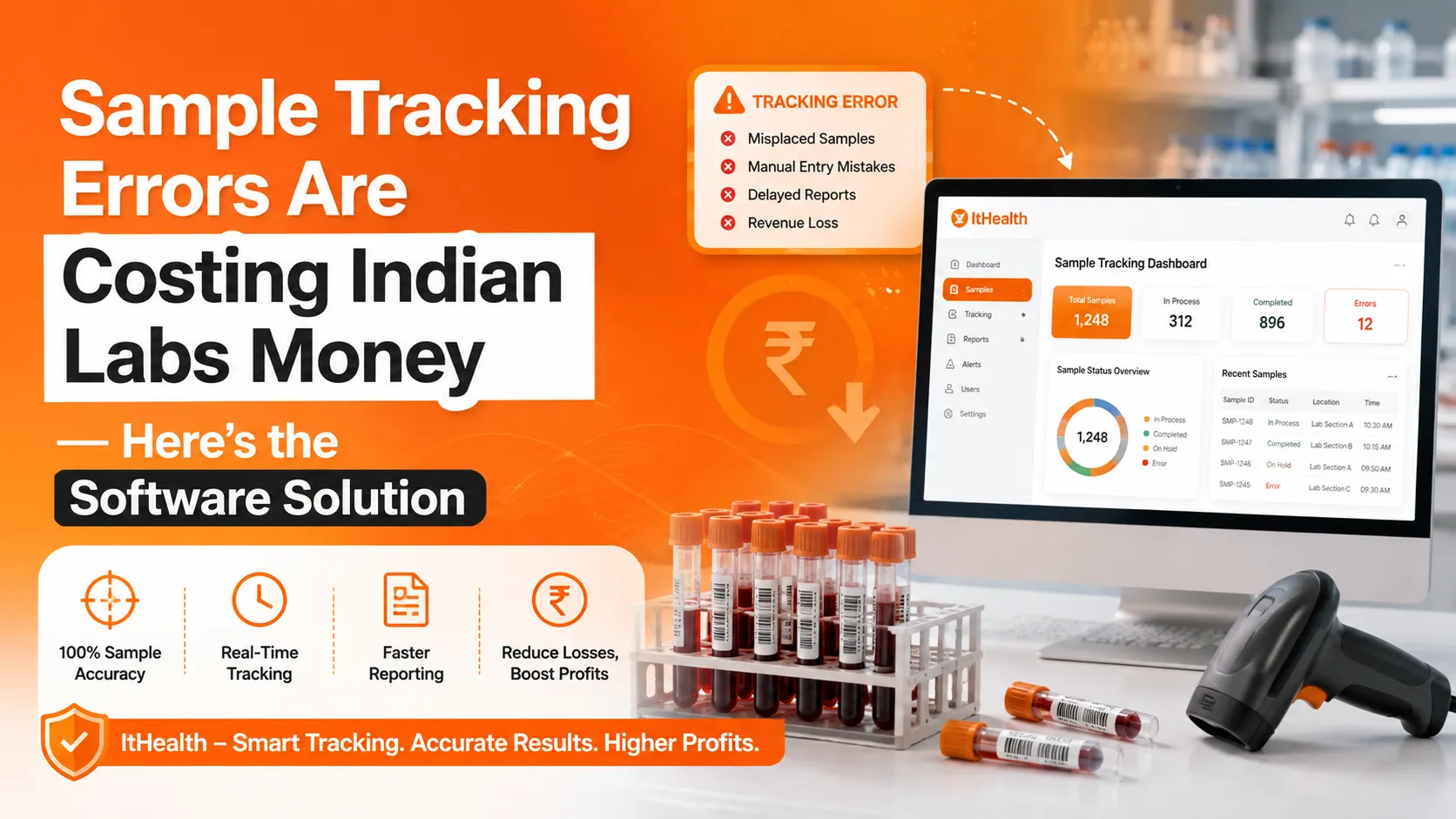

Every misplaced sample, every duplicate test, every re-collection request costs an Indian diagnostic lab more than time — it costs money, patient trust, and staff morale. Yet sample tracking remains one of the most under-addressed problems in lab operations, often treated as an unavoidable cost of doing business rather than a solvable process failure.
The truth is simpler and more actionable than most lab owners realize: sample tracking errors are almost always a symptom of manual, disconnected workflows — and they're fixable with the right system. This is exactly why demand for the best laboratory software in india has grown so quickly among lab owners who've quietly been absorbing these losses for years without naming the problem directly.
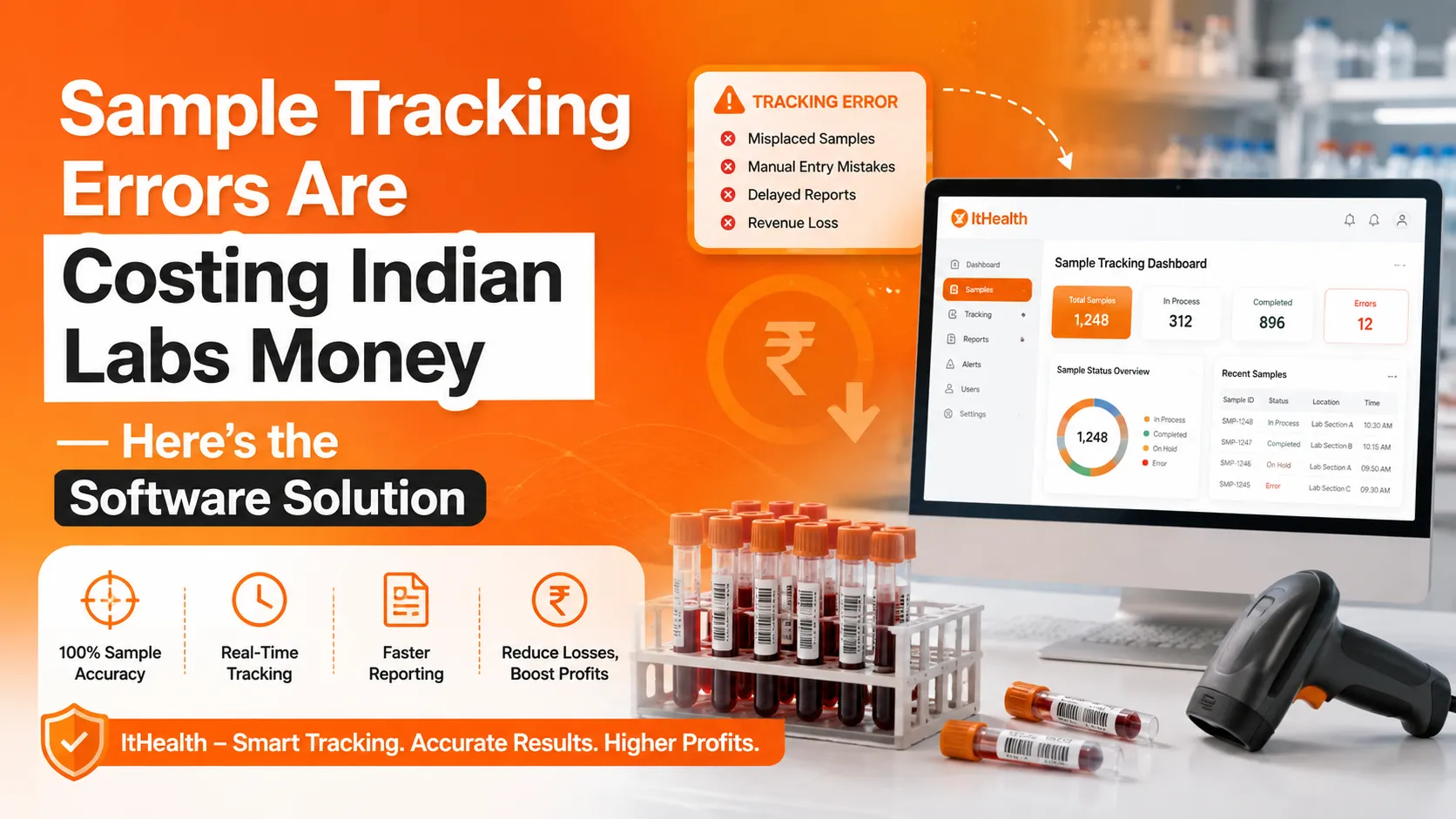
The Hidden Cost of a "Small" Tracking Error
A single mislabeled sample doesn't sound like a major issue. But trace its actual cost through a lab's operations and the picture changes:
- Re-collection costs — calling the patient back, re-drawing a sample, and repeating the test consumes staff time and reagents that were already spent once.
- Delayed reports — a lost or misidentified sample pushes turnaround time past patient expectations, often triggering complaints or refund requests.
- Reputational damage — patients rarely give feedback quietly; a bad experience with sample handling frequently ends up as a public review.
- Compliance risk — for labs pursuing or maintaining NABL accreditation, tracking errors show up as process failures during audits.
Staff time lost to manual reconciliation — technicians spending hours cross-checking registers to locate a missing sample is time not spent on actual testing.
Multiply these across even a moderate-volume lab processing hundreds of samples daily, and the financial impact becomes substantial — even if no single error feels significant in isolation.
Why Manual Tracking Fails at Scale
Most Indian labs that still rely on physical registers or basic spreadsheets aren't lacking diligent staff — they're working within a system that wasn't designed for today's volumes.
1. No real-time visibility
Once a sample leaves the collection point, its status exists only in someone's memory or a handwritten log. If that staff member is busy or unavailable, no one else can confirm where the sample stands.
2. Manual labeling errors
Handwritten labels are prone to misreads — a "7" that looks like a "1," a patient ID copied incorrectly. These small mistakes are the single largest contributor to sample mix-ups.
3. No audit trail
When something goes wrong, tracing back exactly where and when the error occurred is nearly impossible without a digital log of every handoff.
4. Disconnected departments
Collection, processing, and reporting teams often work off separate paper systems that don't sync, creating blind spots at every handoff point.
5. No accountability layer
Without a system logging who handled a sample at each stage, identifying where a process broke down — and preventing it from recurring — becomes guesswork.
This is precisely the gap that a proper diagnostic lab management software india solution is designed to close.
What a Digital Sample Tracking System Actually Fixes
Moving sample tracking from paper to software isn't just a technology upgrade — it directly targets each failure point above.
Barcode-based sample identification
Every sample receives a unique digital identifier at collection, eliminating handwriting errors entirely and making misreads virtually impossible.
Real-time status updates
As a sample moves through collection, processing, testing, and verification, its status updates automatically and is visible to every authorized staff member instantly — no phone calls, no register-flipping.
Automated handoff logging
Every stage transition is logged with a timestamp and staff identifier, creating a complete audit trail without anyone needing to manually record it.
Duplicate and mismatch alerts
Modern systems flag potential duplicate entries or mismatched patient-sample pairings before they become processing errors, catching mistakes before they compound.
Centralized dashboard visibility
Lab managers can see exactly where every sample sits in the pipeline at any given moment, making bottlenecks visible immediately rather than after a patient complaint.
Labs actively comparing the best laboratory management software in india should treat these five capabilities as the baseline, not the advanced tier — sample tracking accuracy is foundational, not optional.
The Financial Case for Fixing This Now
It's worth translating this into numbers, even roughly. A lab processing 300 samples a day with even a 2% tracking error rate is dealing with six problematic samples daily — each potentially requiring re-collection, reprocessing, or a delayed report with a frustrated patient. Over a month, that's roughly 180 incidents, each carrying a real cost in materials, staff time, and patient goodwill.
Compare that to the cost of a pathology lab software in india subscription, which typically runs as a predictable monthly cost covering the entire lab's operations — not just sample tracking. For most labs, the math favors digitization within the first few months of adoption, once re-collection costs and staff time are properly accounted for.
Features That Directly Reduce Tracking Errors
Not all lab software treats sample tracking with equal seriousness. When evaluating the best pathology software in india, look specifically for:
- Barcode/QR-based labeling integrated directly into the sample collection workflow, not added as a separate manual step.
- Stage-by-stage status tracking that updates automatically as samples move through the lab.
- Pre-test templates that reduce manual data entry errors at the point of test initiation.
- AI-assisted error flagging that catches inconsistent or unusual results before a pathologist finalizes a report.
- Multi-device access, so lab managers and pathologists can check sample status from anywhere, not just a fixed workstation.
Automated audit logs that satisfy NABL documentation requirements without extra manual paperwork.
One system built with these priorities is ItHealth by Imbibe Tech, which combines automated sample tracking with pre-test templates, AI-powered error flagging, and NABL-aligned reporting — designed specifically around the workflow patterns common in Indian diagnostic labs rather than adapted from a generic international product. It's a useful benchmark when comparing what a genuinely tracking-focused system should offer.
Beyond Tracking: The Compounding Benefit
What makes sample tracking software particularly valuable is that fixing this one problem tends to improve several others simultaneously. Once samples move reliably through a digital pipeline:
- Report turnaround time drops, because there's no time lost searching for misplaced samples.
- Billing accuracy improves, since tests are tied directly to correctly identified samples rather than manually cross-referenced.
- Compliance documentation becomes automatic, satisfying audit requirements as a natural byproduct of daily operations.
Staff morale improves, because technicians spend less time on frustrated reconciliation work and more time on actual lab tasks.
This compounding effect is a major reason labs searching for the best lims software in india find that sample tracking accuracy alone often justifies the investment before even counting the other operational gains.
How to Evaluate Vendors Specifically for Tracking Accuracy
When comparing systems, ask vendors direct, specific questions rather than relying on general feature lists:
- How are samples identified — manually or via barcode/QR? Manual entry at any stage reintroduces the exact risk you're trying to eliminate.
- Is status visibility real-time, or does it require manual refresh/reporting? Real-time visibility is what actually prevents errors, not retrospective reporting.
- What happens when a mismatch is detected? The system should flag it immediately, not surface it after a report has already been generated.
- Is the audit trail automatic? If staff have to manually log handoffs, you haven't actually solved the accountability gap.
How does the system handle multi-branch labs? If you operate more than one location, tracking needs to work consistently across all of them.
Labs serious about solving this problem should treat these questions as non-negotiable during vendor evaluation for the best path lab software in india — a system that can't answer them clearly probably wasn't built with tracking accuracy as a core priority.
Making the Switch Without Operational Disruption
Transitioning from manual to digital tracking doesn't need to happen all at once. A practical approach:
Phase 1 — Digitize sample identification and collection first, since this is where the majority of errors originate.
Phase 2 — Layer in real-time status tracking across processing and testing stages.
Phase 3 — Connect tracking data to reporting and billing, so accuracy gains compound across the full workflow.
This phased approach lets staff adapt gradually while still delivering measurable error reduction from the very first phase.
Final Thoughts
Sample tracking errors are rarely a staffing problem — they're a systems problem, and systems problems have systems solutions. For Indian diagnostic labs still relying on manual registers or disconnected spreadsheets, every tracking error carries a real, calculable cost in re-collection, delayed reports, and compliance risk.
Choosing the right best lab software in india with proper barcode-based tracking, real-time visibility, and automated audit trails isn't just an efficiency upgrade — it's a direct fix to a problem that's been quietly costing labs money for years. The laboratory management software india market has matured enough that this is no longer a difficult or expensive transition; it's simply a decision that's overdue for most labs still working off paper.























Sign in to leave a comment.