You don’t catch the problem in the factory. You catch it after installation—when a shelf dips slightly under weight, or a corner starts chipping where customers touch it the most. By then, the payment is done, the rollout is live, and your options are limited.
That’s the risk with the wrong Store Fixtures Suppliers. The mistake doesn’t show up immediately. It builds quietly.
Most teams treat Store Fixtures like a purchase decision. Compare quotes. Negotiate. Close. What gets missed is execution—how the thing is actually made, finished, packed, and delivered.
What You Think You Ordered vs What Actually Shows Up
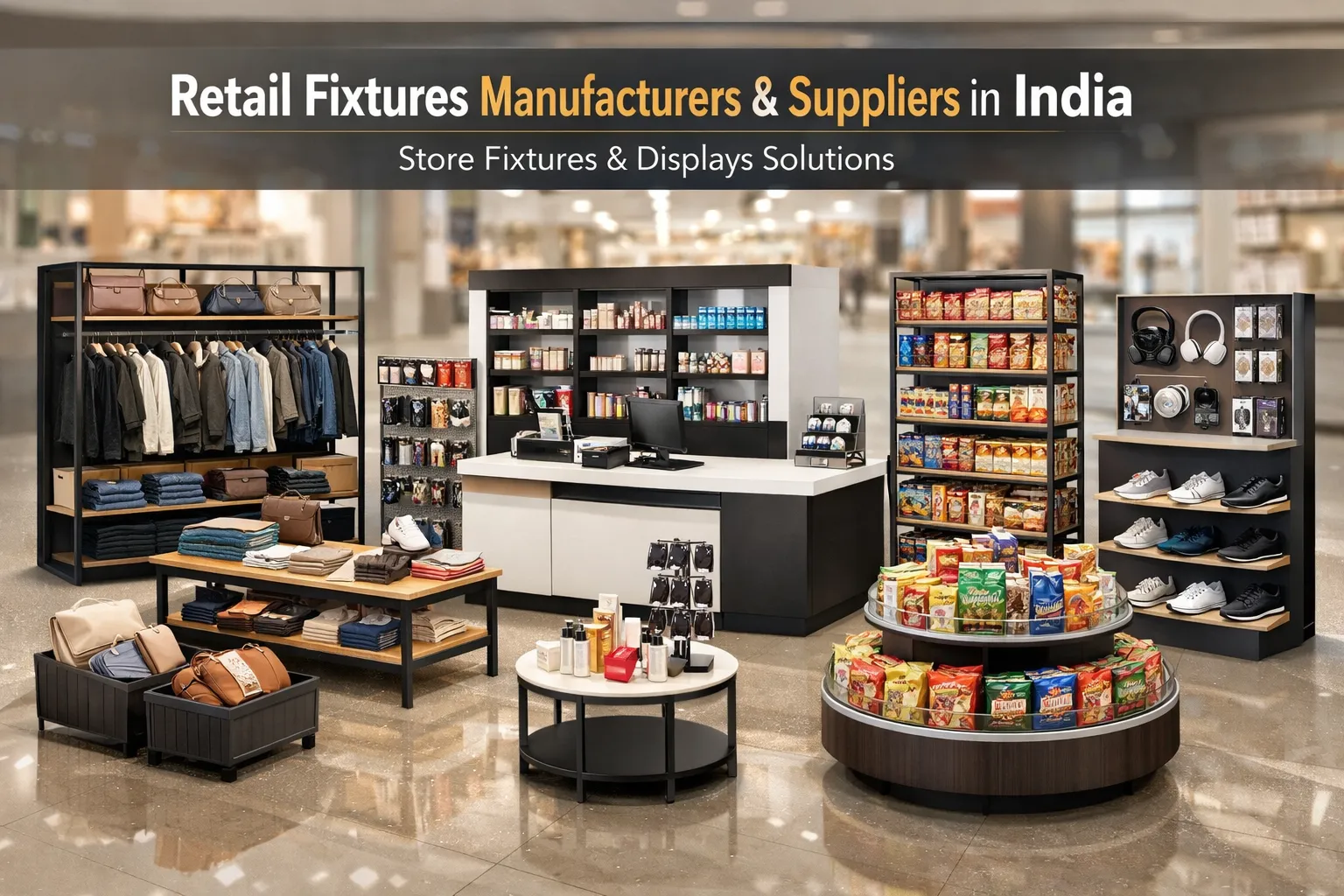
Types of Store Fixtures You’ll See Everywhere
- Gondola shelving
- Wall-mounted display panels
- Checkout and billing counters
- Modular display units
- Hybrid fixtures with digital screens
Nothing unusual here. Every supplier offers these.
Materials and Finishes (Where Problems Start)
- Powder-coated mild steel (usually quoted at 60–90 microns)
- Stainless steel (202 or 304, depending on usage)
- MDF or plywood with laminate
- Acrylic and glass
Here’s where it slips. A supplier commits to 80-micron coating. Production drops it to around 55. You won’t notice during inspection. You’ll notice after 3–4 months when high-touch areas start fading or chipping.
That gap? That’s margin loss.
Load Capacity Isn’t Always Real
- Gondola shelves: 80–120 kg claimed
- Wall fixtures: depends on installation quality
- Freestanding units: often not tested properly
Most Retail Fixtures Manufacturers don’t physically test every design. They estimate. That works—until it doesn’t.
The 5 Checks Buyers Skip (And Pay For Later)
Most sourcing mistakes aren’t dramatic. They’re small assumptions stacking up.
- Who Actually Manufactures It?
If the answer involves outsourcing, expect variation. One batch looks fine. The next doesn’t match. - What Happens When Things Go Wrong?
“We’ll see after delivery” is not a policy. It’s a delay tactic. - Can They Prove Material Quality?
No documents = no guarantee. Simple. - Was a Prototype Built?
Skipping this step saves time upfront. It costs more later when issues repeat across 200 units. - Do They Have Real Project History?
“We’ve done similar work” means nothing without specifics.
And yet, deadlines push teams to ignore at least one of these. That’s usually enough to create problems.
What the Right Supplier Actually Fixes
- Fewer Replacements
Good Store Fixtures hold up for years. Weak ones don’t survive the first cycle. - Stable Timelines
Reliable Store Fixtures Suppliers don’t keep shifting dispatch dates. That alone saves weeks. - Consistent Store Look
Slight variation in finish or size doesn’t sound serious—until you see two stores side by side. - Less Operational Noise
Repairs, adjustments, complaints—they all reduce when fixtures are built right. - Ability to Scale Orders
Strong Store Fixtures Manufacturers in India handle volume without changing quality. - Better Product Visibility
Fixtures influence how products are seen. Bad design or build reduces impact.
This isn’t about aesthetics. It’s about performance.
Why Location Still Matters More Than People Admit
Everyone talks about price. Fewer people talk about distance.
There are plenty of Store Fixtures Suppliers across India, but clusters like NCR, Mumbai, and Bengaluru dominate for a reason—supply chain access, labor, and logistics.
That’s also why many Retail Fixtures Dealers sit close to factories, not retail areas.
Here’s the part that surprises first-time buyers:
Shifting to a supplier closer to your warehouse can cut logistics cost by around 6–8% annually. Over multiple shipments, that’s not small money.
In North India, especially NCR, a lot of Retail Fixtures Manufacturers handle both domestic and export orders. That usually forces better discipline in production.
About Us
We’ve seen fixture projects go wrong—not in design, but in execution. That’s where most issues hide. At Defos Design, we keep manufacturing in-house so we don’t lose control between stages.
In 2021, three separate clients flagged coating fade within months. Same issue, different locations. We traced it back to a powder batch, replaced the supplier, and updated specs across all orders. It cost us in the short term, but we didn’t repeat the mistake.
That’s the difference—fixing once versus explaining repeatedly.
If you’re comparing Store Fixtures Suppliers, don’t just ask for pricing.
Send:
- Drawings or references
- Quantity details
- Load expectations
- Delivery timeline
We’ll respond within 24 hours. MOQ starts at 50 units depending on the design. Reach out to Defos Design before you lock the order—it’s easier to fix things now than after delivery.
Conclusion
Bad Store Fixtures Suppliers don’t fail instantly—they fail slowly, and usually after you’ve committed. The right partner keeps your rollout steady and your costs predictable. Choose based on how they work, not just what they quote.
FAQs
1. How do I identify reliable Store Fixtures Suppliers?
Check if they actually manufacture. Many Store Fixtures Suppliers are just intermediaries.
2. Are Store Fixtures Manufacturers in India good for bulk orders?
Yes, but only some. The stronger Store Fixtures Manufacturers in India will show clear proof of capacity and consistency.
3. How long do Store Fixtures last?
Typically 3–5 years. Poor build quality can reduce that drastically.
4. Do Retail Fixtures Manufacturers handle custom designs well?
Some do. Some just modify existing designs and call it custom. You need to verify.
5. What MOQ should I expect?
Most Store Fixtures Suppliers start around 50–100 units. Smaller orders cost more per piece.
6. How do I avoid quality issues?
Check samples—but don’t rely on them alone. Bulk production often tells a different story.

























Sign in to leave a comment.