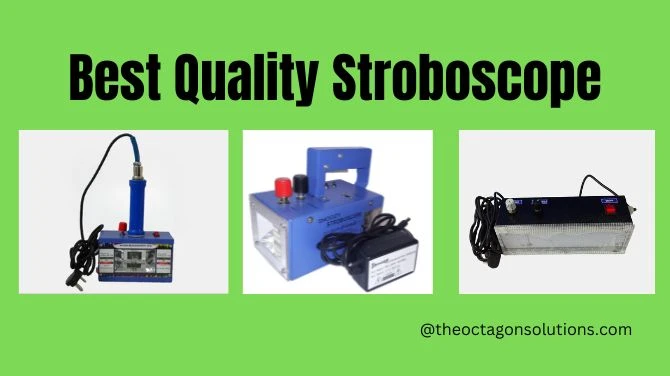

A stroboscope for industrial use is a specialised and versatile tool used in a variety of manufacturing and maintenance applications. It is designed to create the illusion of "slow motion" by shining a bright, high-intensity light at specific intervals. This rapid pulse of light allows users to freeze or slow down the speed of reciprocating machinery, making it appear to be moving at a constant or slow speed.
The primary purpose of an industrial stroboscope is to facilitate the inspection, analysis, and adjustment of fast-moving parts in machinery. By synchronising the flash rate of the stroboscope with the rotational or oscillatory motion of the device being viewed, operators can identify potential issues such as misalignment, imbalance or irregular motion. This helps prevent costly downtime, improve machine performance and ensure personnel safety.
Industrial stroboscopes often come with adjustable flash rates, intensity levels, and various accessories such as trigger inputs and external sensors for precise timing and data acquisition. They are commonly used in industries such as manufacturing, automotive, aviation, textile, etc., where accurate observation of fast-moving components is critical for efficient operation and maintenance.
What is Stroboscope
A stroboscope is a device used to study and visualize the motion of fast moving objects or machinery. It works by emitting short, intense bursts of light at regular intervals, creating the illusion of "freezing" or slowing down. By adjusting the flash rate to match the frequency of the moving object, the stroboscope allows detailed inspection, analysis, and adjustment of machinery. It finds applications in industries such as manufacturing, maintenance, automotive and research where precise observation of fast-moving components is essential for diagnosing problems and ensuring optimum performance.
Who Stroboscope work
The stroboscope works on the basis of the concept of persistence of vision. When an object is illuminated by short bursts of light at regular intervals, our eyes retain an afterimage of the object for a brief moment. If the flashing rate of the stroboscope is synchronized with the frequency of the object's motion, the object will appear to slow down, stop, or move in a controlled manner.
For example, imagine a rotating fan with three blades. When the flash rate of the stroboscope matches the speed of the rotating fan, the fan blades will appear stationary or move slowly, allowing observers to see the position of the blades more clearly.
The stroboscope's ability to control the apparent speed of motion makes it a valuable tool in a variety of fields, including industrial machinery maintenance, vibration analysis, motion analysis in sports, and research applications. By stabilizing or slowing down high-speed movements, the stroboscope enables precise inspection and troubleshooting of machinery and equipment.
Types of Stroboscope
Stroboscopes come in a variety of types and designs, each serving specific needs and applications. Here are some common types of stroboscopes:
Analog Stroboscope: Traditional stroboscope with mechanical controls and analog display. They usually have a rotating disc with slits that can be manually adjusted to control the flash rate.Digital Stroboscope: Modern stroboscope with digital display and controls. They offer more precise adjustments for flash rate and other settings.Xenon stroboscope: Stroboscopes that use a xenon lamp as their light source. Xenon stroboscopes are known for their bright and intense brightness, making them suitable for high speed applications.LED Stroboscope: Stroboscopes that use light-emitting diodes (LEDs) for illumination. LED strobes are energy-efficient, have a long lifespan, and offer adjustable brightness levels.Portable Stroboscope: Compact and lightweight stroboscope designed for easy transport and applications on the go. They are convenient for fieldwork and inspection.Handheld Stroboscope: Stroboscopes are designed to be held and operated with one hand, providing greater flexibility and ease of use.Benchtop Stroboscope: A stroboscope designed for stationary use on a workbench or in a fixed location. They often have more advanced features and higher performance than portable models.Wireless stroboscope: A stroboscope equipped with wireless connectivity for data transfer, remote control, or synchronization with other devices or systems.High-Speed Stroboscope: Special stroboscopes capable of producing extremely intense flashes are suitable for analyzing ultra-high-speed motion and processes.Video stroboscope: The stroboscope, equipped with video recording capabilities, allows users to capture and analyze motion over time.
Each type of stroboscope has its own advantages and specific use cases, ranging from basic visual inspection to precise motion analysis in a variety of industrial, research, and entertainment settings. The choice of stroboscope depends on factors such as the application, features required, budget, and the environmental conditions in which it will be used.
























Sign in to leave a comment.