

Struggling to Combine CRM, ERP, and Product Data? Fix Your Data Engineering Layer
Ever tried answering a simple business question like:
“Which customers bring the most revenue and actually use our product the most?”
It sounds straightforward. But for many companies, the answer is surprisingly difficult to find.
Sales data lives in the CRM. Financial information sits inside the ERP system. Product usage data is stored somewhere else entirely. To get a complete picture, teams often end up exporting spreadsheets, merging files, and trying to make sense of disconnected reports.
At that point, the issue isn’t the tools themselves.
The real problem is the data engineering layer connecting them.
Without a strong data foundation, even the best platforms struggle to work together.
Why CRM, ERP, and Product Data Don’t Easily Align
Most businesses adopt new systems gradually. A CRM is added to manage leads and deals. Later, an ERP handles finance and operations. Product analytics tools start collecting user behavior.
All systems are adequately performing their tasks, but they are not usually created to integrate with each other.
That’s where problems begin.
Data Lives in Separate Silos
CRM platforms focus on customer relationships and deals. ERP systems track invoices, payments, and operations. Product platforms record usage events and activity logs.
Individually, the data is useful. However, when it remains alone, it is hard to know the whole customer journey.
To illustrate, a company may have the information on the deals that were closed in the CRM yet fail to associate the information with the revenue in the ERP or actual product interaction.
This is where data engineering comes into play, namely, assembling those datasets in an ordered manner.
Reports Begin to Tell Dissimilar Stories.
Reporting becomes irregular when using a manual export or partial integration by teams.
The sales dashboards can indicate a single number with the finance reports indicating a different one. Product teams may follow user activity, but are not informed of what accounts will bring revenue.
This confusion is usually as a result of incompatibility in definitions and system transformations. Considerate data engineering design will make sure that data of the different sources are structured and logic-wise identical at the analytics layer.
Insights Arrive Too Late
Slow reporting is another similar problem.
Data combination in many organizations continues to run batch jobs or manual jobs that are executed one or twice a day. Dashboards are updated when it is too late.
In the situation when the leaders require up to date information about sales performance or product interaction, any delays in data transfer turn into a business hazard.
Why the Data Engineering Layer Matters
Consider the data engineering layer as the interconnect of all your business systems.
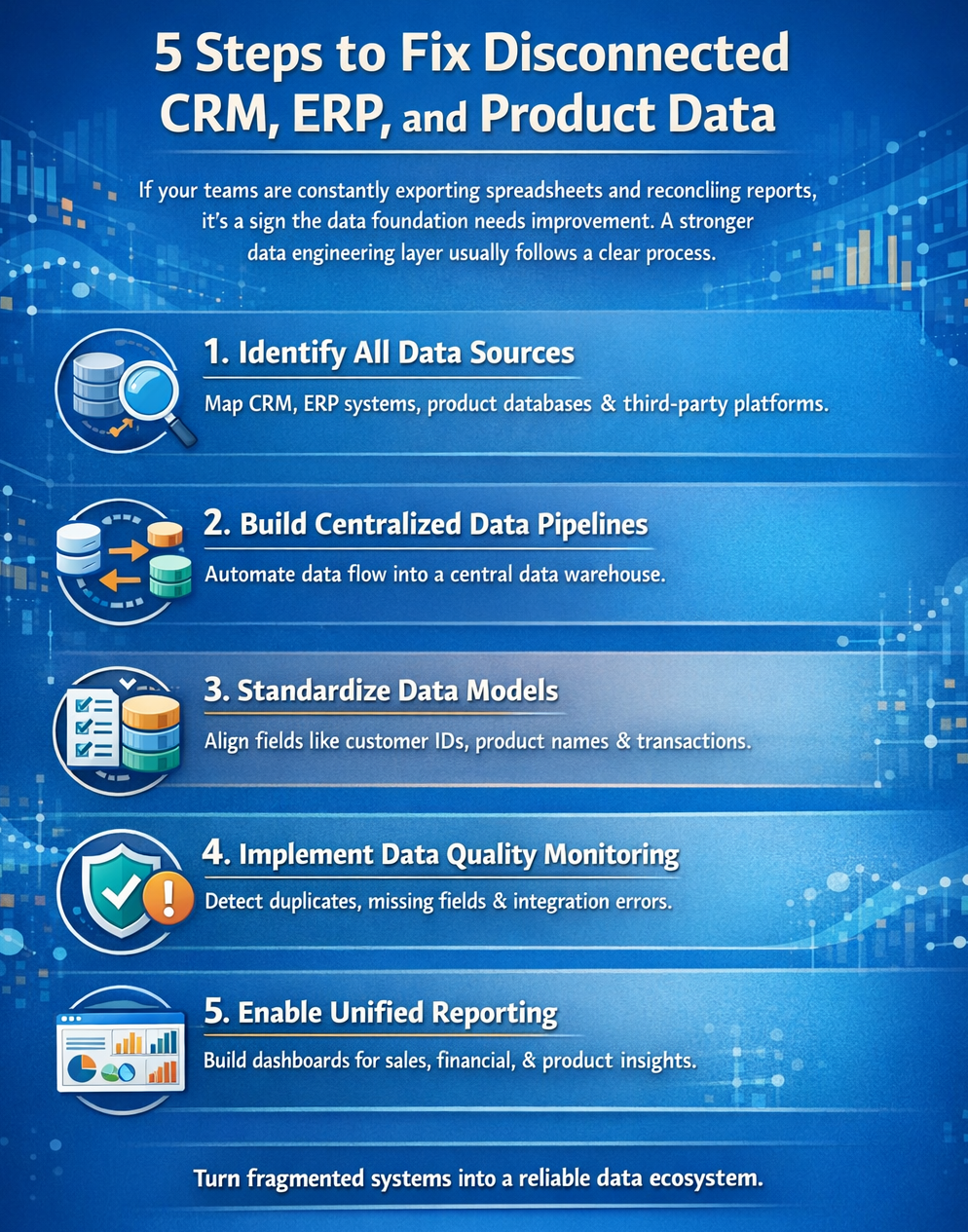
Rather than manually transferring data, automated pipelines are used to retrieve information on the CRM, ERP, and product platforms and migrate it to a central environment to be analyzed.
After that is in place, teams do not take hours to reconcile spreadsheets. They can rely on consistent, unified data.
A well-designed data engineering solution focuses on three important things: reliability, structure, and visibility.
What Strong Data Integration Actually Looks Like
Organizations that successfully combine CRM, ERP, and product data usually build a data architecture designed for scale.
Here are some elements that make a big difference.
Automated Data Pipelines
Rather than exporting data manually, automated pipelines continuously move information between systems and the central data platform.
This ensures dashboards and reports always reflect the latest activity.
Consistent Data Transformation
Data coming from different systems rarely fits together perfectly.
Customer IDs may be different in the CRM and ERP. Product identifiers might follow different naming patterns.
Data must be cleaned and put in a proper format before it can be useful in analytics. This is where data engineers come up with rules of transformation that normalize records across platforms.
Built-In Data Quality Checks
When numerous platforms are interconnected, mistakes can easily propagate in case they are not tracked.
Modern data architectures include validation checks that detect issues like duplicate records, missing fields, or mismatched IDs before they affect reports.
These safeguards keep business data trustworthy.
Scalable Infrastructure
As companies grow, the volume of CRM transactions, financial records, and product events increases rapidly.
Without scalable pipelines, integrations can slow down or break entirely. A reliable data engineering solution ensures the system continues working smoothly as new data sources and higher volumes are introduced.
The Real Benefit: Seeing the Full Customer Story
When CRM, ERP, and product data finally come together, something powerful happens.
Sales teams understand which customers generate long-term value. Finance gains visibility into revenue tied to actual product engagement. Product teams can analyze how usage affects renewals and upgrades.
Instead of looking at disconnected metrics, organizations start seeing the complete customer lifecycle.
And that’s where real insights begin.
Fix the Layer That Connects Everything
Many companies believe their reporting problems come from missing dashboards or analytics tools.
But more often, the real issue is the missing data engineering foundation that connects their systems.
CRM, ERP, and product platforms are powerful individually. Their true value appears when their data flows together seamlessly.
Strengthening that layer doesn’t just improve reporting—it gives the entire organization a clearer, more reliable view of the business.
And in a world driven by data, that clarity becomes a serious competitive advantage.


























Sign in to leave a comment.