
Migrating to the cloud sounds simple: move your servers, databases, and applications to a cloud provider, and voilà you’re “modernized.” In reality, most cloud migrations fail, not because of the technology, but because businesses focus on infrastructure first and workflow later.
Here’s the problem: companies often lift-and-shift their infrastructure without analyzing how their workflows actually operate. They move servers, storage, and apps “as-is” to the cloud, expecting immediate performance gains. But cloud environments are not identical to on-premises setups. Without mapping workflows, dependencies, and data flows, migrations can create more problems than they solve.
This is where cloud migration engineering services come in; they not only move your infrastructure but ensure that workflows are optimized for cloud performance.
The Hidden Risks of Moving Infra First
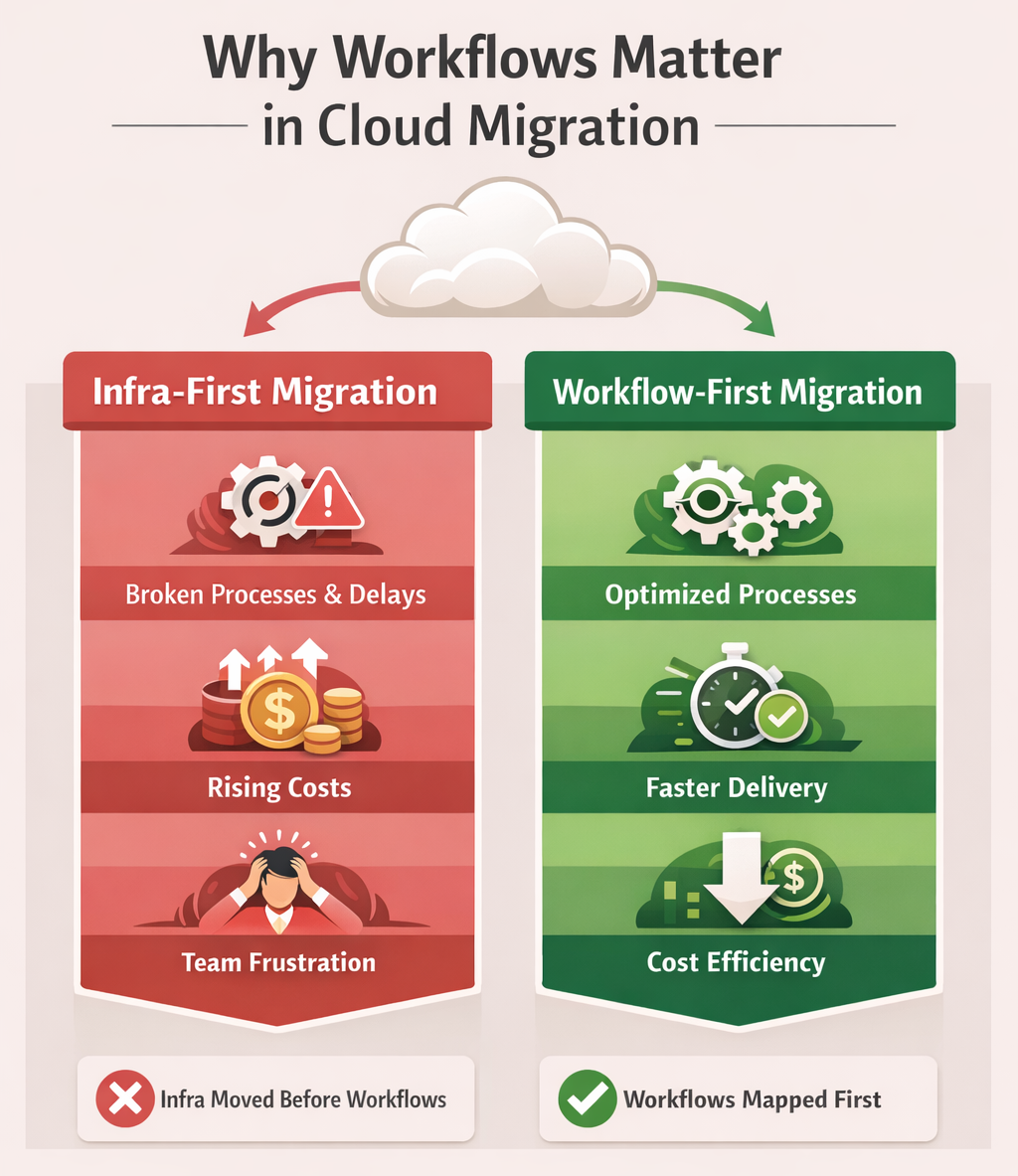
- Workflow Bottlenecks: Infrastructure might be fully functional in the cloud, but workflows often rely on specific configurations, sequence of processes, and integrations. When these aren’t optimized for the cloud, critical tasks slow down, break, or fail entirely.
- Increased Costs Without Benefits: Cloud providers charge for usage. If workflows are inefficient post-migration, you’re paying more for underutilized resources or repetitive tasks, defeating the purpose of migrating.
- Employee Frustration and Productivity Loss: Teams accustomed to existing processes may struggle with workflow disruptions. When approvals, data processing, or reporting lag due to misaligned cloud workflows, frustration spikes—and so does downtime.
- Data Integrity Issues: Many workflows involve multiple systems and touchpoints. Moving infrastructure without reviewing these interactions can result in broken integrations or inconsistent data, affecting decision-making.
A Better Approach: Workflows First
Instead of starting with infrastructure, map out your workflows before migration. Ask questions like:
- Which processes are mission-critical?
- Where do dependencies exist between systems?
- Which workflows can be automated or optimized for the cloud?
Once workflows are fully mapped and optimized, infrastructure can be migrated in a way that supports these processes rather than breaking them. This is where cloud engineering solutions make a difference ensuring the infrastructure, workflows, and automation are fully aligned.
Real-World Example
A mid-sized finance company attempted to migrate its on-prem ERP system to a cloud provider. They moved the servers first and tried running their existing workflows in the cloud. The result?
- Reports took 3x longer to generate
- Data reconciliation failed across departments
- Cloud costs spiked due to repeated processes
After involving cloud migration engineering services, they restructured approval chains and automated repetitive tasks. Post-migration, report generation became faster than ever, and cloud costs dropped by 25%.
Key Takeaways
- Don’t move infrastructure first. Understand workflows before touching servers or storage.
- Map dependencies. Identify where processes interact and how data flows across systems.
- Optimize for the cloud. Use cloud engineering solutions and automation to make workflows faster and cheaper.
- Involve experts. Cloud migration engineers prevent pitfalls by combining infrastructure expertise with workflow insights.
Cloud migration isn’t just a tech upgrade, it's a workflow transformation. Companies that ignore workflow mapping risk inefficiency, higher costs, and frustrated teams. Those who prioritize workflows first, on the other hand, unlock the true power of the cloud.


















Sign in to leave a comment.