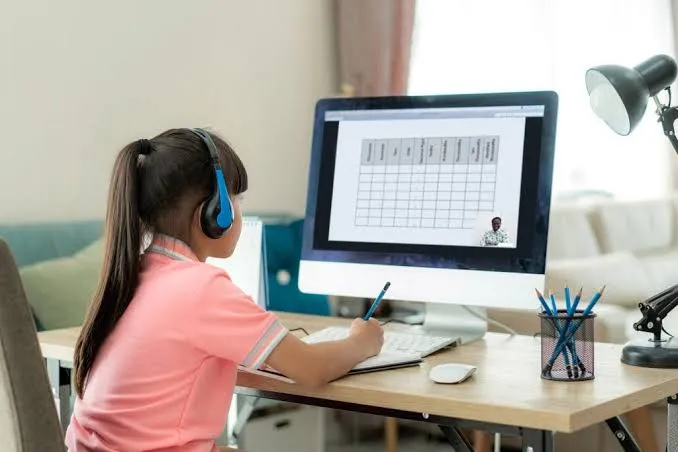

If you've ever sat staring at a page of algebra wondering why none of it makes sense, you're not alone. Thousands of students hit the same wall every year with GCSE Maths and often, it's not because they're "bad at maths." It's because the traditional classroom approach doesn't work for everyone. This is exactly where an online GCSE maths tutor can make all the difference.

Unlike a packed classroom where one teacher has to move at the pace of thirty different students, online tutoring is built around you. And that single shift from group pace to individual pace changes everything.
Let's break down what online tutors actually do differently, and why it's not just maths that benefits, but science and even practical skills like Excel too.
1. They Diagnose Before They Teach
A good online GCSE maths tutor doesn't just jump into a topic and start explaining. They start by figuring out where the gap actually is. Is it a misunderstanding from Year 8 that's been quietly causing problems ever since? Is it exam technique rather than actual knowledge? Is it confidence, not competence?
Classroom teachers rarely have time to diagnose individual gaps this precisely they're managing an entire room. Online tutors, working one-to-one, can ask questions, watch how a student works through a problem in real time, and pinpoint exactly where things go wrong. That precision means less time wasted re-teaching things a student already understands, and more time spent where it actually matters.
2. They Adjust the Pace in Real Time
In a classroom, if a student needs five extra minutes on quadratic equations, the lesson can't simply pause. Everyone moves on together. Online tutoring flips this completely. If a concept needs to be repeated three different ways before it clicks, that's exactly what happens.
This is especially valuable for GCSE Maths, which builds heavily on prior knowledge. If foundational algebra isn't solid, everything from simultaneous equations to trigonometry becomes shakier. A tutor who can slow down, rebuild the foundation, and then speed back up prevents small cracks from turning into major gaps by exam season.
3. They Use Visual and Interactive Tools
Screen-sharing, digital whiteboards, and interactive problem-solving are now standard in online tutoring — and they often explain concepts more clearly than a static textbook page ever could. Watching a graph shift in real time as variables change, or seeing a geometry problem broken into color-coded steps, gives students a different way to see the maths, not just read about it.
This visual approach isn't unique to maths, either. It's just as powerful across science subjects.
Triple Science GCSE: Where One-to-One Support Really Pays Off
Triple science GCSE — Biology, Chemistry, and Physics as three separate qualifications — is content-heavy and demands a level of depth that combined science simply doesn't require. Many students choose triple science because they're considering A-Levels in a science subject, or because they simply enjoy the subjects. But the jump in workload can catch students off guard.
Online tutors specializing in triple science don't just help with revision — they help students build the kind of scientific thinking examiners are looking for: interpreting data, applying concepts to unfamiliar scenarios, and structuring six-mark extended answers properly. These are skills that are hard to develop through memorization alone, and they're exactly what one-to-one guidance is best at building.
Core Science and GCSE Core Science: Building the Right Foundations
For students taking GCSE core science (or combined science), the challenge is different. The content spans biology, chemistry, and physics but at a broader, more condensed level. Because everything moves faster, gaps can form quickly and quietly.
Core science tutoring focuses on making sure students genuinely understand the big-picture concepts — cells, forces, chemical reactions, energy transfer — rather than trying to memorize disconnected facts. A tutor who can connect ideas across topics (for example, showing how energy concepts in physics link to energy transfer in biology) helps students retain information far more effectively than rote learning ever could.
This is another area where online tutors shine: they can pull together resources, practice questions, and past papers instantly, tailoring each session to whichever topic needs the most attention that week.
Why Personalization Beats "One-Size-Fits-All" Every Time
Here's the core idea behind almost everything above: personalization. Whether it's maths, triple science, or core science, the biggest advantage online tutoring offers is the ability to adapt entirely around one student's needs, pace, and learning style.
A tutor might notice that a student struggles more with wording in exam questions than with the underlying maths itself — something a busy classroom teacher might never catch, but something a private tutor sees immediately, session after session.
This kind of tailored attention consistently shows up in improved grades, but perhaps more importantly, in confidence. Students who felt lost in a subject often come out the other side of consistent, personalized tutoring saying the same thing: "It finally makes sense."
It's Not Just Academic Subjects — Practical Skills Matter Too
While GCSEs open academic doors, practical skills open career ones. This is where private Excel tutors come into the picture, and why more parents and students are seeking this kind of support alongside academic tutoring.
Excel isn't taught in depth at GCSE level, yet it's one of the most widely used tools in further education, apprenticeships, and almost every office-based career. Understanding formulas, pivot tables, and data analysis gives students a genuine head start — something that looks great on a CV and translates directly into real-world usefulness.
Private Excel tutors work the same way academic tutors do: one-to-one, hands-on, and tailored to the learner's current skill level. Whether a student wants to get ahead before starting a business course, or a parent wants their child to build practical skills over the summer, this kind of tutoring bridges the gap between "textbook learning" and "real-world readiness."
What All of These Tutoring Approaches Have in Common
Whether it's an online GCSE maths tutor helping untangle algebra, a triple science tutor building strong scientific reasoning, a core science tutor connecting the dots across subjects, or a private Excel tutor building spreadsheet fluency — they all share the same underlying philosophy:
- Meet the student where they are, not where a syllabus assumes they should be.
- Diagnose the actual gap, rather than guessing or re-teaching everything from scratch.
- Adapt pace and method to how the individual learns best.
- Build confidence alongside knowledge, because students who believe they can understand a subject engage with it far more effectively.
Final Thoughts
Being stuck on GCSE Maths or Triple Science, or Core Science doesn't mean a student isn't capable. More often than not, it just means the teaching method hasn't matched their learning style yet. Online tutoring closes that gap in a way traditional classroom settings often can't, offering the flexibility, personalization, and pace-adjustment that makes concepts finally click.
And with practical skills like Excel becoming increasingly valuable outside the classroom, pairing academic tutoring with real-world skill-building sets students up not just to pass their GCSEs, but to walk away genuinely prepared for what comes next.
If you've been feeling stuck, it might not be about working harder it might just be about finding a tutor who works with how you actually learn.





























Sign in to leave a comment.