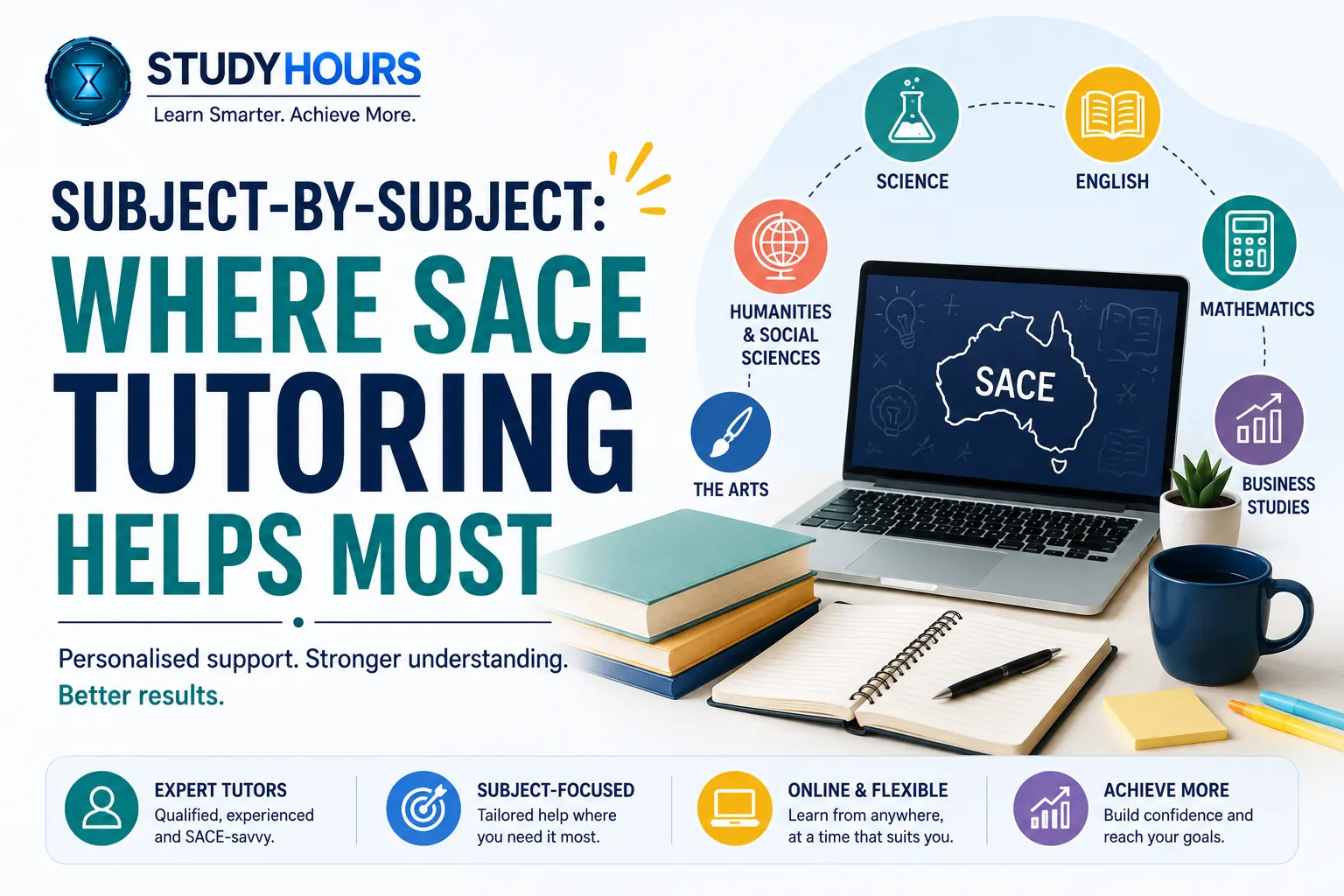

Not every SACE subject presents the same challenges, and tutoring support is most effective when it's tailored to how each subject is actually assessed. Here's a breakdown of where targeted tutoring tends to have the biggest impact.
Mathematics (General, Methods, Specialist)
SACE Maths subjects combine exam performance with folio-style investigations. Students often lose marks not from lacking knowledge, but from poor setting-out, missing working, or misreading command terms like "justify" or "evaluate". A tutor who drills exam technique alongside content — not just content alone — tends to produce the biggest score improvements.
English and English Literary Studies
These subjects reward structured, evidence-based analysis rather than raw opinion. Many students genuinely understand a text but struggle to translate that understanding into a high-scoring written response. Tutoring here often focuses on:
- Building strong thesis-driven paragraphs
- Using textual evidence precisely, not just quoting
- Practising timed essay writing under exam conditions
Sciences (Biology, Chemistry, Physics)
Science subjects blend theoretical exams with practical investigations and scientific reports. Common weak points include applying formulas to unfamiliar scenarios and writing scientifically rigorous conclusions. Tutors who work through past SACE exam papers question-by-question tend to build the pattern-recognition skills students need under time pressure.
Research Project (Stage 2)
The research project is unlike any other SACE subject — it's entirely self-directed. Many students underestimate how much structure and accountability it requires. Here, a tutor's role shifts from "teaching content" to project management: helping students set milestones, refine their research question, and critically evaluate their own evidence.
Humanities (History, Society & Culture, Legal Studies)
These subjects reward analytical writing and the ability to weigh multiple perspectives. Tutoring support typically centres on argument construction, source evaluation, and avoiding the common trap of purely descriptive (rather than analytical) writing.
The Common Thread
Across every subject, the same pattern holds: SACE rewards students who can demonstrate their thinking clearly against specific performance standards. Subject-specific tutoring works because it teaches students not just what to know, but how to show what they know in the way SACE markers are trained to assess it.

































Sign in to leave a comment.