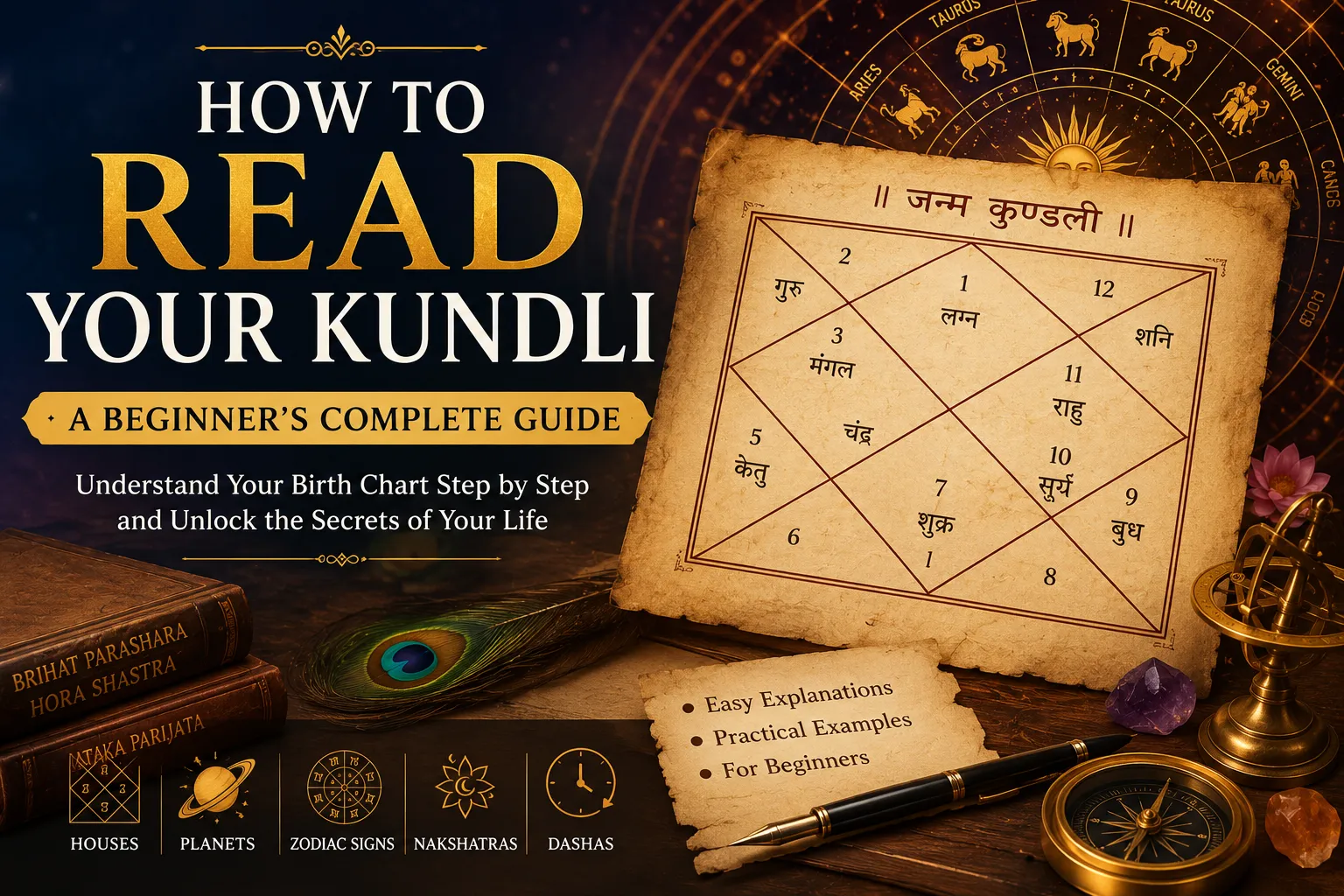

A Kundli, also known as a Janam Kundli or birth chart, is one of the most important foundations of Vedic astrology. It is a detailed astrological chart created using a person's date, exact time, and place of birth. By studying the Kundli, a Vedic astrologer can traditionally analyze different areas of life, including personality, career, relationships, finances, education, and important life periods.
For beginners, looking at a Kundli can seem complicated because it contains zodiac signs, houses, planets, Nakshatras, and various symbols. However, once you understand the basic structure, reading a Kundli becomes much easier.
If you are interested in learning more about Vedic astrology and personalized astrological guidance, visit AstroWizard for more information and astrology services.
This guide explains how to read a Kundli step by step and understand the major elements used in Vedic astrology.
What Is a Kundli?
A Kundli is a representation of the planetary positions at the exact moment a person was born.
To prepare a Kundli, three important pieces of information are generally required:
- Date of birth
- Exact time of birth
- Place of birth
These details help calculate the Ascendant, planetary positions, houses, Moon sign, Nakshatra, and other important components of the birth chart.
In Vedic astrology, the Kundli is not interpreted based on one planet or zodiac sign alone. Astrologers generally consider multiple factors together before reaching an interpretation.
Why Is a Kundli Important in Vedic Astrology?
A Kundli provides a framework for studying different areas of life.
It may traditionally be examined for:
- Personality and behavior
- Career and profession
- Marriage and relationships
- Education
- Wealth and finances
- Family life
- Health-related tendencies
- Spiritual development
- Major life transitions
- Planetary periods
The same birth chart can also be examined from different perspectives depending on the question being asked.
Step 1: Find the Ascendant or Lagna
The first thing beginners should identify in a Vedic Kundli is the Lagna, or Ascendant.
The Ascendant is the zodiac sign rising on the eastern horizon at the time of birth. It becomes the starting point for arranging the twelve houses.
The Lagna is traditionally associated with:
- Personality
- Physical appearance
- Individual identity
- General behavior
- Vitality
- Approach toward life
For example, if Aries is the Ascendant, Aries becomes the first house. The remaining signs then follow in their natural zodiacal order.
The Ascendant is especially important because changing the birth time can sometimes change the Ascendant and therefore alter the house structure of the chart.
Step 2: Understand the Twelve Houses
A Kundli contains twelve houses, and each house represents a different area of life.
1st House – Self
The first house represents the individual, personality, appearance, confidence, and general life direction.
2nd House – Wealth and Family
The second house is traditionally associated with family, accumulated wealth, speech, food, and personal values.
3rd House – Communication and Courage
This house represents communication, courage, skills, siblings, short journeys, and personal initiative.
4th House – Home and Happiness
The fourth house relates to home, property, mother, education, emotional security, and domestic happiness.
5th House – Creativity and Intelligence
The fifth house is associated with intelligence, creativity, children, romance, education, and self-expression.
6th House – Challenges and Service
The sixth house traditionally represents work, service, competition, debts, obstacles, and health-related matters.
7th House – Marriage and Partnerships
The seventh house is one of the most important houses for relationships. It is traditionally associated with marriage, partnerships, business relationships, and one-to-one connections.
8th House – Transformation
The eighth house relates to transformation, sudden changes, inheritance, shared resources, and hidden matters.
9th House – Fortune and Higher Knowledge
The ninth house is traditionally connected with higher education, philosophy, spirituality, teachers, long-distance travel, and dharma.
10th House – Career
The tenth house is particularly important when analyzing career and professional life. It represents occupation, achievements, authority, reputation, and public responsibilities.
11th House – Income and Gains
The eleventh house is associated with income, gains, friendships, social networks, ambitions, and fulfillment of desires.
12th House – Expenses and Spirituality
The twelfth house traditionally represents expenses, foreign connections, isolation, retreat, sleep, and spiritual or introspective themes.
Step 3: Identify the Planets
The next step is to identify which planets are located in each house.
Vedic astrology traditionally works with nine major Grahas:
- Sun
- Moon
- Mars
- Mercury
- Jupiter
- Venus
- Saturn
- Rahu
- Ketu
Each planet represents different qualities and themes.
Sun
The Sun is traditionally associated with confidence, identity, authority, leadership, and vitality.
Moon
The Moon represents emotions, mental tendencies, sensitivity, habits, and inner experiences.
Mars
Mars is associated with energy, courage, initiative, competition, and determination.
Mercury
Mercury represents communication, intelligence, analytical thinking, learning, and business skills.
Jupiter
Jupiter is traditionally associated with wisdom, knowledge, expansion, teaching, optimism, and guidance.
Venus
Venus represents relationships, beauty, comfort, creativity, enjoyment, and artistic interests.
Saturn
Saturn is associated with discipline, responsibility, patience, structure, hard work, and long-term development.
Rahu
Rahu is traditionally associated with ambition, material desires, unconventional experiences, and areas where a person may seek expansion.
Ketu
Ketu is associated with detachment, introspection, spirituality, and experiences connected with letting go.
A planet's meaning changes depending on its house, zodiac sign, strength, relationships with other planets, and the overall chart.
Step 4: Understand the Zodiac Signs
The twelve zodiac signs are another important part of a Kundli.
They are:
- Aries
- Taurus
- Gemini
- Cancer
- Leo
- Virgo
- Libra
- Scorpio
- Sagittarius
- Capricorn
- Aquarius
- Pisces
The sign describes the style or quality through which a planet operates, while the house indicates the area of life where that energy is expressed.
For example, Venus in a particular sign may be interpreted differently from Venus in another sign. Similarly, Venus in the seventh house has a different traditional significance from Venus in the tenth house.
This is why reading only a zodiac sign is not enough to understand an entire Kundli.
Step 5: Examine the Moon Sign
The Moon sign, known as Chandra Rashi, is an important component of Vedic astrology.
The Moon is traditionally associated with the mind, emotions, habits, feelings, and psychological tendencies.
The Moon's position can therefore provide additional insight into how a person responds emotionally and processes experiences.
Two people can have the same Ascendant but different Moon signs, resulting in different emotional patterns according to traditional astrology.
Step 6: Find the Janma Nakshatra
The Moon's position also determines the person's Janma Nakshatra, or birth Nakshatra.
Vedic astrology traditionally recognizes 27 Nakshatras. Each has its own symbolism, planetary ruler, and characteristics.
Nakshatras are used in several areas of Jyotish, including:
- Personality interpretation
- Compatibility analysis
- Timing techniques
- Dasha calculations
- Traditional naming practices
Understanding the Nakshatra can add another layer of interpretation beyond the zodiac sign.
Step 7: Study the Planetary Lords
Every house in a Kundli has a ruling planet based on the zodiac sign occupying that house.
The planet ruling a house is called its house lord.
For example, if Taurus occupies the tenth house, Venus becomes the tenth-house lord because Venus traditionally rules Taurus.
The placement of that house lord is important because it connects different areas of life.
This is one reason professional Vedic astrologers do not interpret houses independently.
Step 8: Look at Planetary Aspects
Planets can influence other houses and planets through traditional Drishti, or planetary aspects.
In Vedic astrology, planetary aspects are an important part of chart interpretation.
For example, Jupiter, Saturn, and Mars have specific traditional aspect patterns beyond the general seventh-house aspect.
Aspects can modify the interpretation of a house or planet and may strengthen, challenge, or otherwise influence the themes represented in the chart.
Step 9: Understand Planetary Strength
Not every planet is considered equally strong in every Kundli.
Astrologers may examine factors such as:
- The zodiac sign occupied by a planet
- House placement
- Relationships with other planets
- Dignity
- Combustion
- Retrograde status
- Aspects
- Divisional charts
- Overall planetary strength
A planet placed in a favorable position may traditionally produce different results from the same planet placed under challenging conditions.
This is why simply saying that a particular planet is "good" or "bad" can be misleading.
Step 10: Learn About Yogas
A Yoga is a particular combination of planetary placements described in Vedic astrology.
There are many different Yogas, and they are traditionally associated with various outcomes or life themes.
Some Yogas are associated with:
- Wealth
- Leadership
- Education
- Career
- Recognition
- Creativity
- Spiritual development
However, a Yoga should not be interpreted independently. Its practical significance depends on the condition of the planets involved and the rest of the birth chart.
Step 11: Understand Dashas
After examining the basic structure of a Kundli, the next important concept is Dasha.
Dashas are planetary periods used in Vedic astrology to analyze timing.
The most commonly used system is Vimshottari Dasha.
A person's life is traditionally divided into planetary periods, with each period associated with a particular Graha.
The effects of a Dasha are interpreted according to the position and strength of the planet ruling that period.
For example, if a person enters a Jupiter Dasha, an astrologer may examine Jupiter's house placement, sign, aspects, lordship, and other factors before interpreting the period.
Step 12: Study Planetary Transits
Planetary transits, known as Gochar, examine the current movement of planets through the zodiac.
Astrologers may compare current planetary positions with the person's birth chart.
Transits of slower-moving planets such as Saturn and Jupiter are often given particular attention when examining longer-term developments.
Transits are commonly interpreted together with Dashas rather than as a standalone predictive method.
How to Read a Kundli for Career
When studying career, astrologers traditionally pay particular attention to the:
- 10th house
- 10th-house lord
- 6th house
- 2nd house
- 11th house
- Sun
- Saturn
- Mercury
- Jupiter
- Relevant Dashas and transits
The goal is to understand professional tendencies, responsibilities, opportunities, and periods of potential change.
A Kundli should not be treated as a substitute for education, professional experience, career research, or practical planning.
How to Read a Kundli for Marriage
Marriage analysis traditionally involves examining several factors rather than looking only at the seventh house.
Astrologers may study:
- Seventh house
- Seventh-house lord
- Venus
- Jupiter
- Moon
- Relevant planetary combinations
- Dashas
- Transits
- Navamsa chart
For compatibility, two Kundlis may also be compared using traditional techniques such as Guna Milan.
A responsible interpretation should consider the overall charts rather than relying on one score or placement.
How to Read a Kundli for Finance
For financial analysis, Vedic astrologers may examine the second, fifth, ninth, tenth, and eleventh houses along with their ruling planets.
The strength and placement of relevant planets, as well as Dashas and transits, may also be considered.
Astrology can provide a traditional perspective on financial tendencies, but real financial decisions should be based on income, expenses, savings, risk management, and appropriate professional advice.
Common Mistakes Beginners Make While Reading a Kundli
Beginners often make several mistakes when learning astrology.
Looking at Only the Sun Sign
A Kundli contains much more information than a person's Sun sign.
Judging One Planet in Isolation
A planet should generally be studied in relation to its sign, house, lordship, aspects, and other chart factors.
Ignoring Birth Time
An inaccurate birth time can affect the Ascendant and house placements.
Treating Every Prediction as Certain
Astrological interpretations are not guarantees. They are traditionally used to describe tendencies, possibilities, and timing patterns.
Relying on a Single Yoga
One planetary combination does not define an entire life. The complete chart needs to be considered.
Can You Read Your Own Kundli?
Yes, beginners can learn the basic principles of Kundli interpretation.
Start by understanding:
- Ascendant
- Twelve houses
- Zodiac signs
- Planetary placements
- Moon sign
- Nakshatra
- House lords
- Planetary aspects
- Yogas
- Dashas
- Transits
However, advanced Vedic astrology involves many additional concepts, including divisional charts, Shadbala, Ashtakavarga, planetary dignity, and specialized predictive techniques.
For complex questions, consulting an experienced Vedic astrologer may provide a more comprehensive interpretation.
Final Thoughts
Reading a Kundli is much more than checking your zodiac sign. It involves understanding the relationship between the Ascendant, houses, zodiac signs, planets, Nakshatras, planetary lords, aspects, Yogas, Dashas, and transits.
For beginners, the best approach is to learn each element gradually rather than trying to interpret the entire chart at once.
A Kundli can be viewed as a traditional framework for exploring personality, life patterns, relationships, career, and important periods. When used thoughtfully, it can help people reflect on their experiences and consider different possibilities.
If you want to explore Vedic astrology, personalized Kundli analysis, and other astrology services, visit AstroWizard's homepage.
























Sign in to leave a comment.