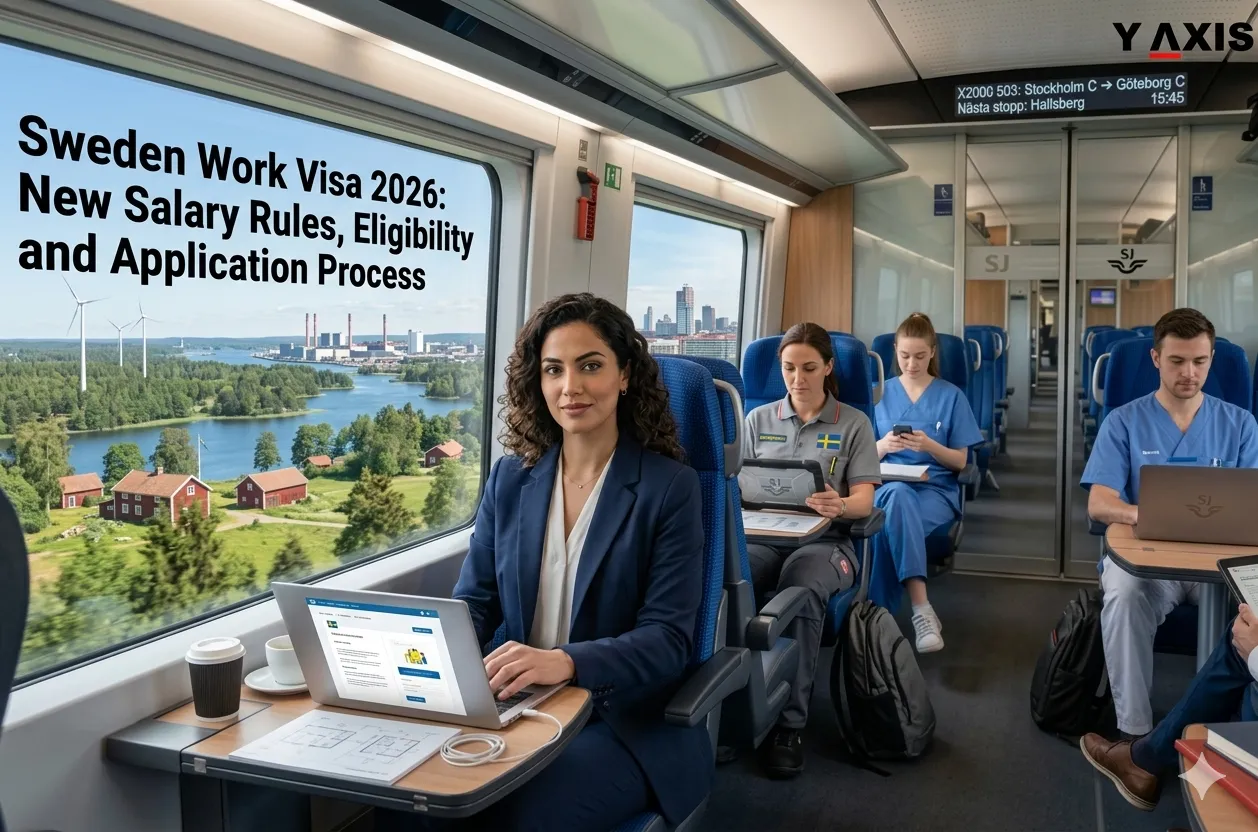

Sweden is one of Scandinavia's most accessible and rewarding destinations for internationally mobile Indian professionals. With over 170,546 active job vacancies, an average monthly salary of SEK 46,000, one of the world's highest employment rates driven by consistent demand across technology, engineering, life sciences, clean energy, and healthcare, and a quality of life that combines world-class public services with genuine work-life balance, Sweden has established itself as a compelling and realistic destination for Indian professionals planning their next international career move.
What makes Sweden particularly notable in 2026 is a combination of an updated salary threshold for work permit eligibility, a streamlined employer-led application process, and one of the most family-friendly immigration systems in Europe. The country also offers one of the shorter permanent residency timelines among Nordic nations, with PR available after four years of continuous lawful residence and citizenship after five years. Sweden additionally permits dual citizenship at the national level, though Indian law means Indian nationals must renounce Indian citizenship upon naturalising as Swedish citizens. This guide covers everything Indian professionals need to know about applying for a Sweden work visa in 2026, from the updated minimum salary requirement and the four main permit categories through to the complete documents checklist, application process, fees, family benefits, and the PR and citizenship pathway.
Why Sweden Appeals to Indian Professionals in 2026
The structural case for Sweden begins with genuine labour demand. Over 170,000 active vacancies exist across the Swedish economy in sectors that closely match the professional strengths of India's engineering, technology, pharmaceutical, and healthcare graduate base. Sweden's ageing population and rapid economic growth in knowledge-intensive industries create workforce gaps that domestic supply and EU migration alone cannot fill, generating consistent and sustained international recruitment activity.
Sweden is home to some of the world's most recognised global companies. Ericsson, Volvo, Spotify, IKEA, H&M, AstraZeneca, Scania, Atlas Copco, ABB, and Sandvik all have major operations in Sweden, and many actively recruit internationally for technology, engineering, research, and management roles. Stockholm is Scandinavia's largest technology hub and one of Europe's most active startup ecosystems, with a concentration of high-growth companies in fintech, edtech, healthtech, and enterprise software. For Indian professionals in these fields, Stockholm offers the combination of established multinational employers and early-stage growth companies that creates the broadest range of professional opportunities.
Sweden's quality of life proposition for Indian families is equally compelling. Free public healthcare for all children under 18, subsidised childcare through the Maxtaxa system with capped costs based on household income, free public education at all levels, monthly child benefit of SEK 1,250 per child under 16, and the generous parental leave system mean that the total compensation package for an Indian professional in Sweden, including public services and family benefits, is substantially richer than the headline salary alone suggests. The 40-hour working week and a minimum of 25 days of paid annual leave are statutory standards, not exceptional benefits.
Approximately 86 percent of Sweden's population speaks English fluently, which means Indian professionals can integrate immediately into professional environments across technology, engineering, and multinational business without language barriers. Swedish language skills materially improve career prospects and are required for citizenship, but many professional roles in Stockholm, Gothenburg, and Malmo operate primarily in English for daily work.
The 2026 Salary Rule: Minimum Monthly Threshold of SEK 13,000
The most operationally important eligibility criterion for the Sweden Work Permit in 2026 is the minimum monthly salary requirement of SEK 13,000 gross. This threshold applies to all employer-sponsored work permit applications and must be met by the salary specified in the employment contract at the time of application.
SEK 13,000 per month represents approximately EUR 1,130 or INR 97,000 per month, which is EUR 13,600 or INR 11.6 lakh per year. This is a relatively low absolute threshold compared to equivalent requirements in Germany, the Netherlands, or Luxembourg, and it reflects Sweden's approach of setting a basic qualification level rather than a high exclusionary bar. In practice, the majority of professional roles in IT, engineering, life sciences, and healthcare in Sweden pay well above this threshold. The practical relevance of the SEK 13,000 minimum is primarily for applicants considering entry-level roles or positions in sectors like education or social care where starting salaries can be closer to this level.
The minimum salary threshold must be reflected in the employment contract submitted with the work permit application. Employers who offer probationary or conditional salaries below SEK 13,000 with a promise of increase are not eligible to sponsor the work permit on that basis. The threshold applies to the contracted gross monthly salary as stated in the binding employment agreement.
Swedish wage levels across the most active sectors for Indian professionals are well above this threshold. The average gross monthly salary in Sweden across the full workforce is approximately SEK 46,000, which is approximately INR 3.9 lakh per month or INR 47 lakh per year. IT professionals earn an average of EUR 38,000 to EUR 60,000 annually at mid-level, which at current exchange rates translates to SEK 430,000 to SEK 680,000 per year. Life sciences and pharmaceutical professionals earn EUR 35,000 to EUR 60,000 at mid-level. Engineers earn EUR 38,000 to EUR 65,000. Healthcare professionals under Swedish public sector pay scales earn EUR 38,000 to EUR 65,000 depending on specialisation.
The Four Sweden Work Permit Categories for Indian Professionals
Sweden's work permit framework for non-EU nationals offers four main categories covering different professional situations. Identifying the correct category determines the eligibility requirements, the documents needed, and the conditions that apply during the employment period.
The Employer-Sponsored Work Permit is the most widely used and most relevant category for Indian professionals in standard employment relationships. It requires a confirmed job offer from a Swedish employer, an employment contract meeting the SEK 13,000 monthly minimum, and employer-provided insurance coverage including health, life, employment, and pension insurance. The permit is initially valid for up to two years and is renewable for a further two years provided the qualifying employment continues. After four years of continuous legal residence, the holder can apply for permanent residence. This permit acts simultaneously as a work permit and a residence permit for stays exceeding three months, which removes the need for a separate visa for qualifying applicants.
The EU Blue Card is available to highly qualified Indian professionals with a recognised higher education qualification equivalent to at least three years of tertiary study and a binding employment contract for at least one year with a salary meeting the Blue Card threshold. Sweden's EU Blue Card salary threshold is higher than the general work permit minimum, broadly set at 1.5 times the average annual salary in the relevant occupation. The Blue Card provides enhanced intra-EU mobility rights after 18 months of Blue Card status in Sweden, allowing movement to work in other EU member states under simplified conditions.
Processing time is one to three months. The application fee is SEK 2,476.
The Intra-Company Transfer Permit covers Indian employees of multinational companies being transferred to the Swedish branch, subsidiary, or affiliated entity of the same corporate group. It applies to managers, specialists, and trainees. The ICT permit does not require the employer to demonstrate that no EU candidate was available for the position, and the application fee is the same SEK 2,476 as the standard work permit. The ICT permit is the most appropriate route for Indian professionals already employed by companies with Swedish operations who are being assigned to Stockholm, Gothenburg, or other Swedish offices.
The Business Visa covers short-term visits for attending meetings, conferences, business events, and negotiations. It is valid for up to 90 days within a 180-day period and does not authorise employment in Sweden. It is not appropriate for Indian professionals planning to take up employment but is relevant for initial employer engagement visits before a formal application is made.
Indian professionals who want to confirm which category applies to their qualifications and offered salary before their Swedish employer begins the application can use a free eligibility check to assess their position in advance.
Full Eligibility Criteria for Indian Applicants
To qualify for the Sweden Employer-Sponsored Work Permit, Indian applicants must satisfy all of the following conditions.
The applicant must be a non-EU and non-EEA national. Indian citizens satisfy this condition.
A valid job offer from a registered Swedish employer is mandatory. The employer must be registered and tax-compliant in Sweden, and the employment must be for a genuine role within the employer's business operations.
The employment contract must specify a gross monthly salary of at least SEK 13,000. The salary must be paid to the employee in Sweden and must meet the terms and working conditions applicable under relevant Swedish collective bargaining agreements or statutory standards for the sector.
The employer must provide mandatory insurance coverage including health, life, employment, and pension insurance. This requirement reflects Sweden's commitment to ensuring that internationally recruited workers have full protection under Swedish employment standards from the point of starting work. Swedish employers who do not provide this coverage cannot legally sponsor international work permits.
The applicant must have the skills, qualifications, or experience required to perform the offered role competently. For regulated professions including medicine, dentistry, nursing, and certain engineering specialisations, formal recognition of Indian qualifications by the relevant Swedish authority is required before work can begin.
The applicant must hold a valid Indian passport with sufficient remaining validity.
The employer must have made the job available to Swedish and EU candidates first, in compliance with Sweden's labour market prioritisation rules. The Swedish Public Employment Service, Arbetsförmedlingen, and the EU EURES portal are the standard channels for this market exposure requirement.
Complete Documents Checklist for Indian Applicants
Preparing a complete and correctly formatted document package before the employer initiates the application is the most important practical step. The Sweden work permit application is submitted online by the employer through the Swedish Migration Agency portal, Migrationsverket, and the applicant provides their personal documents to the employer for inclusion in the submission.
A valid Indian passport with at least 12 months of remaining validity beyond the intended employment start date is the primary identity document.
Recent passport-sized photographs meeting the Swedish Migration Agency specification, with white background and full face clearly visible.
The completed work permit application form submitted through the Migrationsverket portal. The employer completes the employer-side sections and the applicant completes the personal information sections.
The signed employment contract confirming the role, gross monthly salary at or above SEK 13,000, contract duration, and start date. The contract must confirm full-time employment and specify the insurance coverage provided by the employer.
Educational degree certificates and academic transcripts covering all relevant qualifications. For regulated professions, formal recognition documentation must be included. Indian degree certificates should be apostilled through the MEA where required by the Swedish authority.
Experience letters from previous employers confirming designation, period of employment, and nature of responsibilities relevant to the offered role.
A Police Clearance Certificate from the Passport Seva Kendra or local police authority, apostilled through the MEA. The PCC must be recent, typically within three to six months of the application date.
Proof of accommodation in Sweden, whether a signed rental agreement, employer-arranged housing confirmation, or confirmed short-term accommodation booking.
Employer insurance documentation confirming that the required health, life, employment, and pension insurance is in place for the applicant from the point of starting work.
The Step-by-Step Application Process
The Sweden work permit process for Indian professionals follows a clear five-stage sequence managed primarily through the Migrationsverket online portal.
The first step is the Indian professional receiving a confirmed job offer from a Swedish employer. The employer must be registered in Sweden, prepared to sponsor the work permit application, and able to provide all employer-side documentation including the insurance confirmation and the signed employment contract.
The second step is the employer initiating the work permit application through the Migrationsverket portal. The employer submits the employer-side documentation, uploads the employment contract, and sends the application link to the Indian applicant to complete their personal information sections. The employer also pays the application fee of SEK 2,476 at this stage.
The third step is the Migrationsverket reviewing and deciding on the application. Processing time is one to three months for most standard employer-sponsored work permit applications. Applications with complete documentation and straightforward employment terms are consistently at the faster end of this range.
The fourth step, which applies for Indian nationals who require a visa to enter Sweden as non-EEA citizens, is applying for the national long-stay visa at the Swedish Embassy or Consulate in India. Once the work permit is approved, the applicant applies for entry clearance at the Swedish Embassy in New Delhi or the Swedish Consulate serving their state. Processing at the embassy stage is typically one to two weeks for standard applications.
The fifth step is travelling to Sweden. Upon arrival, the applicant must register their address with the Swedish Tax Agency, Skatteverket, to receive a Swedish personal identity number, known as a personnummer. The personnummer is required for almost all administrative functions in Sweden including opening a bank account, accessing healthcare, enrolling children in school, and registering for SFI Swedish language classes. The employer typically assists with this registration as part of the onboarding process.
Visa Fees for the Sweden Work Permit
The application fee for the standard Employer-Sponsored Work Permit is SEK 2,476, which is approximately INR 19,800 at current exchange rates. The same fee of SEK 2,476 applies to the ICT Permit and the EU Blue Card. The Business Visa carries a fee of SEK 2,000.
These are the government fees payable to Migrationsverket through the online portal. Additional costs for Indian applicants include the MEA apostille fees for the PCC and degree certificates, certified translation costs for documents not in English or Swedish, health insurance premiums for the period before employer-provided insurance activates, and travel and initial accommodation costs upon arriving in Sweden.
Total out-of-pocket costs for an Indian applicant through the complete process from permit application to arriving in Sweden are typically in the range of INR 25,000 to INR 55,000 including all fees, translations, and preparation costs, making Sweden one of the more cost-effective European work permit processes for Indian applicants.
In-Demand Sectors and Salary Ranges in Sweden in 2026
Information technology is the most active international recruitment sector in Sweden and the strongest fit for Indian professionals. Software developers, backend engineers, cloud architects, DevOps engineers, AI and ML specialists, data engineers, and cybersecurity analysts are all in consistent demand. Stockholm's technology ecosystem, which produced Spotify, King, Klarna, Mojang, and many other globally recognised companies, continues to generate significant employment demand at all levels. Mid-level IT professionals in Sweden earn EUR 38,000 to EUR 60,000 annually, and senior professionals and AI specialists earn EUR 60,000 to EUR 96,000 or above.
Engineering and manufacturing covers mechanical engineers, electrical engineers, automation engineers, product design engineers, and quality assurance engineers across Sweden's industrial base including Volvo, Scania, Atlas Copco, and ABB. Mid-level engineering salaries range from EUR 38,000 to EUR 60,000.
Life sciences and pharmaceuticals is a distinctive strength of Sweden's economy, with AstraZeneca, Recipharm, and a cluster of biotech companies maintaining consistent demand for biomedical scientists, clinical research associates, regulatory affairs specialists, and pharmacists. Salaries in this sector range from EUR 38,000 to EUR 65,000 at mid-level.
Healthcare shortages include general practitioners, specialist physicians, registered nurses, midwives, physiotherapists, and occupational therapists across both public and private healthcare settings. Healthcare professionals must have their Indian qualifications recognised by the National Board of Health and Welfare, Socialstyrelsen, before employment can begin. This recognition process should be initiated well in advance of the work permit application.
Clean technology and renewable energy is one of Sweden's most active investment areas, with wind energy engineers, solar power specialists, energy systems analysts, environmental engineers, and sustainability consultants all in demand as Sweden pursues its net-zero targets.
Family Benefits and Dependent Rights
The Sweden work permit framework provides some of the most comprehensive family benefits in Europe for accompanying dependants.
Spouses and unmarried children under 18 can join the main work permit holder in Sweden through the family reunification programme. The main permit holder must demonstrate stable income sufficient to support the family unit, with additional income requirements per dependent family member.
Spouses who receive a family reunification residence permit are entitled to full work rights in Sweden without needing a separate work permit, a prior job offer, or any minimum salary threshold. This open and unrestricted spousal work right is one of the most practically significant benefits of Sweden's family immigration framework and directly affects the household's total earning potential from the moment the family arrives.
Children with valid residence permits can attend Sweden's free public schools at all levels. Sweden's education system is internationally well-regarded and the instruction in public schools is in Swedish, which children of incoming professionals typically learn quickly through immersion. International schools with English-medium instruction are available in Stockholm and Gothenburg for families who prefer curriculum continuity.
The monthly child benefit, Barnbidrag, of SEK 1,250 per child under 16 is paid to all legal residents regardless of employment status. The Maxtaxa subsidised childcare system caps the monthly cost of full-time preschool for children aged one to five based on household income, making full-time childcare affordable for working parents. Free healthcare and dental care for all children under 18 removes one of the largest family expense categories that parents in many other countries face.
The PR and Citizenship Pathway from the Sweden Work Permit
Sweden's permanent residence pathway is one of the most accessible among Nordic and Northern European countries, requiring four years of continuous legal residence within a five-year period. The four-year calculation uses a rolling five-year window, meaning the holder must have been legally resident for at least four of the most recent five years at the time of application.
The PR requirements include four years of continuous residence within the five-year window, stable income or employment demonstrating financial self-sufficiency, and a clean criminal record with no serious convictions. Swedish language proficiency is not a formal requirement for the PR application itself, though it is required for the subsequent citizenship process.
After five years of continuous legal residence in Sweden, the holder can apply for Swedish citizenship by naturalisation. The citizenship application requires demonstrating five years of continuous legal residence, Swedish language proficiency assessed through language and civic knowledge tests, financial self-sufficiency, and a clean criminal record. Free Swedish language training is available through the SFI, Swedish for Immigrants, programme which is offered by Swedish municipalities to all legal residents.
Sweden permits dual citizenship at the national level, which is a positive feature for professionals from many countries. However, India does not permit dual citizenship, meaning Indian nationals who naturalise as Swedish citizens must renounce Indian citizenship. After renouncing Indian citizenship, OCI card status is available and provides long-term benefits including the right to visit India without a visa and to hold property in India, serving as a practical connection to India for Indian-origin Swedish citizens.
EU Long-Term Resident status is available after five years of continuous legal residence in Sweden and provides the additional benefit of easier movement to and work in other EU member states under simplified conditions, which is an important dimension for professionals who eventually want to explore career opportunities elsewhere in Europe while maintaining their Swedish base.
For Indian professionals who want expert guidance through every stage of the Sweden work visa process, from confirming permit category and salary eligibility through to managing the Migrationsverket application, Swedish Embassy visa, family reunification planning, and the four-year pathway to permanent residency, Y-Axis offers comprehensive immigration support tailored to Indian applicants. Those ready to begin their Sweden career journey can book a free counselling session and receive personalised, current guidance on the most appropriate pathway for their professional profile in 2026.





![How to Get Luxembourg Work Visa for Indians [2025]](https://writeupcafe.com/data/post/1473491/3d54b0b313e4da42bfb18b1998255efe.png.webp)














Sign in to leave a comment.