
Work visas are among the most complex, most scrutinised, and most consequential immigration categories in existence. Unlike tourist visas or student permits, work visas sit at the intersection of immigration law, employment law, and national policy and governments update the rules frequently. A single missed document, an incorrect form code, or a misunderstood eligibility criterion can result in outright refusal, months of delay, or in worst cases, a future ban on re-application.
This is precisely why the demand for qualified work visa consultants has surged globally. But not all consultants are created equal, and knowing how to evaluate them is just as important as knowing why you need one. This guide covers both.
What Do Work Visa Consultants Actually Do?
There's a widespread misconception that a work visa consultant simply fills in forms on your behalf. In practice, their role is significantly more complex and more valuable.
A qualified work visa consultant will typically:
- Assess your eligibility across multiple visa pathways before recommending one
- Advise both the applicant and the sponsoring employer on their respective obligations
- Prepare, review, and compile a complete documentation package
- Identify and proactively address potential grounds for refusal
- Submit the application and manage correspondence with the immigration authority
- Provide guidance through any additional interviews, biometric appointments, or supplementary requests
Beyond the transactional elements, the best work visa specialists act as strategic advisors. They understand how immigration officers interpret applications, what language raises red flags, and how to present a profile in the strongest possible light within the bounds of honesty and accuracy.
The Most Common Work Visa Categories in 2026
Work visa structures vary by country, but these are the categories most frequently handled by specialist consultants:
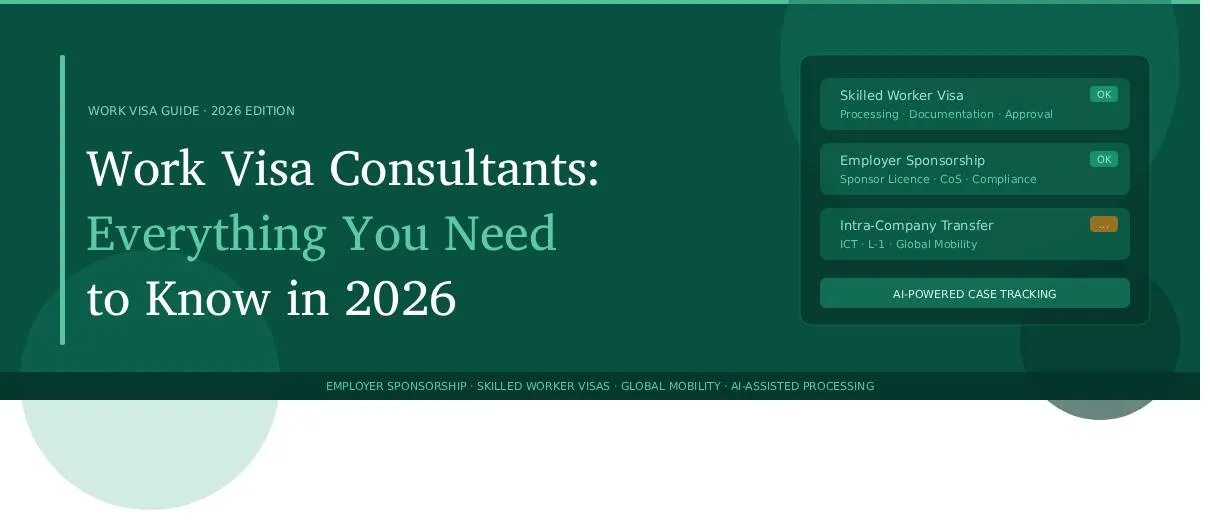
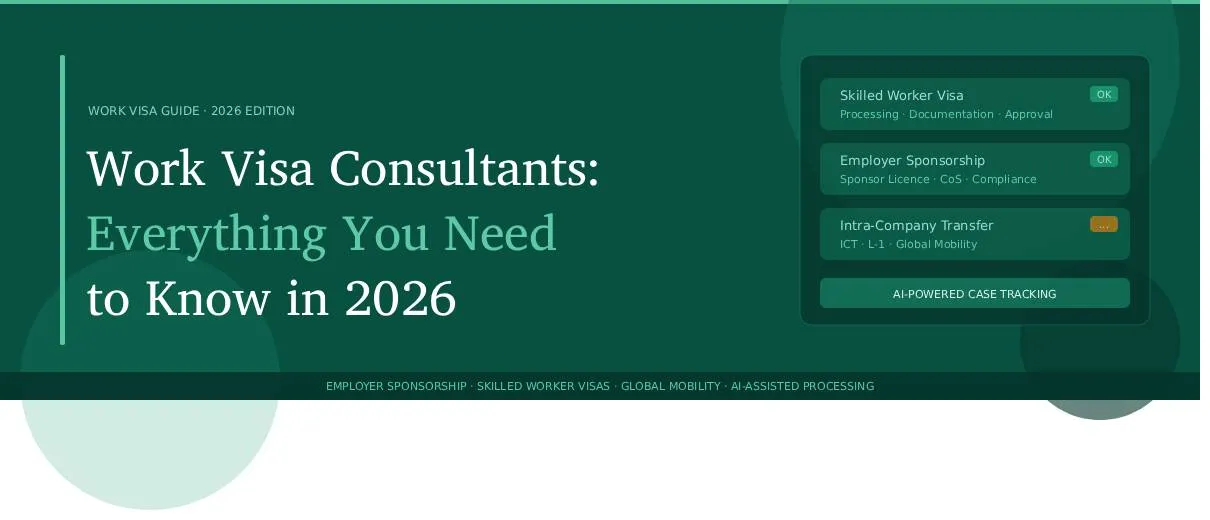
Skilled worker and points-based visas
Countries including the UK, Australia, Canada, and New Zealand operate points-based or skills-assessed systems. Applicants must meet minimum thresholds across factors like age, qualifications, work experience, language proficiency, and in some cases, a job offer from an approved employer.
These visas are popular but heavily document-intensive. A minor error in a skills assessment, or a misclassification of your occupation code, can lead to unnecessary refusals that could have been avoided entirely with professional oversight.
Employer-sponsored work visas
Many countries require that a foreign worker be sponsored by a pre-approved employer one that holds an active sponsor licence or is registered on a government-approved employer list. This introduces a dual compliance requirement: both the worker and the employer must satisfy separate sets of legal obligations.
Work visa consultants who specialise in employer sponsorship understand both sides of the equation. They help employers maintain compliance with sponsor duties while ensuring workers meet the eligibility thresholds.
Intra-company transfer visas
Multinational corporations frequently move employees between offices in different countries using intra-company transfer visas (known as the ICT visa in the EU, the L-1 in the United States, and similar equivalents elsewhere). These routes have strict requirements around the length of prior employment, the nature of the role, and the relationship between the entities involved.
Working holiday and temporary work visas
For younger applicants and those in specific professions, working holiday visas and temporary work permits offer a lower-commitment entry point to work experience abroad. While these are generally simpler to apply for, even minor eligibility miscalculations such as applying past the eligible age window can result in refusal.
Why More Applicants Are Turning to Professional Visa Consultants Online
The shift toward digital-first work visa consulting is one of the clearest trends of the past three years. Applicants no longer need to visit a local office or rely on a single consultant in their city. Today, some of the most experienced and successful work visa specialists operate entirely online serving clients across multiple jurisdictions and time zones.
This matters for several reasons:
- Access to niche expertise is no longer geographically limited
- Digital consultants often maintain more up-to-date policy knowledge through real-time case exposure
- The ability to submit and track applications online has made remote consulting just as efficient as in-person service
- Reviews and credentials are easier to verify when a consultant maintains a strong digital presence
For applicants looking to work in Australia, the UK, Canada, or other major destination countries, the combination of online accessibility and specialist expertise has made platforms like professional work visa consultants an increasingly practical choice. Firms that publish detailed guidance, maintain active communication, and clearly outline their processes such as Best Migration Consultant's work visa services reflect the kind of transparent, client-focused model that 2026 applicants increasingly expect.
How AI Is Changing the Work Visa Process
Artificial intelligence has moved from the margins to the mainstream of immigration consulting, and nowhere is this more visible than in work visa applications.
Automated document pre-checks
Before a human consultant reviews your file, AI-powered tools now perform automated pre-screening of your documents against current visa requirements. This catches issues that might otherwise go unnoticed an expired certificate, a missing employer letter, or an inconsistency between dates on two documents before the application reaches an immigration officer.
Policy monitoring and real-time updates
Immigration rules for work visas change frequently and with little warning. In 2025 alone, several major destination countries updated their occupation shortage lists, revised salary thresholds, and adjusted sponsor licence requirements. AI-powered policy monitoring tools allow progressive consulting firms to flag these changes immediately and proactively advise clients who may be affected.
Predictive eligibility assessments
Some platforms now offer AI-assisted eligibility assessments that calculate the probability of approval based on historical case data, current policy parameters, and the applicant's specific profile. These tools don't replace legal judgement, but they give both the consultant and the applicant a clearer, data-informed starting point for decision-making.
What this means for you
When choosing among work visa consultants, ask whether they use modern, technology-assisted case management. Consultants who have integrated AI tools into their workflow tend to process applications more accurately, flag issues earlier, and keep clients better informed throughout the process.
How to Evaluate Work Visa Consultants: A Practical Checklist
The market for work visa consulting services is large and uneven. These are the criteria that separate genuinely qualified professionals from those who are simply well-marketed:
Registration and licensing
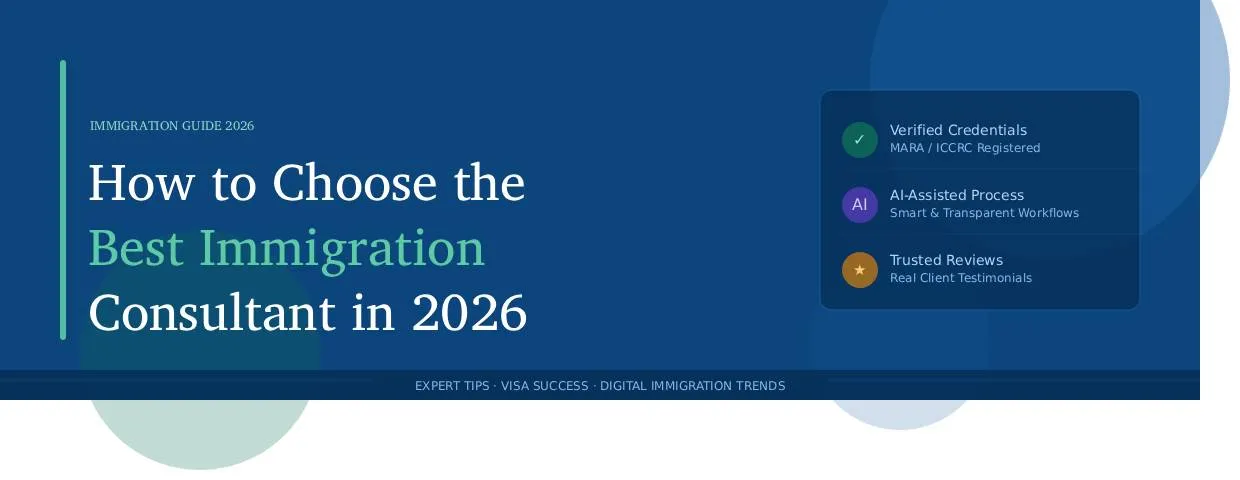
Every legitimate work visa consultant must hold a valid registration with the relevant professional or regulatory body in their country of operation. Verifying this takes less than five minutes and skipping this step is one of the costliest mistakes applicants make.
Relevant case history
Work visas are complex enough that specialist experience matters. A consultant with deep experience in skilled worker visas may have limited exposure to intra-company transfers or creative/entertainment work permits. Ask specifically about their track record in your visa category and destination country.
Transparent fee structures
Reputable consultants will be upfront about their fees from the outset. Be cautious of advisors who provide vague pricing, add hidden charges mid-process, or bundle in services you didn't ask for. Pricing may vary legitimately based on complexity but the basis for that pricing should be clearly explained.
Communication standards and response times
Visa timelines are often tight. Your consultant should commit to specific response times and maintain consistent communication throughout your case. Before engaging anyone, ask how you'll receive updates, who your primary contact will be, and what happens if your assigned consultant is unavailable.
Independent reviews
Check for verified reviews on third-party platforms such as Google Business, Trustpilot, or relevant industry directories. Look for consistency across reviews, specificity about the types of cases handled, and how the consultant responds to any negative feedback.
Common Work Visa Mistakes That Consultants Help You Avoid
Even intelligent, well-prepared applicants make avoidable errors on work visa applications. The most frequent include:
- Submitting documents that have expired since the initial assessment
- Failing to disclose previous visa refusals (a requirement in virtually every jurisdiction)
- Incorrect occupation classification, leading to eligibility miscalculation
- Providing employer letters that don't meet the specific wording requirements
- Underestimating processing timelines and missing job start dates as a result
- Applying under the wrong visa subclass when a more suitable pathway exists
A skilled consultant who handles work visa applications regularly will have encountered and corrected every one of these scenarios. Their value isn't just in knowing the rules; it's in knowing the ways people unknowingly break them.
The Digital-First Future of Work Visa Consulting
The immigration consulting industry is undergoing a structural shift that shows no sign of reversing. By 2026, the most competitive and client-trusted firms are those that combine regulatory expertise with digital accessibility, transparent communication, and technology-assisted accuracy.
For applicants, this is a significant advantage. The barrier to accessing high-quality work visa advice has never been lower. The challenge now is not finding a consultant it's finding the right one.
The criteria outlined in this guide verified credentials, specialist case history, transparent pricing, strong reviews, and digital transparency apply regardless of which country you're applying from or applying to. Use them consistently, and you substantially increase both the quality of your experience and the likelihood of a successful outcome.
Conclusion: Make Your Next Career Move Count
A work visa is more than a stamp in a passport. It's the legal foundation for a new chapter in your professional life and it deserves to be handled with the same care you'd bring to any major career decision.
Whether you're a skilled professional targeting a points-based system, an employee navigating a sponsored transfer, or an employer trying to bring international talent on board compliantly, the right work visa consultant can be the difference between a smooth transition and a costly, stressful delay.
Do your research. Verify credentials. Ask the hard questions. And when you find a consultant who is transparent, experienced, and genuinely invested in your outcome that's the one worth trusting with your future.





![How to Get Luxembourg Work Visa for Indians [2025]](https://writeupcafe.com/data/post/1473491/3d54b0b313e4da42bfb18b1998255efe.png.webp)















Sign in to leave a comment.