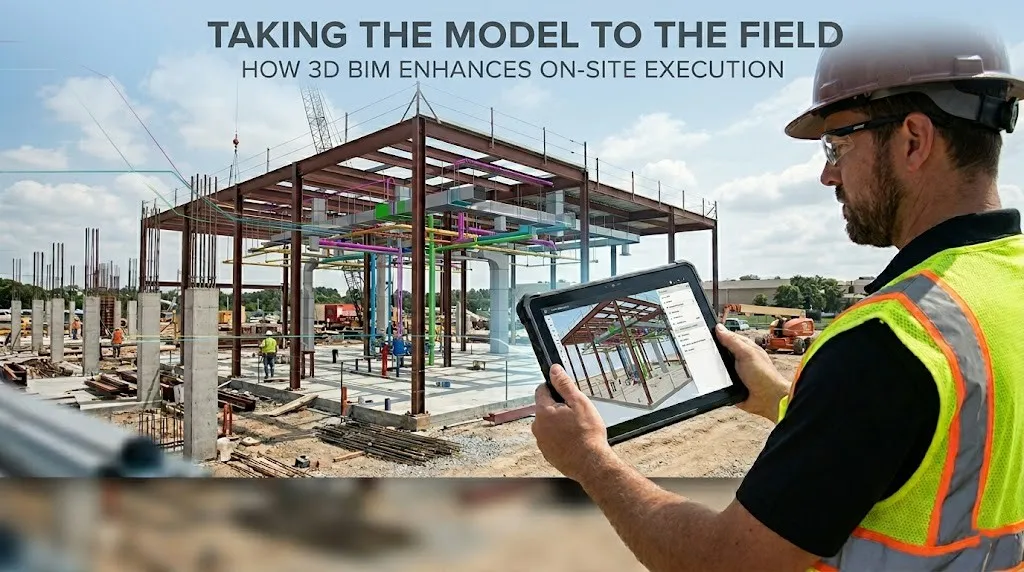

Could a single digital pivot be the difference between a project that finishes 5% under budget and one that spirals into a 50% schedule delay? In an industry where only 5% of global construction projects are historically completed within their original budget and timeline, the transition from office-bound 3D models to active on-site execution is no longer a luxury—it is a survival strategy. As we move through 2026, the construction sector has reached a tipping point: Building Information Modeling (BIM) has officially moved out of the trailer and onto the toolbelt.
The Great Digital Migration: From Office to Asphalt
The AEC (Architecture, Engineering, and Construction) industry has long suffered from a "digital disconnect." Architects and engineers spend thousands of hours perfecting high-fidelity models, only for that intelligence to be flattened into 2D PDFs or paper blueprints the moment it hits the field. This "translation loss" is where the majority of project risk resides.
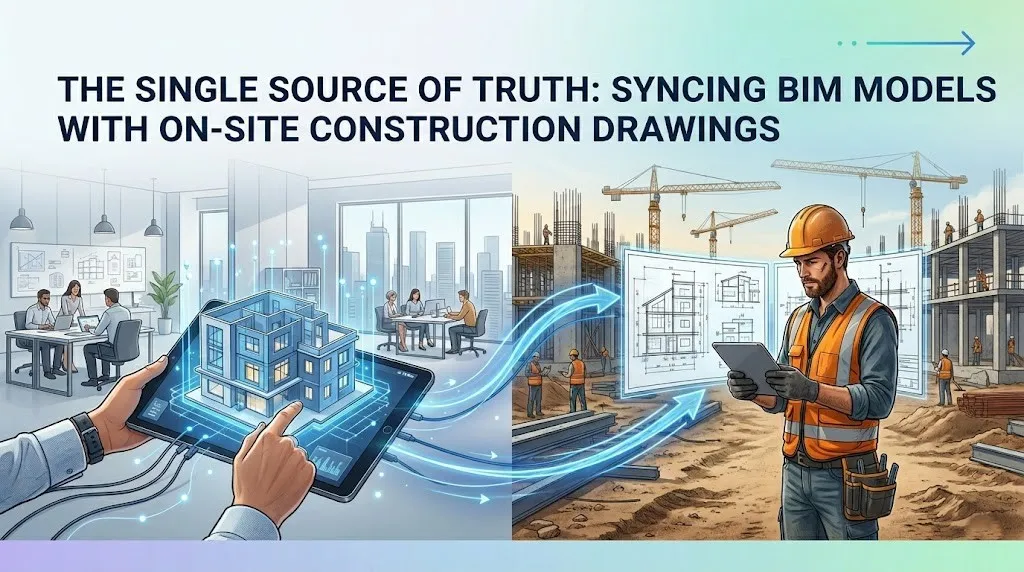
Recent data from the Dodge Construction Network indicates a seismic shift: over 92% of mechanical contractors now utilize BIM for fabrication, with 84% reporting that digital fabrication capabilities are now a prerequisite for winning high-value work. The current market is defined by escalating complexity and a shrinking labor pool. According to McKinsey’s latest Industry Outlook, the integration of applied AI and immersive reality within BIM workflows has seen a 700% increase in industry adoption over the last three years. We are witnessing the maturation of "BIM-to-Field" workflows, where the 3D model serves as the Single Source of Truth (SSOT) guiding everything from robotic total stations to automated drilling systems.
To bridge this gap effectively, many firms are turning to professional BIM services to ensure their models are "field-ready"—meaning they possess the Level of Development (LOD) 400 detail necessary for actual assembly rather than just conceptual design.
1. Mitigating the "Chaos Factor": Real-Time Coordination
The most immediate value of 3D BIM on-site is the radical reduction of the "Chaos Factor"—those unpredictable site conditions that lead to costly Request for Information (RFI) cycles. In traditional 2D workflows, a pipe clashing with a structural beam might not be discovered until a subcontractor is standing on a ladder with a wrench in hand.
The Power of Pre-Emptive Action
By utilizing a federated 3D model on-site—a combined model containing structural, MEP, and architectural data—field teams can conduct "virtual rehearsals" of complex installations. Research published in the Journal of Construction Engineering and Management highlights that 3D models identify an average of 0.5 interferences per square meter before construction begins.
When these clashes are resolved digitally:
- Cost Reduction: Projects see a 5% to 8% reduction in total costs through optimized 5D (cost) estimation.
- Zero Rework: MEP systems that are pre-coordinated in 3D report nearly 95% less rework during the installation phase.
- Enhanced Safety: By simulating crane swings and site logistics in 3D, safety officers identify "pinch points" and high-risk zones before they become active hazards.
2. The Hardware of Execution: Bridging the Digital-Physical Divide
Taking the model to the field requires more than just a tablet; it requires a hardware ecosystem that can interpret 3D data with millimeter precision. In 2026, three core technologies are driving this integration:
Robotic Total Stations (RTS) and Layout Automation
Traditional layout—using tape measures and string lines—is notoriously error-prone. Tools like the Hilti PLT 400 or Trimble Ri allow a single operator to layout formwork, anchor points, and interior partitions directly from the BIM model. This replaces the slow, two-person manual process with a high-speed digital workflow that maintains the integrity of the design intent.
Site Robotics and Semi-Automation
We are moving beyond simple layout to actual execution. Semi-automated technologies, such as the Hilti Jaibot, use the detailed BIM design to autonomously drill overhead holes and identify them with trade-specific marks. Industry benchmarks show this can increase drilling productivity by 30-40% while significantly reducing physical strain on workers.
Mixed Reality (MR) and Augmented Reality (AR)
AR-enabled headsets allow site supervisors to "see through" walls by overlaying the 3D model onto the physical environment. This immersive visualization helps in verifying installations against the design and facilitates "live" communication between field crews and remote engineers. This is a critical step in how BIM enhances the construction process by providing visual clarity that 2D drawings simply cannot match.
3. Stakeholder Perspectives and Global Dynamics
The benefits of on-site BIM vary significantly across the project lifecycle. While large-scale infrastructure projects in India and the Middle East are mandating BIM for transparency, small-to-mid-sized contractors in the West often grapple with the "BIM tax"—the initial cost of software and training.
Regionally, the ISO 19650 standard has become the global gold standard for information management. In markets like the UK, Singapore, and Australia, compliance is often a legal requirement for public works. In emerging markets, BIM professionals are commanding a 25% salary premium, reflecting the high value the market places on standardized digital execution.
4. Overcoming Implementation Friction
Despite the clear ROI, the path to field-integrated BIM is fraught with challenges. The 2025 Construction Technology Report identifies "cultural resistance" and "fragmented data governance" as the primary barriers to success.
Actionable Takeaways for AEC Leaders:
- Contractualize BIM Requirements: Don't just "request" BIM; make it a part of the subcontractor's contract, specifying the required Level of Development (LOD)—ideally LOD 400 for fabrication.
- Invest in "Field-First" Training: Instead of training every employee on complex modeling software, focus on training field crews on mobile model viewers and digital layout tools.
- Bridge the Gap with Specialists: If internal capability is low, outsource coordination to specialist BIM firms. This converts a fixed capital cost into a project-level variable cost.
- Leverage the Cloud: Use Common Data Environments (CDEs) to ensure that the model the foreman sees on their tablet is the latest version, eliminating the "outdated print" problem.
The Forward-Looking Conclusion: The Era of the Digital Twin
The future of construction execution lies in the Digital Twin. By 2030, the BIM software market is projected to reach $22 billion, driven by the integration of IoT sensors and real-time site data. Taking the model to the field is the essential first step in this journey. It transforms the 3D model from a static drawing into a living, breathing asset that guides every bolt, beam, and budget.
As we look toward the horizon, the question for AEC professionals is no longer "Should we use BIM on-site?" but rather "How quickly can we integrate it?" Those who bridge the digital-physical divide today will be the ones building the high-performance world of tomorrow.



























Sign in to leave a comment.