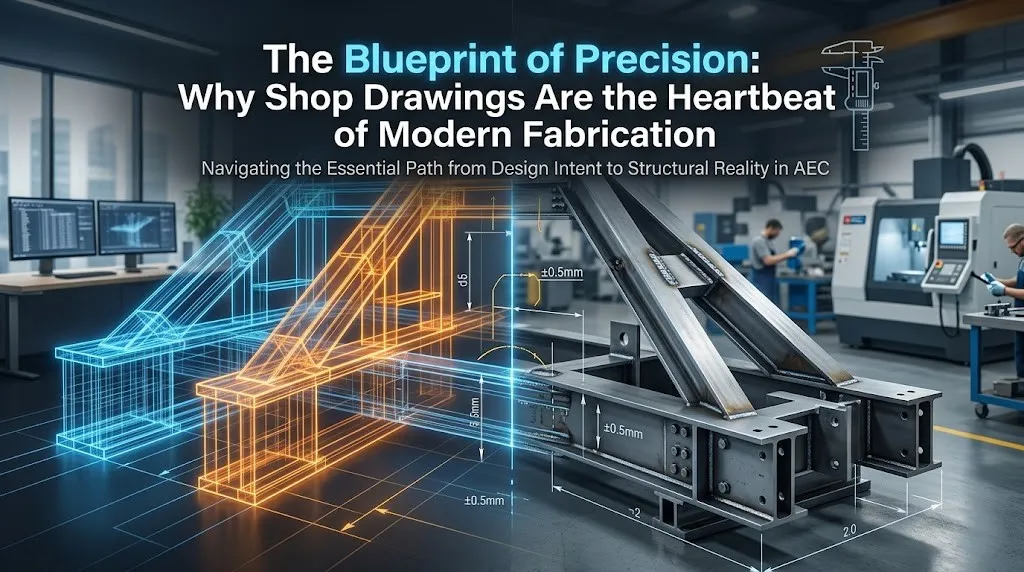

Did you know that nearly 30% of all construction industry waste is attributed to rework and field errors? In an era where a single millimeter of misalignment can cost a project thousands of dollars, the bridge between an architect’s vision and the actual steel on-site is more critical than ever. We often celebrate the sweeping curves of a glass facade or the strength of a bridge, but the unsung hero of these structural marvels isn't the design intent it’s the shop drawing.
From Concept to Reality: Setting the Stage
In the traditional AEC workflow, a massive gap often exists between what an architect envisions and what a fabricator can actually build. Design drawings provide the "what," but they rarely provide the "how." As global construction output is expected to reach $13.9 trillion by 2037, the pressure to deliver faster, leaner, and more accurately has never been higher.
Shop drawings serve as the ultimate translation layer. While the design documents offer a roadmap, the shop drawings are the GPS coordinates, providing the granular detail necessary for fabrication, assembly, and installation. Without them, the digital transformation we talk so much about in BIM (Building Information Modeling) would simply stall at the factory door.
The Critical Role of Shop Drawings in the Fabrication Loop
1. The Ultimate Source of Truth for Manufacturers
Unlike general construction plans, shop drawings are prepared by the contractor, subcontractor, or fabricator. They aren't just "drawings"; they are technical manuals for production. According to industry benchmarks from the American Institute of Architects (AIA), shop drawings must include dimensions, manufacturing conventions, and special fabrication instructions that design drawings purposefully omit to avoid clutter.
When a steel beam is being cut, the fabricator doesn't need to know the color of the lobby carpet; they need to know the exact bolt-hole placement and the grade of the weld. This specificity is why shop drawings are the backbone of different types of drawings used in construction.
2. Risk Mitigation and Error Detection
Research from the Construction Industry Institute (CII) suggests that discovering an error in the fabrication shop is 10 times cheaper than discovering it on the construction site. Shop drawings act as a "pre-construction" rehearsal. By detailing every joint, connection, and material specification, project teams can identify clashes—such as a HVAC duct trying to occupy the same space as a structural brace—long before the crane starts lifting.
3. Material Optimization and Cost Control
In a world where material costs (especially steel and timber) have fluctuated by over 20% annually in recent years, precision equals profit. Detailed shop drawings allow for exact material take-offs. This minimizes over-ordering and reduces the "scrap" factor. When you have a clear fabrication map, you can implement Just-In-Time (JIT) manufacturing, ensuring that components arrive on-site exactly when needed, reducing storage costs and site congestion.
The BIM Revolution: How Digital Twins Empower Shop Drawings
The transition from 2D CAD to 3D BIM has fundamentally changed the "DNA" of shop drawings. We are no longer just looking at lines on a page; we are looking at data-rich components.
Level of Development (LOD) and Accuracy
In the BIM world, shop drawings typically represent LOD 400. At this level, elements are modeled with enough detail for fabrication and assembly. This is where the "Digital Twin" earns its keep. By using construction documentation services that leverage BIM, firms can automate the extraction of shop drawings directly from the 3D model, ensuring that if the model changes, the fabrication details update in real-time.
Global Standards and Regional Nuances
While the ISO 19650 standard provides a global framework for managing information over the life cycle of a built asset, regional requirements for shop drawings vary. For instance:
- In the US: Emphasis is heavily placed on the submittal and approval process to mitigate legal liability.
- In the EU: There is a stronger push toward "Open BIM" standards to ensure interoperability between different fabrication software.
- In the Middle East: Massive infrastructure projects are increasingly mandating 4D (time) and 5D (cost) integration within the shop drawing phase.
Stakeholder Perspectives: Who Wins with Better Drawings?
The value of a high-quality shop drawing ripples across the entire project team:
- Architects: They gain peace of mind knowing their design intent is being interpreted correctly without having to dictate every single nut and bolt.
- Contractors: Precise drawings mean fewer "Requests for Information" (RFIs) and fewer "Change Orders," which are the primary killers of project schedules.
- Fabricators: They can automate their CNC machines directly from the data, increasing throughput and reducing manual labor errors.
- Facility Managers: Once the building is complete, these detailed drawings provide a "manual" for future repairs and renovations.
Actionable Takeaways for AEC Professionals
If you are looking to optimize your fabrication workflow, consider these research-backed strategies:
- Invest in Early Collaboration: Bring fabricators into the design conversation during the Design Development (DD) phase. This "Integrated Project Delivery" (IPD) approach can reduce RFI counts by up to 40%.
- Standardize Submittal Workflows: Use digital platforms (like Procore or Autodesk Construction Cloud) to track shop drawing approvals. A delay in approving a shop drawing is a direct delay in the fabrication lead time.
- Prioritize Interoperability: Ensure your construction documentation services provider uses software that can export IFC or COBie data, preventing data loss between the designer and the shop.
- Verify via Laser Scanning: For renovation projects, use Point Cloud data to inform your shop drawings. There is no point in having a perfect fabrication if the existing site walls are out of plumb.
The Future: AI and Automated Fabrication
Looking ahead, the role of the shop drawing is evolving from a static document to a dynamic stream of data. We are seeing the rise of Generative Design, where AI helps determine the most efficient fabrication paths for complex geometries. Furthermore, with the growth of 3D printing in construction and modular pre-fabrication, the "shop drawing" will eventually become the code that drives robotic assembly arms.
As we move toward a more sustainable and efficient AEC industry, the humble shop drawing remains our most powerful tool for ensuring that what we dream in the studio is what we build on the ground. By treating these documents not as a chore, but as a strategic asset, firms can protect their margins, enhance their reputation, and build the future—one precise connection at a time.




























Sign in to leave a comment.