
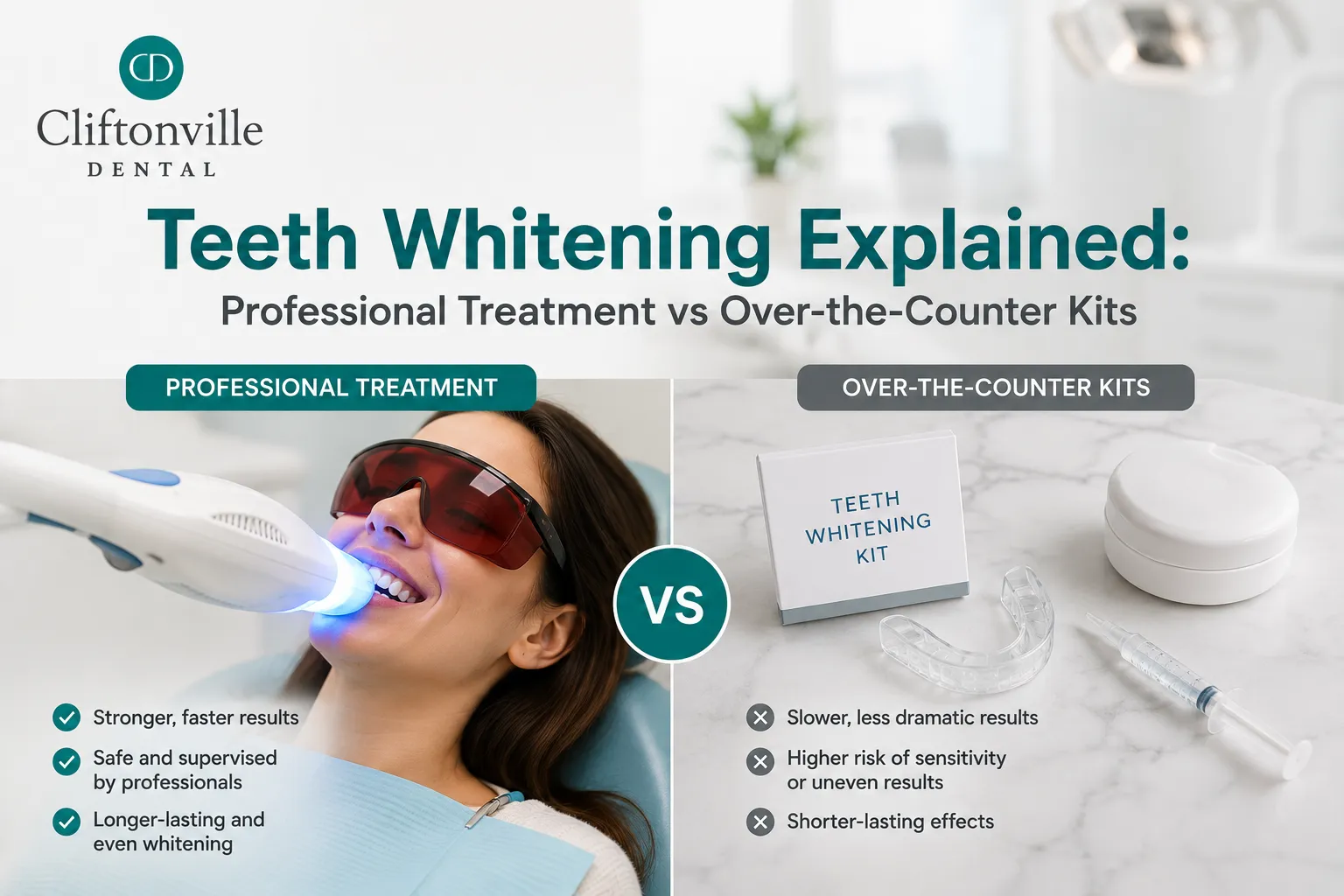
Quick answer: In the UK, only a registered dental professional can legally carry out tooth whitening, and products containing more than 0.1% hydrogen peroxide cannot be sold direct to the public. That single rule explains why shop-bought kits underperform: they are legally capped at a strength too low to change tooth colour much. Whitening toothpastes remove surface stain, they do not whiten. Beauty salons offering whitening are breaking the law.
Whitening is the most requested cosmetic treatment in dentistry and also the one surrounded by the most nonsense. People spend money on kits that cannot work by design, or worse, sit in a salon chair having a procedure performed by someone with no dental training at all.
Here is what actually happens, what is legal, and what to expect from each route.
The legal position, because it explains everything else
Tooth whitening is the practice of dentistry in the UK. That means it can only be carried out by a dentist, or by a dental hygienist, therapist or dental nurse working to a dentist's prescription after the dentist has examined the patient.
Products used must contain no more than 6% hydrogen peroxide or equivalent, the first application must be done by a dentist, and products sold direct to consumers are limited to 0.1% hydrogen peroxide. The General Dental Council prosecutes people who carry out whitening illegally, and salon and mobile whitening services have been repeatedly taken to court over it.
So when you see a beauty salon or a stall in a shopping centre offering teeth whitening, one of two things is true. Either they are using a legally compliant strength that is far too weak to do much, or they are using an illegal strength with no clinical oversight. Neither is a good purchase.
Why shop-bought kits disappoint
At 0.1% hydrogen peroxide, high street kits are around sixty times weaker than what a dentist can use. Some produce a mild effect over weeks. Most produce very little.
The other issue is fit. Professional whitening uses trays moulded to your teeth from impressions or a digital scan, which keeps gel on the teeth and off the gums. One-size-fits-all trays and strips leak gel onto soft tissue, which causes irritation, and they miss areas, which causes patchy results.
Then there are the online sellers shipping stronger products from outside the UK. These are unregulated, sometimes contain chlorine dioxide, which is acidic and can strip enamel, and come with no examination beforehand. Enamel does not grow back.
What whitening toothpaste actually does
Whitening toothpastes contain mild abrasives and sometimes enzymes that remove extrinsic stain from tea, coffee, red wine and tobacco. Removing stain can make teeth look brighter, and that is a genuine benefit.
What they cannot do is change the underlying colour of the tooth, because that requires peroxide penetrating the enamel to break down pigment molecules inside the tooth. There is no legal toothpaste on the UK market that does this. If your teeth are naturally a darker shade, no toothpaste will change it.
The two professional options
Home whitening with custom trays. The dentist examines you, takes impressions or a scan, and has trays made to fit your teeth precisely. You wear them with prescribed gel, either for a few hours daily or overnight, typically for two to four weeks. This is the most widely used method and generally gives the most controllable, even result. It also means you keep the trays and can top up later at low cost.
In-surgery whitening. Gel is applied in the chair with the gums protected, often activated by light, in an appointment of an hour or so. It produces a visible change the same day. Many practices pair it with a short course of home trays afterwards to stabilise the result.
Neither is universally better. In-surgery suits deadlines and people who will not wear trays consistently. Home whitening suits gradual, controlled change and is usually gentler on sensitivity.
What whitening will not fix
This is where expectations need managing honestly.
- Crowns, veneers, bridges and white fillings do not whiten. Whitening natural teeth around older restorations can leave those restorations looking obviously darker or now mismatched. Sometimes the plan has to include replacing them afterwards.
- A single dark tooth after root canal treatment usually needs internal whitening, a different technique altogether.
- Tetracycline staining and severe fluorosis respond poorly and may need veneers or composite bonding instead.
- Decay and gum disease must be treated first. Whitening gel on an untreated cavity or inflamed gums is painful and pointless, which is exactly why an examination beforehand is a legal requirement rather than an upsell.
Sensitivity, and how long results last
Temporary sensitivity to cold is the most common side effect and usually settles within a day or two of finishing. It can be managed by reducing wear time, taking breaks between sessions, or using a desensitising gel or high-fluoride toothpaste. Tell your dentist rather than pushing through it.
Results typically hold for one to three years, depending heavily on diet and smoking. Because you keep custom trays, topping up with a single application every few months is straightforward and inexpensive. If you drink several coffees a day, expect to top up sooner.
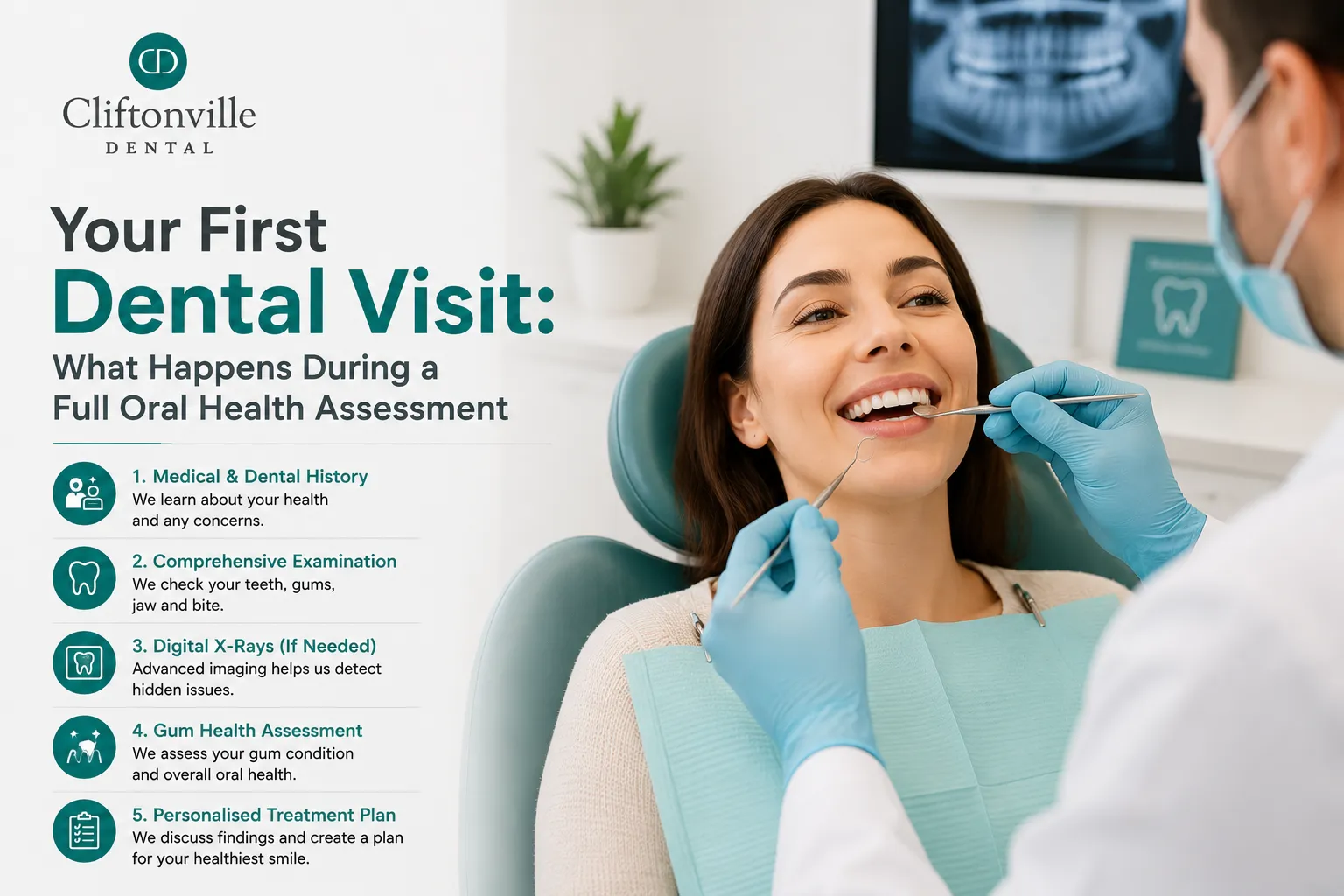
Before considering any cosmetic work, it is worth having had a proper examination first. What that should involve is set out in an earlier post on what happens at a full oral health assessment.
What to ask before booking
- Who will carry out the treatment, and are they GDC registered?
- What concentration is being used, and is it within the 6% limit?
- Are custom trays included, and do I keep them?
- What is the total cost, including any review appointments and top-up gel?
- Will my existing fillings, crowns or veneers still match afterwards?
- What happens if I get sensitivity partway through?
A reputable Dentist in Northampton will answer all six without hesitation, and will examine you before agreeing to treat.
About the practice behind this article
Cliftonville Dental is a private practice at 65 The Avenue, Cliftonville, Northampton NN1 5BT, on 01604 604545. It is owned and run by Dr Anesh Patel and Dr Arti Shah, both of whom still treat patients. Dr Patel qualified from King's College London in 1999 and returned to his hometown of Northampton, where he has worked ever since, with postgraduate training focused on cosmetic and implant dentistry. Dentists across Northamptonshire refer patients to the practice for that work.
The practice opens six days a week including evenings, publishes its fees and takes online bookings. Alongside teeth whitening, treatment covers preventative and general dentistry, hygienist care, white fillings, root canal treatment, crowns, bridges, veneers, CEREC same-day crowns, children's dentistry, orthodontics including Invisalign, dental implants and facial aesthetics, with sedation available for anxious patients.
Frequently asked questions
Is teeth whitening safe? Carried out by a dental professional after an examination, whitening is a well-established treatment with a long safety record. The risks come from unsupervised use, illegal concentrations and unregulated products bought online, which can damage gums and enamel.
Can a beauty salon legally whiten my teeth? No. Tooth whitening is the practice of dentistry in the UK and can only be performed by registered dental professionals. Salons offering it are acting illegally, and the GDC has prosecuted providers for exactly this.
Does whitening damage enamel? Peroxide-based whitening at prescribed concentrations does not remove or thin enamel. Acidic unregulated products, particularly those containing chlorine dioxide, can. This is one of the strongest arguments against buying whitening products from unknown online sellers.
Will whitening work on crowns or veneers? No. Whitening only affects natural tooth structure. If you have visible restorations, discuss the sequencing with your dentist, because you may want to whiten first and then replace those restorations to match the new shade.
How long does teeth whitening take? Home whitening with custom trays typically takes two to four weeks. In-surgery whitening takes around an hour in a single appointment, often followed by short home top-ups.
Can I whiten my teeth while pregnant? Whitening is generally postponed during pregnancy and breastfeeding as a precaution, since there is limited evidence either way. Routine dental care should continue as normal.
The bottom line
If you want a genuine change in tooth shade, professional whitening is the only route that legally and practically delivers it. Whitening toothpaste manages stain, high street kits are capped too low to do much, and salon whitening is illegal.
Get examined, get custom trays, and be sceptical of anything that promises dramatic results without a dentist involved.
About the author
Dr Anesh Patel BDS, MFGDP (UK), GDC No. 76250, is Principal Dentist and co-owner of Cliftonville Dental in Northampton. He qualified from King's College London in 1999 and has practised in Northampton ever since, with postgraduate training focused on cosmetic and implant dentistry. He treats patients at the practice alongside Dr Arti Shah.

















Sign in to leave a comment.