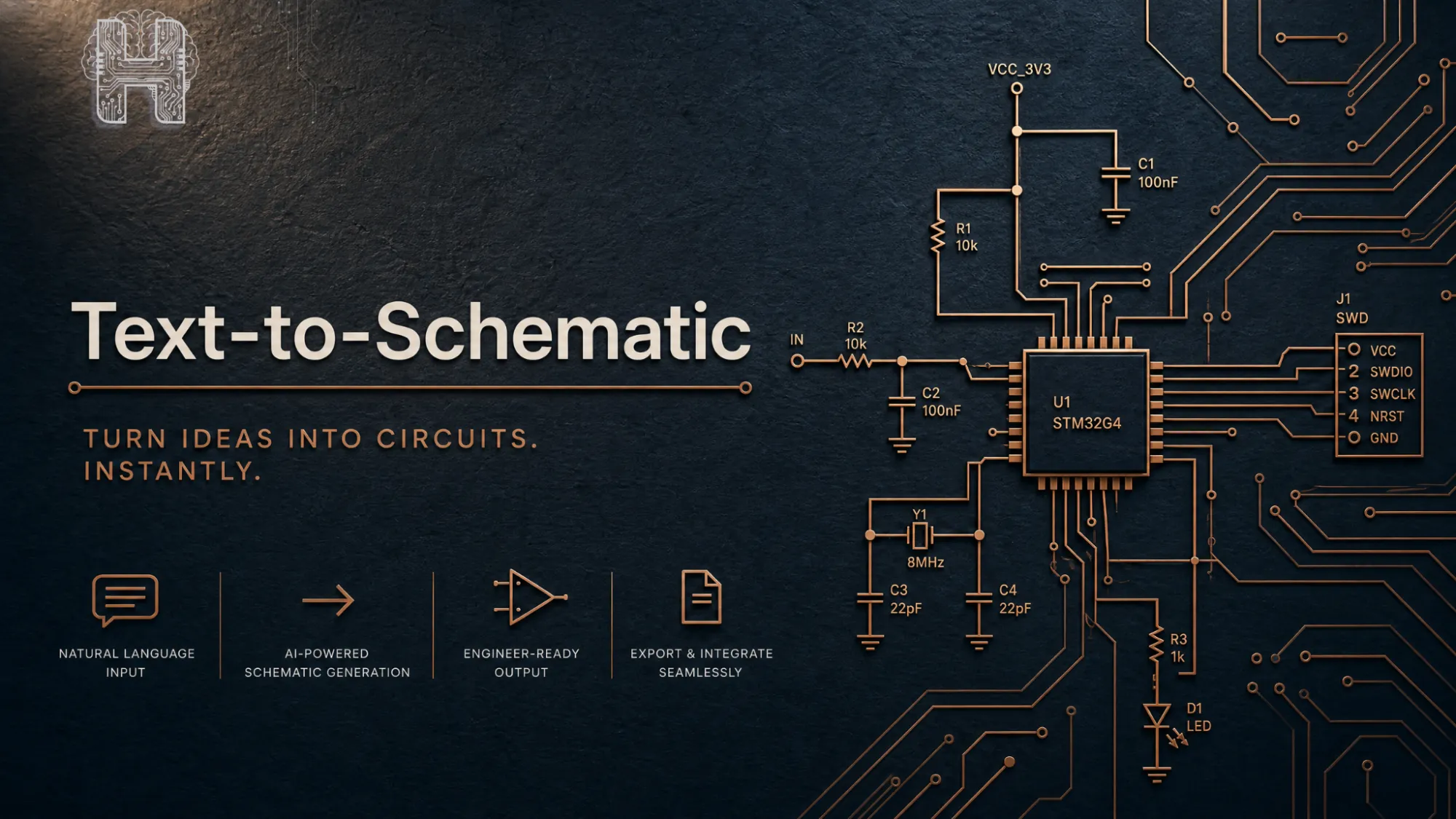

Building an electronic circuit has traditionally required extensive knowledge of electronics, manual schematic capture software, and hours of design work. Engineers first create a schematic, select components, validate connections, and then move to PCB layout before manufacturing and PCB assembly.
Today, AI circuit design tools have flipped that process on its head. With platforms like Helektron, you can describe what you want in plain English and get a working design in return no engineering degree required. While this workflow is effective, it can be time-consuming, especially during the early design stage.
Today, AI circuit design is transforming how electronic products are created. Instead of manually drawing every connection, engineers can simply describe the functionality they need, and an AI schematic generator converts that description into a structured working design. This modern approach reduces repetitive work, accelerates product development, and makes hardware design more accessible than ever before.
What Is Text-to-Schematic and How Does It Work?
Text-to-schematic is an AI-powered technology that converts natural language into an electronic circuit schematic. Rather than starting with a blank canvas, users describe what they want to build for example, a battery-powered temperature monitoring system with Wi-Fi connectivity or an LED driver with overcurrent protection.
The AI analyzes the requirements, identifies suitable electronic components, and generates a logical schematic that serves as the foundation for a working design. Unlike traditional schematic capture software, which requires manual placement and wiring of every component, AI automates the initial design process while still allowing engineers to review, modify, and validate the final schematic.
How Build Circuits with AI | Helektron Turns Text into a Schematic
An AI schematic generator takes a natural-language prompt and converts it into an electronic schematic the diagram that shows how components like resistors, capacitors, and microcontrollers connect to each other. Instead of manually placing parts in schematic capture software, you describe the function you want (say, "a battery charger with overcurrent protection") and the AI handles component selection, connections, and layout logic.
This doesn't replace circuit design software like KiCad it works alongside it. Build Circuits with AI | Helektron, as an AI PCB design tool, lets you export directly into formats compatible with KiCad and other industry-standard programs, so you can fine-tune the design further if needed.
As an advanced AI circuit design platform, Build Circuits with AI | Helektron helps users:
• Generate electronic schematics from simple text descriptions.
• Reduce repetitive manual design tasks.
• Speed up hardware prototyping.
• Create projects ready for PCB layout.
• Improve productivity for engineers, students, and hardware teams.
How to Describe a Circuit for Best Results
The output is only as good as the input. A few tips for writing prompts that lead to a clean, working design:
• State the function, not just the parts. Instead of "resistor and LED," try "an LED indicator that turns on when voltage exceeds 5V."
• Include constraints. Mention voltage range, current limits, board size, or power source (battery vs. mains) if they matter.
• Name protection requirements. If your circuit needs a circuit breaker, fuse, or overcurrent protection, say so explicitly — AI tools won't assume safety features unless asked.
• Specify the use case. "For a wearable device" vs. "for an industrial control panel" leads to very different component choices.
• Iterate. Treat the first output as a draft. Refine your prompt based on what the AI generates, the same way you'd revise a rough sketch.
From AI Schematic to PCB with Build Circuits with AI | Helektron
A schematic is only the beginning of the hardware development process. After the design is reviewed, it moves to PCB layout, design verification, manufacturing preparation, and finally PCB assembly.
An intelligent AI PCB design tool makes this workflow significantly faster by reducing errors during the initial design stage. Once the schematic is complete, engineers can export and continue development in professional circuit design software such as KiCad for detailed PCB routing, design rule checks, and manufacturing file generation.
This combination of AI-assisted schematic generation and professional PCB tools allows engineers to focus more on optimization and innovation rather than repetitive drafting.
From Prompt to Working Design
Once you've described your circuit, a good AI circuit design platform walks through several steps automatically:
1. Component selection- matching your requirements to real, sourceable parts.
2. Schematic generation- laying out the electrical connections.
3. Validation- checking for issues like incorrect polarity or unsupported voltage ranges.
4. Export- producing files ready for PCB assembly or further editing in schematic capture software.
This is where text-to-schematic tools save the most time. What once took an engineer several hours of manual schematic capture can now be reviewed and refined in minutes.
Why AI Circuit Design Is the Future of Electronics
The demand for faster product development has made AI circuit design one of the most significant innovations in electronics engineering. AI is not replacing engineers it is eliminating repetitive tasks that slow down the design process.
Compared with conventional circuit design software, AI-powered workflows offer several advantages:
• Faster schematic generation.
• Reduced manual design errors.
• Easier design iterations.
• Improved productivity.
• Better accessibility for PCB design for beginners.
Why Build Circuits with AI | Helektron Is the best Fit for PCB Design Beginners
For newcomers to PCB design, the traditional learning curve is steep understanding component datasheets, trace routing, and design rules takes time. Build Circuits with AI | Helektron lowers that barrier significantly by acting as an AI schematic generator built for exactly this gap. Beginners can go from an idea to a testable prototype without first mastering every detail of electrical engineering, while still producing files clean enough to send off for PCB assembly.
For further Details contact
Team Helektron at +91 87965 06854
Read more about: How AI is changing the circuit design in 2026
Or visit website helektron.ai

























Sign in to leave a comment.