
One of the biggest mistakes Amazon sellers make is evaluating opportunities too quickly.
A product shows strong revenue.
Competition seems manageable.
The niche looks attractive.
Decision made.
Unfortunately, markets are rarely that simple.
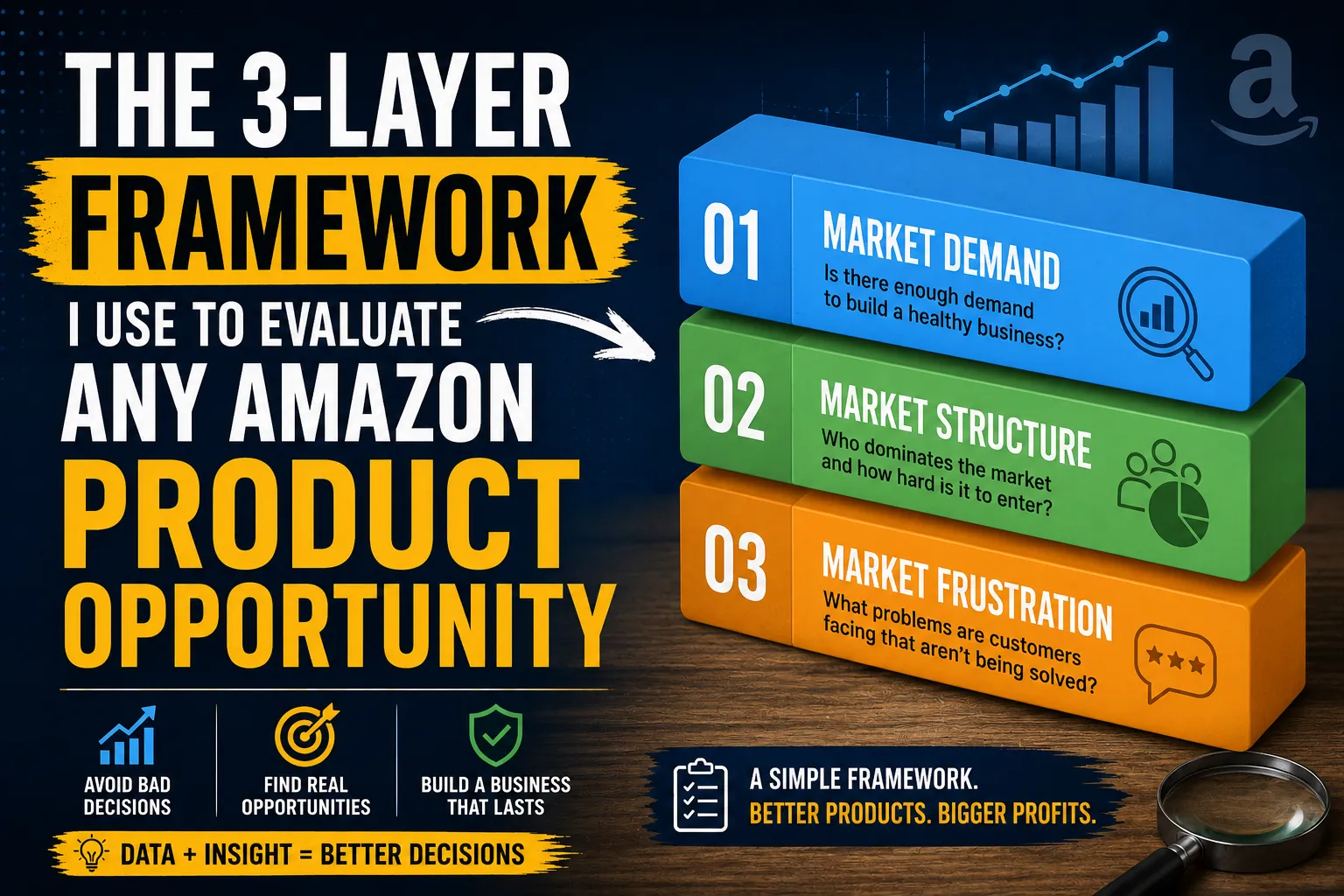
Over time, I've found that the best product opportunities usually pass through three different filters before they're worth serious consideration.
I call it the 3-Layer Evaluation Framework.
Layer 1: Market Demand
The first question is obvious:
Do customers actually want this product?
Without demand, nothing else matters.
At this stage, I focus on:
- Search volume
- Revenue estimates
- Market size
- Demand consistency
Tools like Helium 10 Black Box can provide a quick overview of whether a market is active enough to justify deeper research.
But this stage is only the beginning.
Strong demand alone does not create a good opportunity.
Layer 2: Market Structure
Once demand is confirmed, the next question becomes:
Who already owns this market?
This is where many sellers get into trouble.
A niche may generate millions in annual sales while remaining extremely difficult to enter.
I look for:
- Brand concentration
- Review distribution
- Listing quality
- PPC intensity
For example, if three brands control 80% of category revenue, the opportunity may be less attractive than the revenue numbers suggest.
Understanding market structure often reveals risks hidden beneath the surface.
Layer 3: Market Frustration
This is the layer most sellers ignore.
And often the most important one.
The question is:
What are customers unhappy about?
I spend time reading:
- Reviews
- Questions
- Product complaints
- Competitor weaknesses
If customers repeatedly mention the same frustration, a potential opportunity may exist.
A market with demand and dissatisfaction is often more attractive than a market with demand and complete satisfaction.
Because improvement becomes possible.
Why Most Sellers Stop Too Early
Many Amazon sellers stop after Layer 1.
They see:
- High revenue
- Growing demand
and assume they've found a winner.
The problem is that demand only tells you that money is changing hands.
It doesn't tell you:
- How difficult the market is
- How strong competitors are
- Whether customers are happy
Those factors often determine whether a launch succeeds.
The Power of Combining Data and Insight
Modern Amazon tools provide incredible visibility.
Platforms like Helium 10 help sellers understand:
- Keyword demand
- Competitive activity
- Market trends
But the strongest decisions happen when data is combined with customer insight.
Numbers tell you what is happening.
Customers tell you why.
Both are necessary.
Final Thoughts
Product research doesn't need to be complicated.
But it should be systematic.
Before entering any market, ask:
- Is there demand?
- What does the competitive landscape look like?
- Where are customers dissatisfied?
If a niche passes all three tests, it's usually worth investigating further.
And in a marketplace as competitive as Amazon, having a framework often beats relying on instinct alone.
SECURE YOUR MATRIX COMMAND Use Promo Code: AMZBEIBEI20 to unlock the Helium 10 Suite and begin architecting your multi-account empire today.



























Sign in to leave a comment.