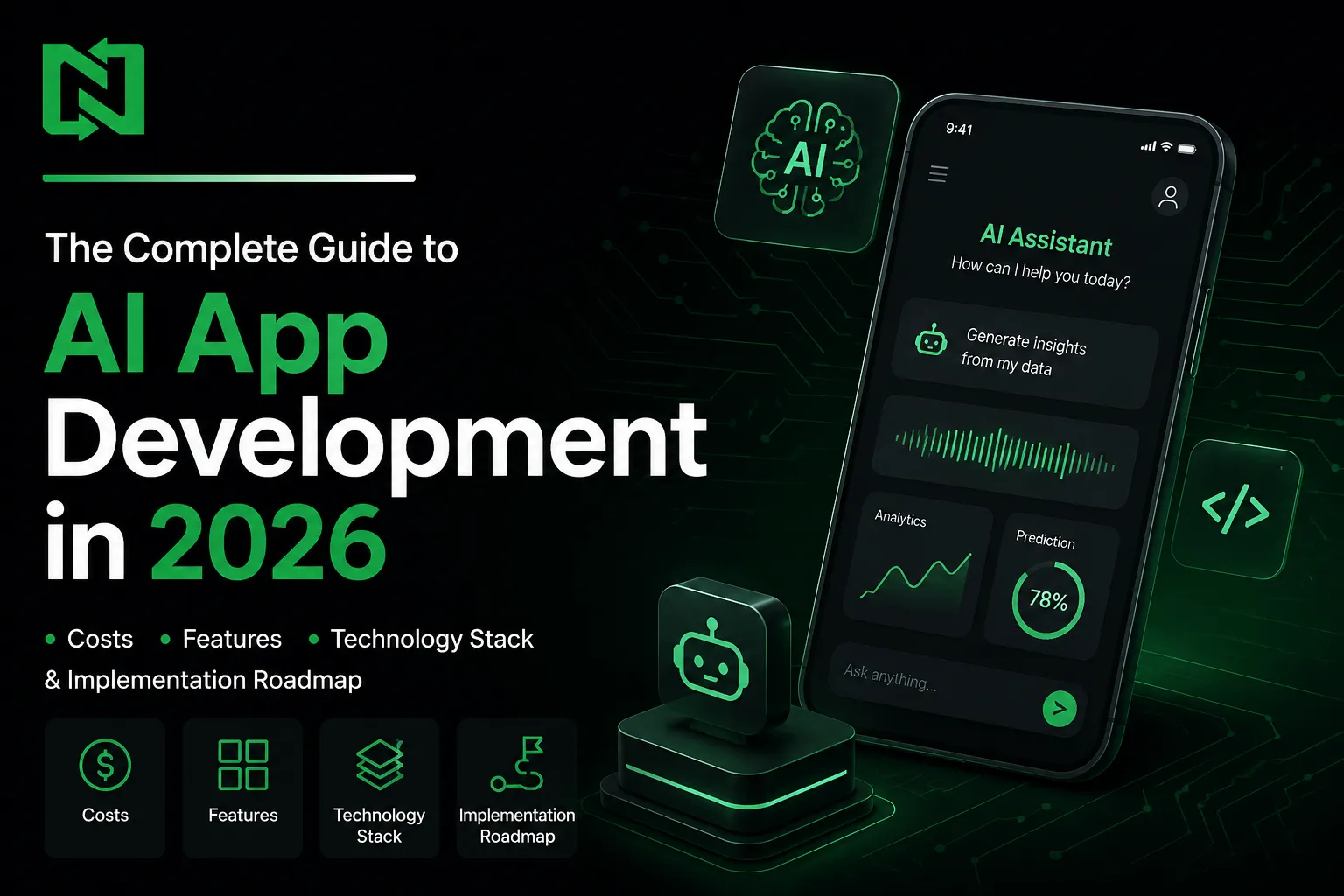

Artificial intelligence is no longer a luxury reserved for large technology corporations. In 2026, businesses of every scale, from early-stage startups to regulated enterprises, are integrating AI into their core products. However, the gap between a promising concept and a production-ready AI application is wider than most founders and product teams anticipate.
This guide breaks down everything you need to know before budgeting, building, or scaling an AI-powered product. It covers real cost ranges, team structures, technology choices, compliance obligations, and a phase-by-phase roadmap designed for decision-makers and technical leads alike.
If you are searching for a trusted partner to bring your vision to life, explore Noukha as your AI App Development Company in USA. The sections below will help you prepare the right questions before that conversation.
1. What Drives AI App Development Costs in 2026
Before reviewing any number, it helps to understand the variables that push costs up or down. Two teams building an AI chatbot can land at vastly different price points depending on the infrastructure they choose, the compliance environment they operate in, and the maturity they need on day one.
Core Cost Drivers at a Glance
| Cost Factor | Impact Level | Notes |
| AI Model Selection | Very High | Hosted API vs. self-hosted changes both cost structure and architecture |
| Data Volume | High | More tokens processed means higher inference and storage costs |
| User Scale | Medium | Concurrent users affect infrastructure provisioning |
| Security Requirements | High | Enterprise-grade security adds tooling, auditing, and specialist hours |
| Regulatory Compliance | High | HIPAA, SOC 2, GDPR each require dedicated engineering effort |
| Third-Party API Integrations | Medium | CRM, ERP, or data platform connectors add scope |
| Cloud Infrastructure | High | Multi-region, redundancy, and autoscaling increase monthly spend |
These factors do not operate in isolation. A healthcare application, for example, may face high impact from four or five rows simultaneously, which is why enterprise AI projects in regulated sectors carry significantly higher price tags than consumer-facing MVPs.
2. Hosted LLM APIs vs. Self-Hosted Open Source Models
This is the first major architectural decision every AI product team faces. Neither option is universally superior. The right choice depends on your data policies, budget horizon, team maturity, and regulatory context.
Option A: Hosted LLM APIs
Cloud-based model providers handle infrastructure, updates, and scaling on your behalf. You pay for usage and receive enterprise service agreements in return.
Common Examples
• OpenAI GPT series
• Anthropic Claude
• Google Gemini
Key Advantages
• Faster time to market with minimal infrastructure configuration
• Automatic model updates without redeployment overhead
• Predictable uptime backed by enterprise SLAs
• Lower upfront capital expenditure
Primary Challenges
• Costs scale with usage, making high-volume applications expensive
• Vendor lock-in creates switching costs if pricing or policies change
• Data residency requirements may conflict with sending information to third-party APIs
Estimated Monthly API Costs by User Volume
| Monthly Active Users | Estimated Monthly Cost (USD) |
| 1,000 | $500 to $2,000 |
| 10,000 | $3,000 to $15,000 |
| 100,000 and above | $20,000 to $100,000+ |
Option B: Self-Hosted Open Source Models
Deploying your own model on private or cloud infrastructure gives you full control over data and long-term inference costs, but requires significant operational investment.
Common Examples
• Meta Llama (enterprise variants)
• Mistral AI models
• Alibaba Qwen enterprise series
• DeepSeek models
Key Advantages
• No outbound data transmission to third-party providers
• Lower per-query costs at high volume once infrastructure is established
• Full customization through fine-tuning on proprietary datasets
Primary Challenges
• GPU cluster costs are significant and recurring
• Requires dedicated MLOps engineering capability
• Model updates and safety patches become your team's responsibility
Estimated Monthly Infrastructure Costs by Deployment Size
| Deployment Scale | Monthly Infrastructure Cost (USD) |
| Small (1-50 concurrent users) | $2,000 to $8,000 |
| Medium (50-500 concurrent users) | $10,000 to $30,000 |
| Enterprise (500+ concurrent users) | $30,000 to $150,000+ |
Recommendation: For most startups and small-to-midsize businesses, hosted APIs provide the fastest path to a working product. For regulated industries where data cannot leave your environment, a self-hosted or hybrid architecture is worth the additional engineering investment from day one.
3. AI App Development Cost Ranges in 2026
Costs vary widely based on scope, team composition, and the maturity of the product. The three tiers below represent the most common project profiles.
Tier 1: Minimum Viable Product (MVP)
| Attribute | Details |
| Budget Range | $25,000 to $75,000 |
| Typical Timeline | 8 to 12 weeks |
| Core Features | Authentication, AI chat interface, knowledge base search, analytics dashboard, cloud deployment |
| Best For | Startups validating a hypothesis or demonstrating capability to investors |
Tier 2: Growth-Stage AI Platform
| Attribute | Details |
| Budget Range | $75,000 to $250,000 |
| Typical Timeline | 3 to 6 months |
| Core Features | Multi-user system, retrieval-augmented generation (RAG), workflow automation, third-party integrations, AI monitoring |
| Best For | Companies with validated demand scaling toward a broader user base |
Tier 3: Enterprise AI Ecosystem
| Attribute | Details |
| Budget Range | $250,000 to $1,000,000+ |
| Typical Timeline | 6 to 12 months |
| Core Features | Multi-agent orchestration, internal knowledge systems, compliance controls, private model deployment, advanced analytics |
| Best For | Large organizations replacing legacy processes or building internal AI platforms at scale |
4. Real-World Case Studies
Case Study A: AI Customer Support Assistant for a SaaS Startup
The Business Problem
A growing SaaS company was experiencing unsustainable support ticket volume. Response times were increasing, customer satisfaction scores were declining, and hiring additional agents was not economically viable at the current revenue stage.
The Solution
The team built an AI-powered support assistant that could answer product questions by searching through customer documentation and past ticket resolutions. The system used a hosted language model API connected to a vector search database populated with the company's knowledge base.
Team Composition
| Role | Allocation |
| Product Manager | 20% of time |
| AI Engineer | Full time |
| Backend Developer | Full time |
| Frontend Developer | Part time |
| QA Engineer | Part time |
Outcomes
| Metric | Result |
| Total Investment | $45,000 over 10 weeks |
| Ticket Deflection Rate | 60% of incoming queries handled without human intervention |
| Response Time Improvement | 35% faster average resolution |
| Support Availability | 24 hours a day, 7 days a week |
| Return on Investment | Positive ROI achieved within 4 months of deployment |
Case Study B: Enterprise Knowledge Intelligence Platform for Healthcare
The Business Problem
A healthcare enterprise needed a secure system that could retrieve accurate information from thousands of internal documents across multiple departments. Existing search tools returned irrelevant results and could not interpret the intent behind queries.
The Solution
The team built a private RAG platform with a self-hosted language model, role-based access controls tied to departmental permissions, and full audit logging for regulatory traceability. Document ingestion pipelines ran nightly to keep the knowledge base current.
Team Composition
| Role | Allocation |
| Product Owner | Full time |
| AI Architect | Full time |
| AI Engineers | 2 full time |
| Backend Engineers | 2 full time |
| Frontend Engineers | 2 full time |
| DevOps Engineer | Full time |
| Security Specialist | Part time |
| QA Team | 2 members |
Outcomes
| Metric | Result |
| Total Investment | $480,000 over 9 months |
| Document Search Time | 75% reduction in time to locate relevant records |
| Productivity Improvement | 40% increase across measured workflows |
| Compliance | HIPAA-aligned architecture with full audit trail |
| Adoption | Enterprise-wide rollout completed within 60 days of launch |
5. AI App Development Roadmap: Phase by Phase
Phase 1: Discovery and Planning (Weeks 1 to 4)
This phase is about alignment before any code is written. Teams that skip structured discovery often discover costly misalignments in week eight.
Key Activities
• Structured requirements workshops with all primary stakeholders
• Use case prioritization based on business value and technical feasibility
• Compliance and data governance review
• AI architecture decision and vendor evaluation
• Resource planning and risk identification
Primary Deliverables
• Product requirements document and prioritized backlog
• AI architecture diagram with data flow documentation
• Signed-off budget estimate and milestone schedule
Phase 2: MVP Development (Weeks 5 to 12)
The goal of this phase is a functional product that can be tested with real users. Scope discipline is critical. Features that are not essential to validating the core hypothesis should be moved to a later phase.
Key Activities
• UI and UX design with iterative prototyping
• AI model integration and prompt engineering
• Backend service development and API construction
• Initial automated and manual quality assurance testing
Primary Deliverables
• Deployed MVP accessible to a defined set of test users
• Initial user testing results and documented findings
Phase 3: Pilot Launch (Months 4 to 6)
A controlled rollout to a limited user group reveals how the product performs under real conditions. This phase generates the data needed to justify further investment.
Key Activities
• Phased user onboarding with structured feedback collection
• AI model performance tuning based on production traffic
• Monitoring and alerting infrastructure setup
Primary Deliverables
• Performance benchmarking reports
• Prioritized enhancement backlog based on user feedback
Phase 4: Scale and Optimization (Months 7 to 12)
With validated product-market fit, the focus shifts to reliability, security, and expanding capabilities to capture more of the addressable use case.
Key Activities
• Infrastructure autoscaling and cost optimization
• Security hardening and penetration testing
• Advanced AI features such as multi-agent workflows
• Workflow automation to reduce manual intervention
Primary Deliverables
• Enterprise-ready platform capable of supporting full user base
• Operational dashboards for business and engineering stakeholders
6. Team Roles and Effort Estimates
The table below provides realistic hour ranges by role across different project tiers. These are planning benchmarks, not fixed quotes. Actual hours depend on scope, integrations, and iteration requirements.
| Role | Hours (MVP) | Hours (Growth) | Hours (Enterprise) |
| Product Manager | 160 to 240 | 300 to 500 | 500 to 800 |
| AI Architect | 120 to 200 | 200 to 400 | 400 to 800 |
| AI Engineer | 400 to 800 | 600 to 1,200 | 1,500 to 3,000 |
| Backend Developer | 300 to 700 | 500 to 1,000 | 1,000 to 2,500 |
| Frontend Developer | 200 to 500 | 300 to 700 | 700 to 1,500 |
| DevOps Engineer | 120 to 250 | 200 to 400 | 400 to 900 |
| QA Engineer | 150 to 300 | 250 to 500 | 500 to 1,000 |
| Security Specialist | 40 to 120 | 120 to 250 | 250 to 600 |
Total effort ranges: MVP projects typically require 800 to 1,200 hours. Growth-stage platforms run from 1,500 to 3,000 hours. Enterprise ecosystems often exceed 4,000 hours and can reach 8,000 hours or more for complex multi-system integrations.
7. Legal and Compliance Checklist Before Production Deployment
Deploying an AI application without addressing compliance is not just a legal risk. It is a reputational risk that can surface at the worst possible moment. The checklist below applies broadly, though specific obligations vary by jurisdiction and industry.
Data Governance
• Data retention policy documented and enforced at the infrastructure level
• Automated data deletion workflows tested and operational
• Data residency requirements reviewed against cloud provider regions
User Privacy
• Consent mechanism in place before any personal data is processed by AI
• Privacy policy updated to reflect AI data usage
• User opt-out pathway functional and tested
AI Governance
• Model provenance documented including version, training methodology, and known limitations
• Training data sources reviewed for licensing compliance and bias risk
• Bias testing completed across representative demographic segments
• Human oversight process defined for high-stakes decisions
Security
• All stored data encrypted at rest using current standard algorithms
• All data in transit encrypted via TLS 1.3 or above
• Role-based access controls configured and tested
• Audit logging active and output stored in tamper-resistant storage
8. AI Technology Stack for 2026
Multimodal AI Models
Modern AI applications increasingly process multiple input types within a single session. A customer service platform might accept a typed question, a product image, and a voice recording simultaneously. Building for this from the start avoids costly re-architecture later.
Common model choices in production environments as of 2026 include GPT-5 series models, Claude 4 from Anthropic, Gemini 2.x from Google, Llama enterprise variants, and Qwen enterprise models from Alibaba.
Vector Database Comparison
Retrieval-augmented generation architectures depend on vector databases to surface relevant context before model inference. Each option has distinct strengths.
| Vector Database | Primary Strengths | Best Suited For |
| Pinecone | Fully managed, minimal configuration | Startups prioritizing speed over control |
| Weaviate | Hybrid keyword and semantic search | Enterprise applications needing both search modes |
| Milvus | Open source with high scalability | Large-scale deployments with dedicated MLOps teams |
| Qdrant | Cost-efficient with strong filtering capabilities | Mid-market teams with budget constraints |
| pgvector | Native PostgreSQL extension | Teams with existing relational database infrastructure |
Edge AI Inference Frameworks
Running model inference at the edge rather than in centralized cloud data centers reduces latency, lowers ongoing cloud spend, and keeps sensitive data on-device. Key frameworks used in 2026 production deployments include ONNX Runtime, TensorRT, ExecuTorch, MediaPipe, Core ML, and TensorFlow Lite.
Model Governance and Observability Tools
Enterprise AI teams are increasingly required to demonstrate that their models behave as intended and that decisions can be explained to auditors or regulators. The tooling landscape has matured significantly.
Documentation Standards
• Model Cards: structured summaries of model capabilities, limitations, and intended use
• Data Sheets for Datasets: provenance documentation for training and evaluation data
Monitoring and Observability Platforms
• Langfuse: open source LLM observability with prompt version tracking
• Arize AI: production model monitoring with drift detection
• WhyLabs: data quality and model performance monitoring
• MLflow: experiment tracking, model registry, and deployment management
• Weights and Biases: experiment visualization and collaboration
9. How to Choose the Right AI Development Partner
Selecting a development partner for an AI project is materially different from hiring a conventional software agency. The technical landscape changes quarterly, compliance requirements vary by geography and industry, and the gap between a prototype and a production system is significant.
When evaluating a potential partner, look for demonstrated experience with the specific AI architecture your use case requires, not just general software development credentials. Ask for examples of production deployments, not just demos. Request references from clients in your sector, particularly if you operate in a regulated industry.
Transparency around cost estimation methodology matters. Partners who provide fixed quotes without discovery tend to make up the difference in change orders. A credible partner will conduct a scoping phase, surface unknowns early, and present estimates with clearly stated assumptions.
Noukha works with startups and enterprises across the United States to plan, build, and scale AI applications. As an experienced AI App Development Company in USA, the team brings end-to-end capability covering AI strategy, architecture, development, compliance alignment, and post-launch optimization.
Conclusion
Building a production-ready AI application in 2026 requires clear thinking about model selection, infrastructure ownership, team composition, compliance obligations, and realistic budget expectations. The companies that succeed are those that treat discovery seriously, choose partners with deep AI expertise, and plan for ongoing maintenance from the start.
Whether your immediate need is an MVP to validate a product thesis or an enterprise platform to replace a legacy process, the frameworks, cost ranges, and case studies in this guide provide a foundation for informed decisions. The investment in planning before development nearly always reduces total project cost and time to value.
To discuss your specific requirements with an experienced team, visit Noukha's AI App Development Company in USA services page to start a conversation.
Author Bio – Ramanathan Alagappan
Ramanathan Alagappan is the Founder and CEO of Noukha, a technology consulting and product development firm focused on building AI-powered applications, custom software solutions, and scalable digital platforms. Since founding Noukha in 2024, he has helped startups, enterprises, and growing businesses transform ideas into market-ready products through a combination of strategic thinking, modern engineering, and emerging technologies.
With expertise spanning artificial intelligence, mobile app development, cloud architecture, SaaS platforms, and digital transformation, Ramanathan specializes in designing solutions that balance innovation with real-world business outcomes. His approach combines enterprise-grade execution standards with startup agility, enabling organizations to accelerate growth, improve operational efficiency, and create exceptional customer experiences.
Under his leadership, Noukha has established itself as a trusted technology partner for businesses seeking to leverage AI, automation, and custom software to gain a competitive advantage. Ramanathan is passionate about helping organizations navigate the rapidly evolving technology landscape and build products that are scalable, secure, and future-ready.




















Sign in to leave a comment.