
If you've ever tried to lose weight, gain weight, or just eat "better," you've probably run into a wall of confusing advice. Cut carbs. Don't cut carbs. Eat six small meals. Eat two big ones. Count calories. Don't count calories, just eat clean.
It's exhausting, and most of it skips over the one number that actually ties everything together: your TDEE.
If you've never heard that term before, don't worry — this guide assumes zero prior knowledge. By the end, you'll understand exactly what TDEE is, why it matters more than any specific diet trend, how to calculate your own, and the mistakes almost every beginner makes when they first start using it.
Let's start from the very beginning.
1. What TDEE Is (and Why It Matters More Than Just Watching What You Eat)
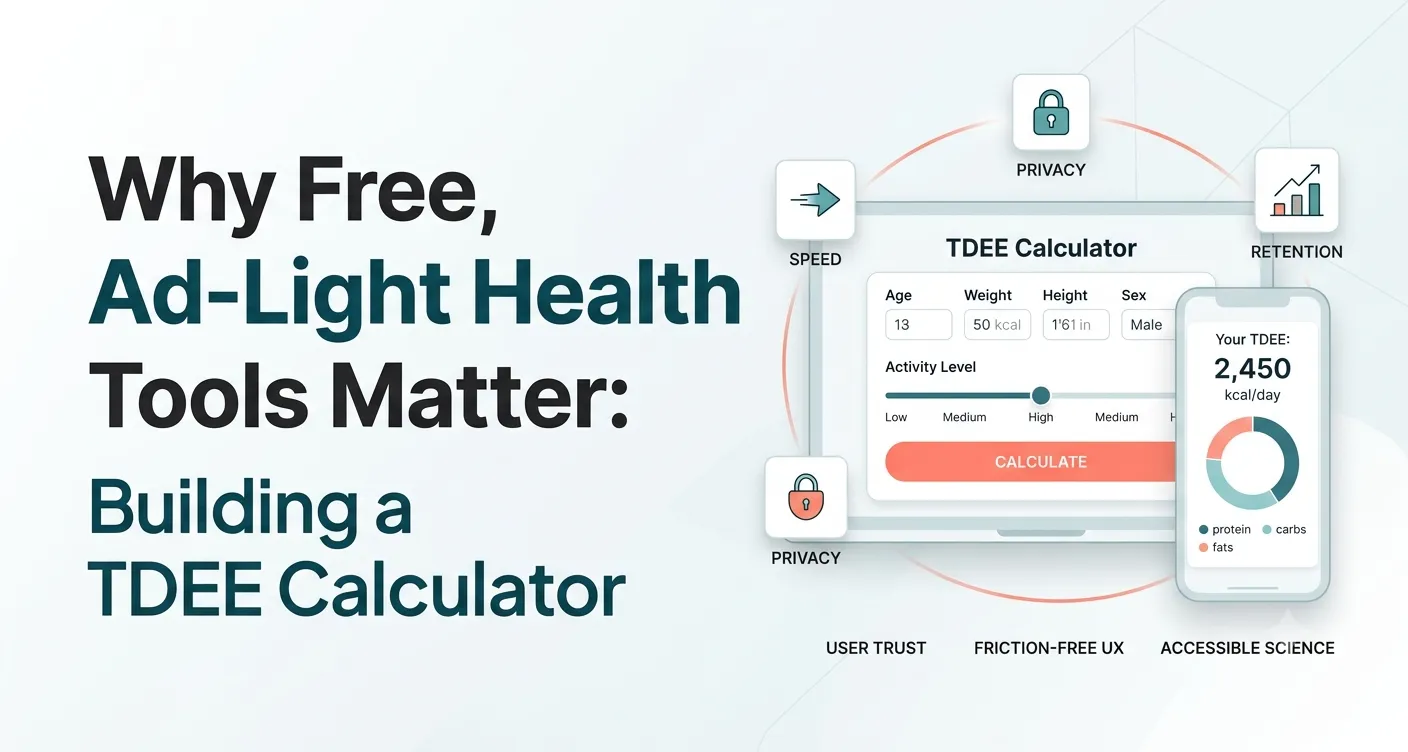
TDEE stands for Total Daily Energy Expenditure. In plain language, it's the total number of calories your body burns in a single day.
That's it. That's the whole concept. Your body burns calories constantly, even when you're not doing anything that feels like "exercise." Right now, as you read this, your body is burning calories to keep your heart beating, your lungs breathing, your brain thinking, and your cells repairing themselves. That baseline burn happens whether you're at the gym, at your desk, or asleep in bed.
TDEE adds up all of that background burning, plus the extra calories you burn from movement, exercise, and even the process of digesting food itself. It's usually broken into a few components:
- Basal Metabolic Rate (BMR): the calories your body burns just to stay alive, doing absolutely nothing. This is usually the biggest chunk of your TDEE, often somewhere around 60-70% of your total.
- Non-Exercise Activity Thermogenesis (NEAT): calories burned from everyday movement that isn't formal exercise — walking around your house, fidgeting, doing chores, typing, standing up from your chair. This varies a lot between people and is a bigger factor than most beginners realize.
- Exercise Activity: calories burned specifically from workouts, sports, or intentional physical activity.
- Thermic Effect of Food (TEF): calories your body spends digesting and processing the food you eat. Yes, eating itself burns a small number of calories.
Add all of that together, and you get your TDEE — the true total of everything your body burns in a 24-hour period.
Why does this matter more than just "watching what you eat"?
Because "watching what you eat" without knowing your TDEE is like trying to manage a budget without knowing your income. You can be very disciplined about spending less, but if you don't know how much money is actually coming in, you're just guessing whether you're saving, breaking even, or going into debt.
Calories work the same way. Your body weight changes based on the relationship between calories in (what you eat) and calories out (your TDEE). If you eat less than your TDEE consistently, you'll lose weight. If you eat more, you'll gain weight. If you eat roughly the same as your TDEE, your weight will stay stable.
Without knowing your TDEE, "eating healthy" or "eating less" is a vague, directionless goal. You might be eating fewer calories than you used to, but still eating more than your body actually needs — and wondering why the scale isn't moving. Or you might be under-eating far more than necessary, feeling miserable for no extra benefit. TDEE turns a fuzzy goal into an actual number you can plan around.
2. Why TDEE Matters Especially for Beginners
If you're brand new to trying to change your weight or body composition, TDEE matters even more than it does for someone who's been at this for years. Here's why.
It replaces guesswork with a starting point. Beginners often start a fitness or weight goal by just "eating less" or "eating clean," with no real target. That approach can work for a little while through sheer willpower, but it's fragile — because you have no actual number to measure against. Knowing your TDEE gives you an anchor point. You're no longer guessing whether a day of eating was "good enough." You have an actual target range to compare against.
It prevents two very common beginner mistakes: eating way too little, or barely creating any deficit at all. Without a TDEE estimate, beginners tend to fall into one of two traps. Some undereat aggressively, assuming that less is always better, which often leads to fatigue, irritability, and eventually burnout or bingeing. Others think they're eating in a deficit but are actually eating close to or even above their TDEE, because they've underestimated how many calories are in their normal meals. Both mistakes are avoidable once you have a real number to work from.
It builds an honest feedback loop. One of the most valuable things TDEE does for a beginner is turn your results into information instead of mystery. If you're eating below your estimated TDEE and not losing weight after a couple of weeks, that's useful data — it tells you your real TDEE might be a bit different than the formula estimated, and you can adjust. Without a TDEE estimate to compare against, you have no baseline to know whether your results make sense or not.
It reduces the emotional rollercoaster of "diet culture" thinking. A lot of beginner frustration with weight goals comes from treating food as morally "good" or "bad," rather than as a simple energy input. Framing things around TDEE shifts the mental model from "I was bad today" to "I ate above my number today" — a more neutral, less emotionally loaded way to track progress. This matters a lot for people who are just starting out and are especially vulnerable to discouragement and all-or-nothing thinking.
It applies to every type of goal, not just weight loss. Beginners sometimes assume TDEE is only relevant if you're trying to lose weight, but it's just as important if your goal is to gain weight (for muscle building) or simply maintain your current weight while changing your diet quality. In every case, TDEE is the reference point you eat around.
3. How to Calculate Your TDEE (The Basic Formula Approach)
Now let's get into the actual math. Don't worry — you don't need to be good at math to do this. It's really just a couple of simple steps.
Step 1: Calculate Your BMR
Your BMR (Basal Metabolic Rate) is the foundation of your TDEE calculation. There are a few different formulas fitness professionals use, but the most common and generally considered fairly accurate is the Mifflin-St Jeor equation. Here's what it looks like:
For men: BMR = (10 × weight in kg) + (6.25 × height in cm) − (5 × age in years) + 5
For women: BMR = (10 × weight in kg) + (6.25 × height in cm) − (5 × age in years) − 161
Let's walk through an example so this feels less abstract. Say you're a 30-year-old woman, weighing 70 kg, standing 165 cm tall.
BMR = (10 × 70) + (6.25 × 165) − (5 × 30) − 161 BMR = 700 + 1031.25 − 150 − 161 BMR = 1420.25
So this person's estimated BMR is roughly 1,420 calories per day — that's the number of calories her body would burn if she stayed in bed all day doing nothing.
If you're more comfortable with pounds and inches instead of kilograms and centimeters, most online TDEE calculators (including free tools built specifically for this) will do the unit conversion automatically, so you don't need to do that math by hand.
Step 2: Multiply by an Activity Multiplier
Since almost nobody actually spends the whole day lying in bed, the next step is multiplying your BMR by an activity multiplier that reflects how active your day-to-day life actually is. These multipliers are standardized categories:
- Sedentary (little or no exercise, desk job): BMR × 1.2
- Lightly active (light exercise 1-3 days/week): BMR × 1.375
- Moderately active (moderate exercise 3-5 days/week): BMR × 1.55
- Very active (hard exercise 6-7 days/week): BMR × 1.725
- Extra active (very hard exercise, physical job, or training twice a day): BMR × 1.9
Continuing our example: if this 30-year-old woman has a desk job and only exercises lightly a couple times a week, she'd fall into the "lightly active" category.
TDEE = 1420.25 × 1.375 TDEE = 1952.8
So her estimated TDEE would be roughly 1,953 calories per day — the total number of calories her body burns including her daily activity, not just her baseline functions.
Step 3: Use That Number as Your Starting Reference Point
Once you have your TDEE estimate, here's roughly how to use it depending on your goal:
- To lose weight: eat somewhat below your TDEE, commonly a deficit of 300-500 calories per day for a gradual, sustainable pace
- To gain weight/muscle: eat somewhat above your TDEE, commonly a surplus of 200-400 calories per day
- To maintain your current weight: eat close to your TDEE
It's worth saying clearly: this initial number is an estimate, not a precise measurement of your unique metabolism. It's calculated from population averages, so it gets you into a reasonable ballpark, but your actual body might burn a bit more or less than the formula predicts. That's completely normal, and it's exactly why the next section matters so much.
4. Common Pitfalls Beginners Hit With TDEE
Understanding the concept and doing the math correctly is only half the battle. Most beginners run into the same handful of mistakes once they start actually using their TDEE number in real life. Here are the big ones.
Pitfall #1: Guessing Their Activity Level Too Generously
This is probably the single most common mistake. People tend to overestimate how active they actually are. Someone who works a desk job and works out three times a week might select "moderately active" or "very active," when in reality, unless the rest of their day involves a lot of walking or movement, "lightly active" or even "sedentary" might be more accurate.
Why does this matter so much? Because a too-generous activity multiplier inflates your TDEE estimate, which means you'll be eating more than your body actually needs while thinking you're in a deficit. This is one of the most common reasons beginners feel like they're "doing everything right" but not seeing results — the starting estimate was too high from the beginning.
The fix here is simple honesty. If most of your day is spent sitting — at a desk, in a car, on a couch — you're probably more sedentary than you think, even if you hit the gym a few times a week. Formal exercise sessions are usually a smaller slice of your total daily movement than people assume.
Pitfall #2: Never Recalculating
A lot of beginners calculate their TDEE once, write the number down, and never touch it again — sometimes for months or even years. This is a mistake, because TDEE isn't a fixed, permanent number. It changes as your body weight changes, as your activity level changes, and even due to natural metabolic adaptation over time.
Here's a concrete example of why this matters: if you started at 80 kg and successfully lost 10 kg over a few months, your TDEE at 70 kg will genuinely be lower than it was at 80 kg, because a smaller body generally requires fewer calories to maintain. If you keep eating according to your original TDEE calculation from months ago, you might find your weight loss stalling — not because something's wrong with you, but simply because the math itself changed as your body did.
The fix is to treat your TDEE as a living number, not a one-time output. Recalculate every several weeks, especially after meaningful weight changes, or better yet, use a tool that adjusts your estimate automatically based on your actual logged results over time rather than requiring you to redo the math manually.
Pitfall #3: Ignoring Water Weight Fluctuation
This one trips up almost every beginner at some point, and it's completely understandable. Here's the scenario: you step on the scale one morning, and you're up 1-2 kg (2-4 lbs) from the day before, despite eating carefully. Panic sets in. Did something go wrong? Is the diet not working?
In almost all cases, the answer is no — what you're seeing is water weight fluctuation, not fat gain. Body weight naturally fluctuates day to day due to a wide range of factors that have nothing to do with fat: sodium intake, carbohydrate intake (carbs cause your body to retain more water, temporarily), hydration levels, hormonal cycles, digestive contents, and even how much you slept the night before.
None of these factors reflect actual changes in body fat, but they can easily move the scale by a kilogram or two in either direction, sometimes overnight. A beginner who doesn't understand this can end up panicking over completely normal fluctuations, making unnecessary and often unhealthy adjustments to their eating in response to noise rather than a real trend.
The fix is to stop reacting to single-day weigh-ins and instead look at your weight trend over a week or two. A single high or low reading means very little on its own. What matters is the overall direction over time — is your weekly average trending down, up, or staying flat? That trend line is a far more honest reflection of what's actually happening with your body than any individual day's number.
Pitfall #4 (Bonus): Treating the First Number as Gospel
Related to the recalculation issue, but worth calling out separately: many beginners treat their very first TDEE calculation as an unquestionable fact, rather than what it actually is — an educated estimate based on population averages. Two people with identical age, weight, height, and activity level can have genuinely different real-world TDEEs due to differences in muscle mass, hormonal factors, genetics, and other individual variables that a formula simply can't capture.
This doesn't mean the formula is useless — it's a perfectly reasonable starting point. But it does mean you should expect to fine-tune the number based on your actual results, rather than assuming the formula got it exactly right on the first try. If you're eating consistently at your calculated TDEE for weight maintenance and you're steadily gaining or losing weight anyway, that's not a sign you're doing something wrong — it's useful evidence that your real TDEE is somewhat different from the formula's estimate, and you should adjust the number accordingly.
A Few Quick Questions Beginners Often Ask
"Do I need to weigh and measure everything I eat to make this work?"
Not necessarily, at least not forever. When you're first calibrating your TDEE against real results, more accurate logging helps you get a clearer picture faster. But you don't need to weigh every almond for the rest of your life. Many people log carefully for a few weeks to calibrate their number, then loosen up once they have a good sense of their portions and their real TDEE.
"What if my activity level changes a lot from week to week?"
This is common — maybe you're very active some weeks and much more sedentary during busy or stressful periods. If your activity swings a lot, it's often more useful to think in terms of a weekly average rather than trying to nail an exact daily number. Some people even adjust their intake slightly higher on more active days and slightly lower on rest days, while keeping the weekly total consistent with their goal.
"Is a more 'accurate' formula always better than Mifflin-St Jeor?"
Not necessarily. There are other formulas out there — Harris-Benedict, Katch-McArdle (which factors in body fat percentage), and others — and some can be more precise for specific populations, like people with a lot of muscle mass. But for most beginners, Mifflin-St Jeor is a well-regarded, simple starting point, and the difference between formulas usually matters far less than actually tracking your real-world results and adjusting from there.
"What if I calculate my TDEE and it feels really low?"
This happens more often for people who are shorter, smaller-framed, or less active than they assumed. It can feel discouraging, but a lower TDEE doesn't mean something is wrong with you — it just means your calorie targets will need to be a bit more precise, since there's less room for excess. This is exactly the kind of situation where accurate tracking (rather than rough guessing) makes the biggest difference.
Putting It All Together
Here's the beginner-friendly summary of everything above:
- TDEE is the total number of calories your body burns in a day, combining your baseline metabolism, daily movement, exercise, and digestion.
- It matters because it turns a vague goal ("eat healthier") into an actual number you can plan around and measure results against.
- You can estimate it using a BMR formula (like Mifflin-St Jeor) multiplied by an activity level.
- Treat the number as a starting estimate, not a fixed fact — be honest about your activity level, recalculate as your weight changes, and don't panic over daily scale fluctuations that are just water weight, not fat.
If doing this math by hand feels like a lot, you don't have to. There are free tools built specifically to handle all of this for you — calculating your BMR and TDEE from your basic stats, letting you log your weight and meals over time, and adjusting your estimate based on your real results instead of leaving you stuck with a single static number forever.
One option worth checking out is MyTDEECalculatorPro, a free tool that walks you through your initial TDEE estimate and then lets you track your progress over time so the number actually adapts to you, rather than the other way around. It's a solid starting point if you want to put everything in this guide into practice without doing the calculations manually every few weeks.
Whatever tool or method you use, the important thing is this: once you understand your TDEE, you stop guessing. And for anyone just starting out on a weight or fitness goal, that shift — from guessing to actually knowing — tends to make everything else about the process a lot less overwhelming.



























Sign in to leave a comment.