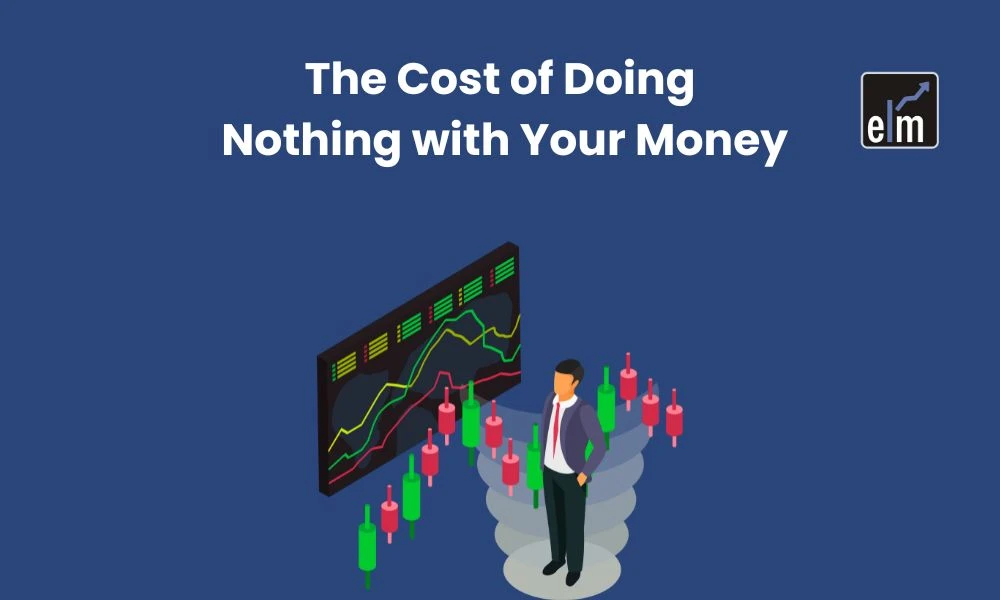

For many individuals, doing nothing with money is the best option. Having money in a savings account or leaving it dormant can be comforting. There is no market fluctuation to be feared, no headlines to monitor, or risk of watching prices change. On the face of it all, it appears prudent and risk-free.
Nevertheless, this sense of security comes with a cost, which most of us realize many years too late. The choice of doing nothing is not an inactive choice. It is a very active choice, similar to all financial choices, which leads us to our future.
When Idle Money Quietly Loses Value
Money left dormant will not remain so. Working behind the scenes will always be inflation, causing your money to shrink in value with each passing day and every dollar having a lower purchasing power.
This is one of the most common experiences a person has in his or her life. Those things which were affordable a few years ago gradually start becoming expensive. The cost of education increases, and the bills for healthcare and living start increasing. Your money has not vanished; the purchasing power has.
"The basic problems involved in money that is idle are straightforward but harmful:"
- Inflation quietly drains savings.
- Bank rates of interest could struggle to match the rising price levels.
- The loss of purchasing power passes by unseen.
"Over time, the effects of erosion start to add up," says Pam Krueger, president ofPAL Adaptive Investment Management, a Milwaukee investment advisory firm that exclusively deals with retirees and pre-retirees with already accumulated assets that range from a couple of million to ten million or more.
The Hidden Cost of Lost Compounding
The worst part of inaction is always not what you lose but what you could have gained. Compound interest values time over anything else, ever. When you invest your money, it gets more chances to grow since it will have had more years to accrue.
Many investors learn about this only after the event. They look back on the long periods they never entered the markets while waiting for the optimal moment. Unfortunately, lost time never comes back.
The actual cost of noncompliance is
- Fewer years for the compounding process.
- Accumulated lower wealth even if you invest more in the later stages.
- More pressure to save heavily for the future in order to catch up.
- Waiting for optimal conditions means that periods of market growth can often be entirely missed.
Why Fear and Inertia Keep Money Stuck
One aspect that prominently affects financial choice includes human behaviour. Markets seem unpredictable, fear is magnified through news, and short-term unpredictability makes one feel quite uneasy about investing in the market.
Some investors choose not to invest at present and wait for a clearer future to invest in the marketplace.
With time, procrastination turns into a habit. The funds stay parked not due to a lack of investment intent, but due to the intimidation of the first step.
Some of the reasons why people put off making an investment include
- "Fear of short-term market fluctuations."
- Overchoice resulting in confusion.
- Overthinking and procrastination.
In avoiding market risk, an investor incurs yet another kind of risk that is not as obvious but is damaging nonetheless: the danger of being left behind.
Mutual Funds – The Real Solution
Mutual funds are a structured approach to transition from passive to proactive. They are suited for those investors who are not interested in continuously monitoring the markets and individual stocks.
Rather than trying to forecast short-term patterns, mutual funds give investors an opportunity to consistently invest over time. They turn idle money into productive capital through diversification, savvy management, and prudence.
The Solution to the Inaction Problem in Mutual Funds
- Mutual funds offer solutions for many emotional and practical pitfalls that investors encounter:
- By diversification, dependence on one stock or one sector is eliminated.
- The need to make decisions constantly is eliminated with professional fund management.
- Systematic Investment Plans facilitate regular investments.
It also helps money to increase beyond inflation.
Compounding, therefore, happens behind the scenes. As time passes, even small investments start to make a difference.
SIPs Turn Hesitation into Habit
Systematic Investment Plans help significantly in bringing behavioural changes. The investments get executed automatically on a fixed interval irrespective of the market situations.
This eliminates the emotional aspect of investing. There are no decisions to make regarding when to invest or concern for short-term fluctuations.
SIPs have several advantages, as they
- They lower the stress of timing the market.
- They smooth out volatility over time.
- They make a habit of consistent investment.
Rather than waiting for the optimal time, SIPs help you remain invested and harvest benefits from time in the market.
The Real Risk Is Standing Still: When it comes to trends
The ups and downs are clear in the market and make people feel risk-averse. The risk of not acting remains invisible yet much more dangerous in the long run.
Functions of true financial risk:
- The purchasing power attains zero.
- Missing years of compounding.
- Failure to meet long-term financial objectives.
While mutual funds do not eliminate market risk, they are managed through time discipline and diversification.
Final Thought
Actually doing nothing with your money may seem very sound from a current perspective, but in truth, passive actions affect you in a negative manner in the future. The trick is not in taking bold risks and constantly checking but in following a very simple and disciplined system that will help your money grow.
Mutual funds can thus overcome the contradictions of saving and wealth creation. They can convert procrastination into consistency and even allow small investors to invest in growth. It is indeed the small change over time between procrastination and action that can make a big difference.
For those who feel confused about mutual funds or want to learn about them in depth from the very beginning, there are several reliable resources available online that explain the concepts, risks, and long-term approach in a simple and structured manner.





























Sign in to leave a comment.