

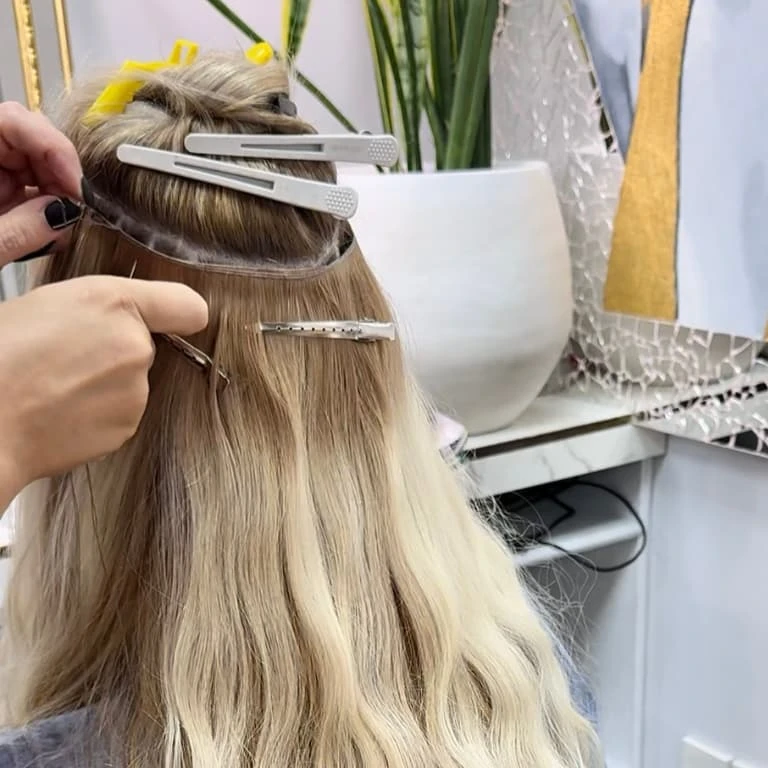
When people choose hair extensions, they often focus on length, colour, or price. One detail that matters just as much, yet is rarely explained clearly, is the cuticle. The cuticle plays a major role in how hair feels, moves, and lasts over time. Understanding the cuticle difference helps explain why Russian hair extensions are often described as softer and easier to manage when compared with European hair.
This article explains the difference in simple terms, based on salon practice, hair science, and long-term wear experience.
What Is the Hair Cuticle?
The cuticle is the outer layer of the hair strand. It looks like tiny overlapping scales that run from root to tip. When these scales lie flat, hair feels smooth and reflects light well. When they lift or face different directions, hair becomes rough, dull, and more likely to tangle.
All healthy human hair has a cuticle, but the thickness, shape, and strength of this layer can vary depending on hair origin, climate, and handling.
Natural Conditions Shape Hair Growth
Hair grows as a response to the environment. Climate, water quality, and daily habits all influence how hair forms over time. Russian hair often comes from colder regions where hair needs protection from low temperatures and dry indoor air.
This leads to a cuticle that is compact and evenly layered. Many stylists notice that Russian hair extensions show fewer lifted cuticles when viewed under magnification, even after months of wear.
European hair, while still human hair, often grows in milder or mixed climates. The cuticle layers can be slightly wider and less uniform. This does not make the hair poor, but it does mean it can react faster to humidity and friction.
Cuticle Thickness and Daily Wear
One key difference between Russian and European hair lies in cuticle thickness. Russian hair strands are often finer, yet the cuticle remains strong and flexible. This allows the hair to bend without cracking or splitting.
Because of this balance, Russian hair extensions often feel soft without becoming weak. European hair can sometimes feel thicker at first touch, but its cuticle may wear down faster with repeated brushing and heat styling.
Over time, worn cuticles lead to tangling, dryness, and uneven texture.
Cuticle Direction and Hair Handling
Another important factor is cuticle direction. High-grade russian hair extensions are collected and prepared with the cuticle kept facing one direction. This keeps the hair strands working together rather than against each other.
When cuticles face mixed directions, hair rubs and catches. This friction increases matting, especially near the nape area. European hair is more likely to be over-processed during sorting, which can disrupt natural cuticle flow.
Aligned cuticles help hair stay smoother with less effort.
How Processing Affects the Cuticle
Processing plays a major role in cuticle health. Many European hair bundles are treated to match colour ranges or texture demands. Even gentle processing can weaken the cuticle if done repeatedly.
Russian hair often requires less correction because of its lighter natural shades and fine texture. This means the cuticle remains closer to its original state. As a result, Russian hair extensions tend to respond better to washing and styling over long periods.
Less processing also means the hair keeps its natural movement and shine.
Moisture Control and Cuticle Behaviour
The cuticle controls how moisture enters and leaves the hair strand. A tight, even cuticle helps hair absorb just enough moisture without swelling too much.
Russian hair usually shows steady moisture behaviour. It does not dry out too fast, nor does it puff up in damp air. This stability is one reason many wearers find Russian hair extensions easier to style day after day.
European hair can absorb moisture more quickly, which may lead to frizz or loss of shape if care routines are not adjusted.
Long-Term Feel and Appearance
Over months of use, the cuticle tells the full story. Hair with a strong cuticle keeps its softness, while damaged cuticles lead to stiffness and split ends.
From salon records and wearer feedback, Russian hair extensions often maintain a smoother feel for a longer time, provided they receive basic care. This includes gentle washing, low heat use, and careful brushing.
The difference is not dramatic at first glance, but it becomes clear with regular wear.
Summary
The cuticle difference between Russian hair and European hair explains much of their performance over time. Russian hair tends to have a finer yet steady cuticle that stays aligned and flexible. This supports smoother texture, easier care, and longer wear.
Understanding the cuticle helps buyers make informed choices and set realistic expectations. For many people, the behaviour of russian hair extensions reflects the quiet strength of hair shaped by its natural environment rather than heavy processing.






















Sign in to leave a comment.