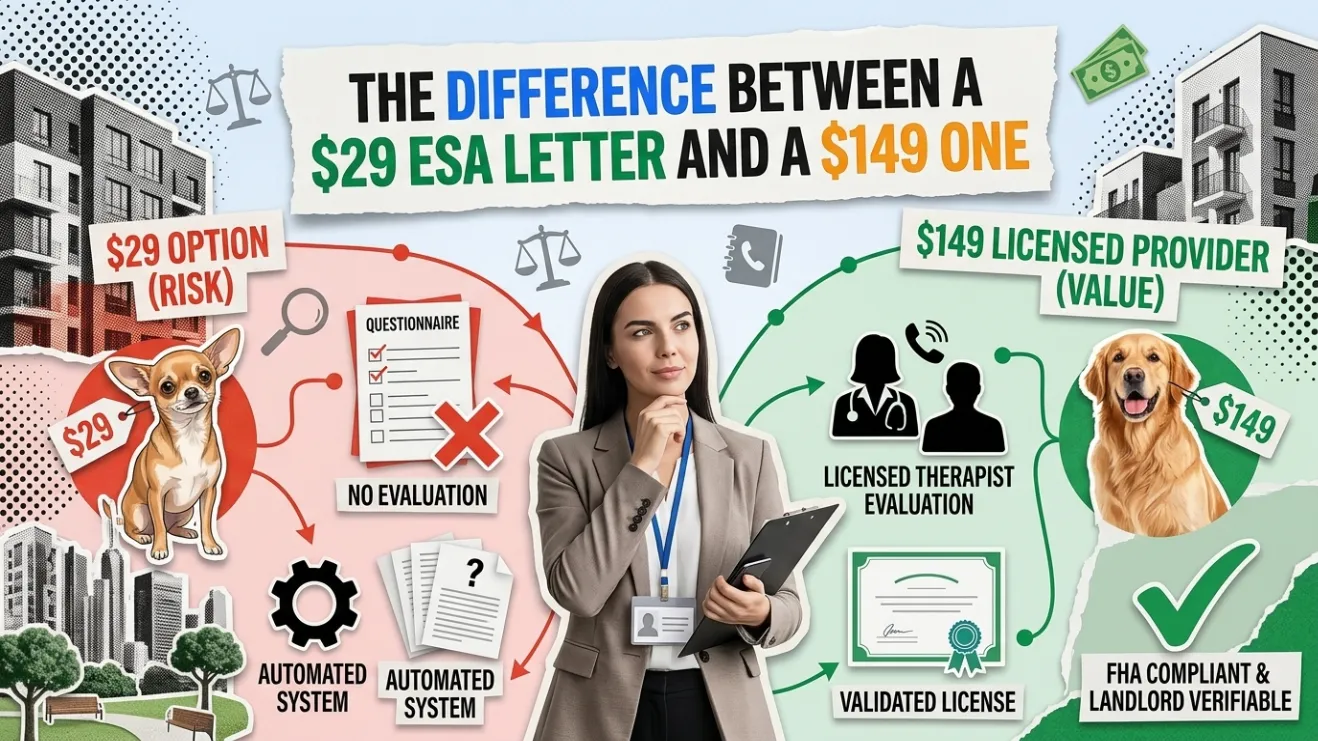

You found a $29 ESA letter online. Maybe through a quick search, maybe through an ad that followed you around for a week. It looks like the same thing. Same PDF format, same official language, same claim that it gives you housing protection under the Fair Housing Act.
So what exactly are you paying for when someone charges $149?
This is one of the most common questions people research before getting an ESA letter, and it deserves a clear answer, not a sales pitch. If you are in the process of comparing options and trying to figure out what is legitimate versus what is a shortcut, this article walks through exactly what separates a letter that works from one that does not.
Why the Price Difference Exists
The cost of an ESA letter is not really about the document itself. It is about what goes into producing that document.
A legitimate ESA letter requires a licensed mental health professional to evaluate you, reach an independent clinical judgment, and issue documentation under their professional license. That professional carries legal and ethical liability for what they sign. Their time, their license, and their professional standing are all attached to the letter.
A $29 letter typically skips the evaluation entirely. You answer a brief online questionnaire, check a few boxes, and a letter is generated automatically or reviewed by someone without a clinical license. The document looks similar on the surface. But what it represents is not the same thing.
That distinction matters the moment your landlord checks.
What Makes an ESA Letter Legally Valid
Under HUD guidelines, a valid ESA letter must be issued by a licensed mental health professional. The letter must include specific information for it to meet the legal standard.
| Required Element | What It Means |
|---|---|
| Full name of the professional | The person who evaluated you and is signing the letter |
| License type and number | The specific credential they hold (LMFT, LCSW, psychologist, etc.) |
| State of licensure | They must be licensed in the state where you live |
| Contact information | How your landlord can reach them to verify |
| Statement of qualifying condition | Confirmation that you have a condition covered under the FHA |
| Statement that the animal provides support | That your animal specifically helps you manage your condition |
Every element on that list exists for the same reason: your landlord is allowed to verify it. HUD guidance permits landlords to confirm that the professional exists, holds an active license in your state, and that the letter came from them. Landlords have become significantly better at doing this. If any element is missing or fails verification, your landlord has a documented basis for rejection.
A $29 letter may look complete on the page. If the license number does not appear in your state's licensing board database, the document is worthless at the moment it matters most.
The Evaluation Requirement, And Why It Is Not Optional
The single biggest difference between a legitimate ESA letter and a cheap one is whether a real clinical evaluation took place.
Under federal law, an ESA letter is a clinical document. It represents a professional's judgment that you have a qualifying mental health condition and that your animal provides therapeutic benefit. That judgment cannot come from a checkbox form. It has to come from a licensed professional who actually assessed your situation.
When you go through a legitimate process, you interact with a therapist licensed in your state. They ask about your condition, how it affects your daily life, and how your animal specifically helps you manage it. They reach a conclusion based on that conversation. If you qualify, they issue the letter under their license.
When you use a $29 service, that conversation does not happen. An algorithm or an unlicensed screener processes your form. Some services have a therapist "review" your form for thirty seconds and sign it. That is not a clinical evaluation by any standard definition.
The consequences of this are practical, not just philosophical. An ESA letter that was not produced through a genuine evaluation is:
- Vulnerable to challenge if your landlord files a Fair Housing complaint
- Potentially invalid if the signing professional's license is in a different state
- Not backed by a professional who can speak to your case if questions arise
- In some cases, produced by someone who is not licensed at all
None of this is hypothetical. Landlord rejections based on unverifiable letters are a documented pattern. Property management companies have internal guidance on what to check. If the letter does not hold up, you are back where you started, except you have already disclosed your mental health history to a service that has no clinical oversight.
A Side-by-Side Look at What You Actually Get
This comparison covers what a typical $29 service and a legitimate provider like RealESALetter.com actually deliver.
| Feature | $29 Service | Legitimate Provider ($149) |
|---|---|---|
| Real evaluation with a licensed therapist | No | Yes |
| Therapist licensed in your state | Often no | Yes |
| License number included in letter | Sometimes | Always |
| Landlord can verify the therapist | Frequently fails | Yes |
| Money-back guarantee if rejected | Rare | Typically yes |
| Professional can be contacted for verification | No | Yes |
| Letter produced under clinical liability | No | Yes |
| Renewal process with the same professional | No | Available |
The $120 difference pays for a professional who is actually accountable. That accountability is what makes the document function legally.
What Landlords Are Actually Checking Now
If you got an ESA letter three or four years ago through a fast online service, it may have worked simply because landlords were not yet checking carefully. That situation has changed.
Property management companies, especially those managing large multi-unit buildings, now have documented processes for handling ESA accommodation requests. Here is what a thorough landlord review typically involves:
- Verifying that the license number on the letter is real using the state licensing board's public search tool
- Confirming the professional's license is active (not expired or suspended)
- Confirming the professional is licensed in the tenant's state of residence (not just any state)
- Contacting the professional directly to confirm they issued the letter
A legitimate ESA letter passes all four checks. A letter produced without a real evaluation may fail at the first step if the signer does not hold an active license in your state.
When a letter fails verification, most landlords treat it as if no letter was submitted. The accommodation request is denied. At that point you are dealing with a lease dispute, not an accommodation process, and your leverage is significantly reduced.
The Cost Argument Runs the Wrong Direction
The $29 option looks like a savings. Run the math on what it actually costs if it does not work.
If your landlord charges a pet deposit of $400 to $600 (the national average range for large dogs), the $120 you "saved" is gone in the first month. If your landlord charges monthly pet rent of $50 to $75 per month, the $120 difference costs you less than two months of fees. If you are in a no-pets building and your letter gets rejected, you are either removing your animal or facing a lease violation.
The legitimate letter is not a luxury option. It is the version that actually does the thing you are paying for. The cheap letter is a risk transfer, you pay $29 and take on the full risk that it fails when it counts.
Services that offer a money-back guarantee if your landlord rejects the letter are reflecting this reality honestly. They know the letter will hold up because it was produced correctly. A service charging $29 with no guarantee is telling you something about how confident they are in what they are selling.
Red Flags to Watch for When Comparing Services
Not every lower-priced service is the same, and not every higher-priced one is automatically legitimate. These are the specific things that indicate a letter will not work:
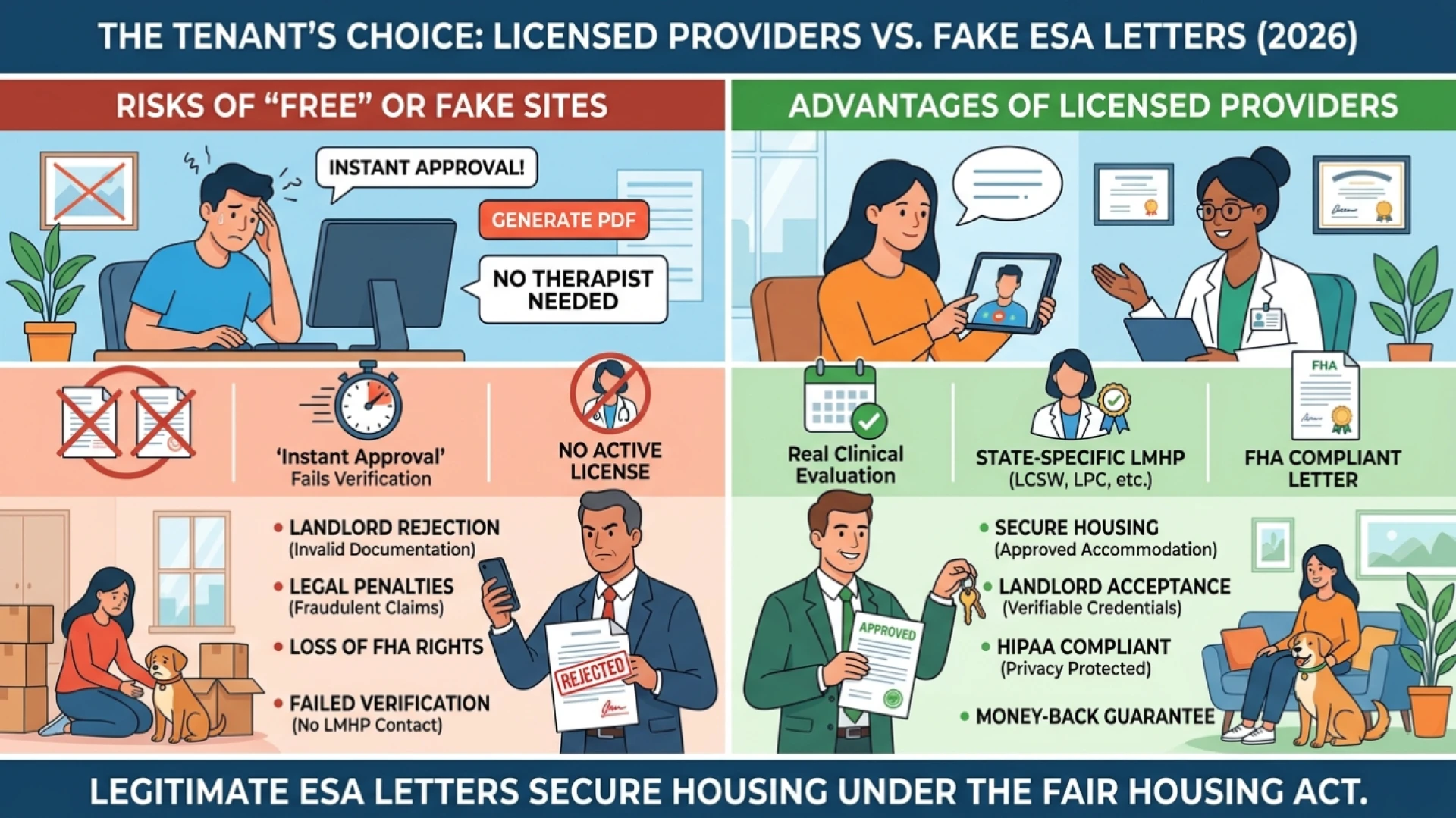
- Instant approval without any evaluation or wait time
- No mention of which state the therapist is licensed in
- No license number visible on the sample letter
- No way to contact the professional after the letter is issued
- No refund or guarantee policy
- The site uses the phrase "ESA registration" (there is no official ESA registry)
- The process is described as a "certification" (ESAs are not certified under federal law)
Legitimate services charge more because they build in real clinical time, state-matched licensing, and ongoing professional accountability. When a service removes all of those things, the only thing they are selling you is a formatted PDF.
What a Legitimate Process Actually Looks Like
For comparison, here is what going through a proper ESA letter process involves when done correctly.
You complete an intake form that collects information about your condition and how it affects your life. That form is reviewed by a licensed mental health professional in your state before the evaluation, not after. You then have a real evaluation, usually conducted by phone, video, or secure messaging, where the therapist asks about your situation, asks follow-up questions, and reaches their own clinical determination.
If you qualify, the therapist writes and signs the letter under their license. The letter includes everything required under HUD guidelines. It arrives by email within 24 hours in most cases. The therapist's information remains on file so your landlord can verify directly.
If your landlord rejects it despite the letter being complete and verifiable, a legitimate provider's money-back guarantee covers you.
That is a complete process. A $29 form that generates a letter in three minutes is not.
Before You Decide
The ESA letter is a legal document that needs to hold up in a real-world housing dispute. The person signing it needs to be a licensed professional in your state who actually evaluated you and is willing to stand behind what they signed.
You are not shopping for a template. You are paying for a clinical professional to document their assessment of your situation under their license. That is what the cost reflects and that is what makes the difference when your landlord calls to verify.
If you are ready to go through a legitimate process, RealESALetter.com connects you with a licensed therapist in your state, conducts a real evaluation, and issues a letter that meets every element of HUD's requirements.




























Sign in to leave a comment.