
Every year, thousands of renters across the United States lose housing accommodations because they trusted a "free ESA letter" website. In 2026, the number of fake emotional support animal documentation services has grown significantly, making it harder for tenants to tell the difference between legitimate providers and scams. The consequences of choosing wrong range from landlord rejection to legal penalties that threaten your housing stability entirely.
Tenants who research their options consistently end up choosing licensed providers over free or ultra-cheap alternatives. This pattern isn't about spending money unnecessarily. It's about understanding what makes an ESA letter legally valid, what landlords actually verify, and why cutting corners on documentation often costs far more in time, stress, and money than getting it right the first time.
This guide explains exactly why tenants across all 50 states are making this shift, what red flags expose fraudulent services, and how to get a legitimate ESA letter that holds up under scrutiny.
What "Free ESA Letter" Sites Actually Offer
The phrase "free ESA letter" is one of the most searched terms in the emotional support animal space. Dozens of websites target this query with promises of zero-cost documentation, instant approvals, and certificates that look official at first glance.
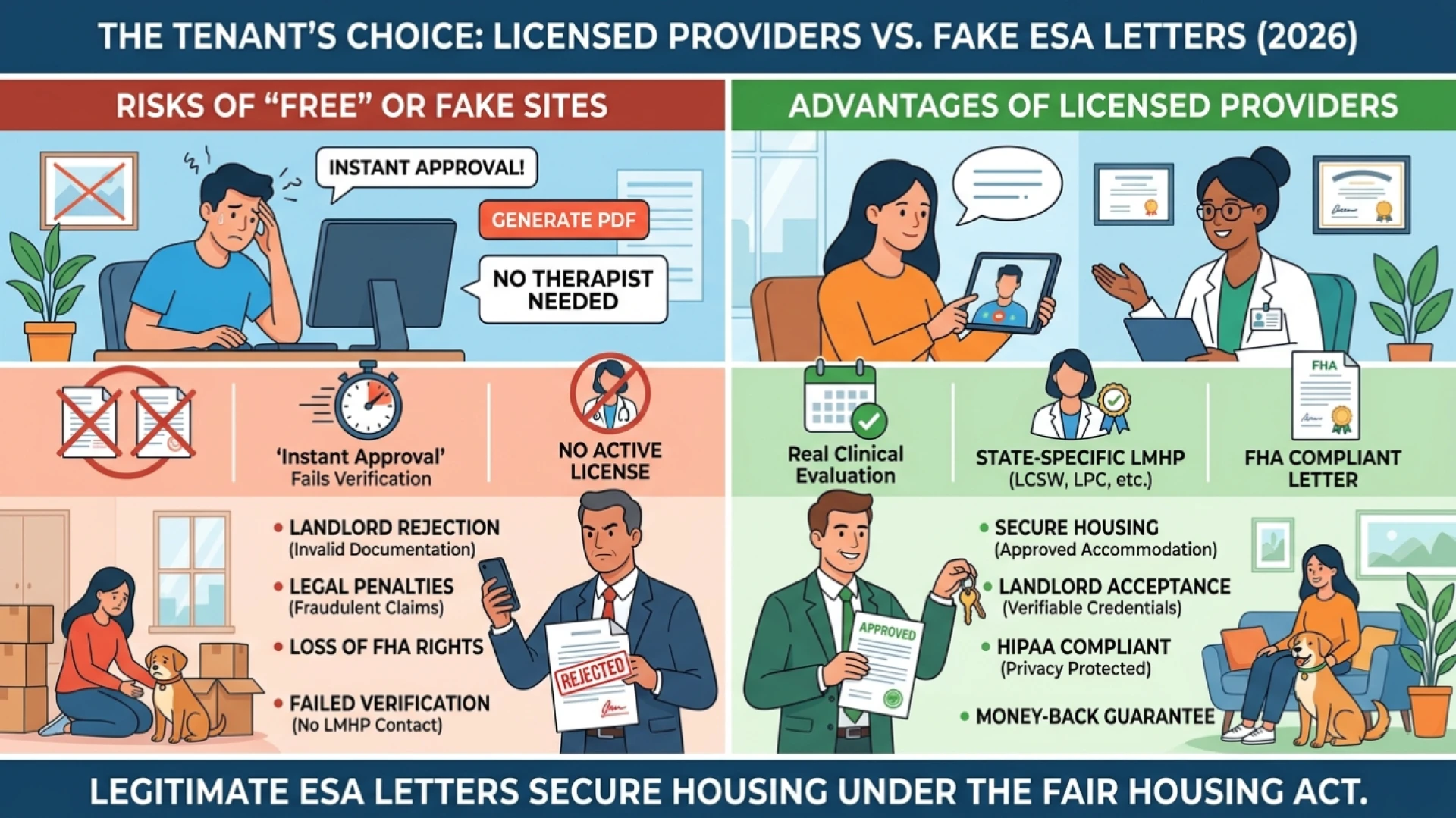
Here's what these sites actually deliver:
- Automated forms that generate PDF documents without any clinical evaluation or therapist involvement
- Unverifiable credentials where the "provider" listed does not hold an active license in your state
- ESA registrations or certifications that have no legal standing under the Fair Housing Act
- Instant approvals that skip the mental health assessment required by HUD guidelines
- Documents that fail landlord verification when property managers call the listed provider
The Fair Housing Act requires that an ESA letter come from a licensed mental health professional (LMHP) who has evaluated the tenant and determined that an emotional support animal is part of their treatment plan. Free sites cannot deliver this because real clinical evaluations take time, professional licensing, and legal accountability — none of which are free.
When a landlord contacts the provider listed on a free letter and finds no verifiable license, the accommodation request fails. Tenants then face the original problem again, this time potentially behind on their application timeline.
The Real Risks of Using Fake ESA Documentation
The consequences of using fraudulent ESA letters extend well beyond a rejected housing application. Understanding these risks explains why tenants who do their research consistently move toward licensed providers.
Landlord rejection is the most immediate risk. Property managers in 2026 use structured verification processes. Many leasing offices cross-reference therapist license numbers against state licensing databases before approving any accommodation request. A document from an unlicensed or fake provider fails this check, and tenants have no recourse once the application is denied on fraudulent documentation grounds.
Legal exposure is a serious secondary concern. Several states have passed laws specifically targeting fraudulent ESA claims. In Texas, HB 4164 created penalties for falsifying ESA documentation. Using a letter you know to be invalid may expose you to legal consequences that go far beyond losing your apartment application.
Loss of FHA rights is the most damaging long-term consequence. Tenants who are caught using fake documentation lose credibility in future accommodation requests. Property managers flag accounts, and HUD complaint pathways become harder to pursue when your original documentation was not legitimate.
The financial math is unfavorable. Most fake letters cost between $30 and $70. Most legitimate providers charge between $100 and $200 for a properly issued letter. The cost of re-applying after a rejection, potentially moving to a different property, or dealing with legal exposure far exceeds the $80 to $100 difference between a scam and a real service.
You can review a detailed comparison of real vs. fake ESA letters to understand the seven specific red flags that identify fraudulent documentation before you submit it to a landlord.
What Makes a Licensed Provider Legitimately Different
Licensed providers operate under a framework that free and scam sites cannot replicate. The distinctions are structural, not cosmetic.
Real licensed mental health professionals conduct actual evaluations. An LMHP — which includes licensed clinical social workers (LCSW), licensed professional counselors (LPC), licensed marriage and family therapists (LMFT), and licensed psychologists — reviews your mental health history, assesses your qualifying condition, and makes a clinical determination before issuing any documentation. This evaluation process is what gives the resulting letter legal validity under the Fair Housing Act.
State-specific licensing matters. Therapists must hold an active license in your state of residence for the letter to meet HUD compliance standards. Reputable providers verify this before assigning your case. Some states, including California, Arkansas, Iowa, Louisiana, and Montana, require a 30-day client-provider relationship and two consultations before a letter can be issued. Licensed providers follow these requirements. Free sites ignore them entirely.
Verification infrastructure supports landlord acceptance. Licensed providers maintain contact information and verification systems that landlords can use to confirm a letter's authenticity. When a property manager calls to verify your documentation, a licensed provider has a real licensed professional available to confirm the accommodation need. This direct verification is the strongest factor in landlord acceptance rates.
HIPAA compliance protects your privacy. Legitimate telehealth platforms handle your mental health information under federal privacy regulations. Free sites often have no privacy infrastructure at all, meaning your personal health information may be stored, shared, or sold without your knowledge.
Why Tenants Are Shifting to Licensed Platforms in 2026
Several trends in 2026 have accelerated the shift away from free ESA letter sites toward licensed providers.
Landlord verification practices have become more rigorous. Major property management companies now use standardized verification checklists for ESA accommodation requests. Letters that lack verifiable license numbers, provider contact information, or proper letterhead fail automatically. Tenants who submitted free letters in previous years and faced rejection are now actively seeking compliant replacements.
State legislation has increased scrutiny. Laws in Texas, California, and Florida have put both tenants and providers under greater legal accountability for ESA documentation. Tenants who understand these legal environments actively choose providers that demonstrate compliance with state-specific requirements.
University housing offices have raised standards. Colleges and universities across the country, including major institutions like UCLA and NYU, have implemented stricter ESA letter verification protocols. Students applying for on-campus ESA accommodations in 2026 consistently report that only letters from verifiable licensed professionals pass the review process.
Word-of-mouth drives informed choices. Online tenant communities and renter forums have become active spaces where people share experiences with ESA documentation services. Accounts of free letter rejections are common. Reviews of licensed providers that result in approved accommodations spread quickly and build service reputations that attract new tenants seeking reliable options.
The Transparent Pricing Advantage
One of the strongest trust signals from licensed providers is pricing transparency. When a platform clearly states its fees, lists exactly what is included, and backs its service with a money-back guarantee, tenants understand what they are paying for.
A transparent ESA letter pricing structure lets tenants evaluate value rather than just cost. At RealESALetter.com, the housing letter costs $149 and includes approval by a licensed therapist, 12-month validity, fast PDF delivery with same-day availability, and renewal discounts. A combined ESA letter and PSD consultation package is available at $199, providing flexibility for tenants who may also need travel-related accommodations.
This pricing sits within the standard industry range for legitimate licensed services. More importantly, it comes with a 100% money-back guarantee: if you don't qualify, if your landlord rejects the letter, or if the letter is not accepted after a HUD complaint is filed, you receive a full refund. Free sites cannot offer this guarantee because they do not issue documents with legal standing in the first place.
Understanding ESA letter costs in this context reframes the decision. A tenant choosing between a $0 document with no clinical backing and a $149 document with licensed evaluation, landlord verification support, and a money-back guarantee is not choosing between cheap and expensive. They are choosing between a document that may not work and one designed to meet the standards required for it to work.
How to Identify a Legitimate ESA Letter Service
Tenants navigating the ESA documentation market in 2026 can apply a consistent set of criteria to evaluate any provider before committing.
A legitimate service will always include the following:
- No instant approval guarantees. Real evaluations take time. Any service promising an approved letter in minutes without speaking to you is not conducting a real evaluation.
- Licensed therapist listed by name, license type, and state. The issuing provider's full credentials must appear on the letter and be verifiable in your state's licensing database.
- State-specific compliance acknowledgment. Services that operate nationally must address state-specific requirements, including the 30-day rules in California, Arkansas, Iowa, Louisiana, and Montana.
- Direct contact information for landlord verification. A legitimate provider offers the issuing therapist's contact details so property managers can confirm documentation independently.
- No ESA registration or certification products. No official ESA registry exists. Any service selling registry entries, ID cards, or certification databases is selling legally meaningless products.
If a service meets all five criteria, it operates within the legal framework that makes ESA letters genuinely useful for housing accommodation purposes.
You can learn more about why online ESA letters from licensed providers are legitimate and what separates compliant telehealth services from documentation mills that produce worthless paperwork.
The Fair Housing Act Framework Tenants Need to Understand
Every tenant seeking ESA housing accommodation operates under the same federal framework: the Fair Housing Act. Understanding this framework clarifies why licensed documentation is not optional.
The FHA requires landlords and property managers to provide reasonable accommodations for tenants with qualifying mental or emotional disabilities. To invoke this protection, a tenant must provide documentation from a licensed mental health professional confirming both the qualifying condition and the therapeutic necessity of the emotional support animal.
HUD Notice FHEO-2020-01 updated guidance for property managers reviewing ESA requests, giving landlords tools to assess the reliability and validity of submitted documentation. This guidance explicitly allows landlords to verify provider credentials and to reject documentation from sources they cannot verify. A free letter from an unlicensed source fails this standard.
The same FHA framework that protects tenants requires legitimate documentation to activate those protections. This is why choosing a licensed provider is not just a quality preference. It is the prerequisite for accessing the housing rights the FHA was designed to provide.
Understanding emotional support animal laws at both the federal and state level helps tenants approach the documentation process with clarity about what is required and what their rights actually are under current law.
Frequently Asked Questions
Are free ESA letters ever legally valid?
Free ESA letters generated by automated systems without a licensed therapist evaluation are not legally valid under the Fair Housing Act. A valid letter requires a real clinical assessment by a licensed mental health professional in your state. Free sites do not provide this service, which is why their documents typically fail landlord verification checks.
How do landlords verify ESA letters in 2026?
Most landlords cross-reference the therapist's license number against their state's licensing board database and may call the provider directly to confirm the letter's authenticity. Letters that list unverifiable, inactive, or out-of-state licenses fail this verification. Licensed providers include current, verifiable credentials and offer direct contact for landlord inquiries.
Can a cheap ESA letter scam result in legal trouble for the tenant?
In some states, yes. Using fraudulent ESA documentation knowingly can expose tenants to fines and other legal consequences. Several states, including Texas with HB 4164, have passed legislation targeting false ESA claims. Using documentation from a non-licensed source creates legal risk that using a legitimate licensed provider avoids entirely. You can review the full breakdown of why cheap ESA letters under $100 are usually scams before making a decision.
How long does a legitimate ESA letter remain valid?
Most legitimate ESA letters issued by licensed providers remain valid for 12 months from the date of issuance. Renewal is typically required annually, and reputable providers offer discounted renewal rates for returning clients. Setting a calendar reminder 30 days before expiration ensures continuous housing protection.
What is the difference between an ESA letter and ESA registration?
An ESA letter is the only legally recognized documentation for housing accommodations under the Fair Housing Act. ESA registration, certification, or ID cards sold by websites have no legal standing. No official ESA registry exists in the United States. Any service selling registration products is providing meaningless documentation that will not satisfy landlord verification requirements under HUD guidelines.
Conclusion
The shift from free ESA letter sites to licensed providers reflects tenants making better-informed decisions about their housing security. In 2026, the consequences of using fraudulent documentation are well-documented, the legal framework is clear, and the path to legitimate protection is straightforward.
A real ESA letter comes from a licensed mental health professional who evaluates your need, issues documentation that meets Fair Housing Act standards, and stands behind that documentation with verifiable credentials. This is what landlords require, what the law supports, and what ultimately protects your right to live with your emotional support animal in the housing you choose.
Choosing a licensed provider is not a luxury. It is the only practical way to access the housing accommodations the Fair Housing Act was designed to provide.

















Sign in to leave a comment.