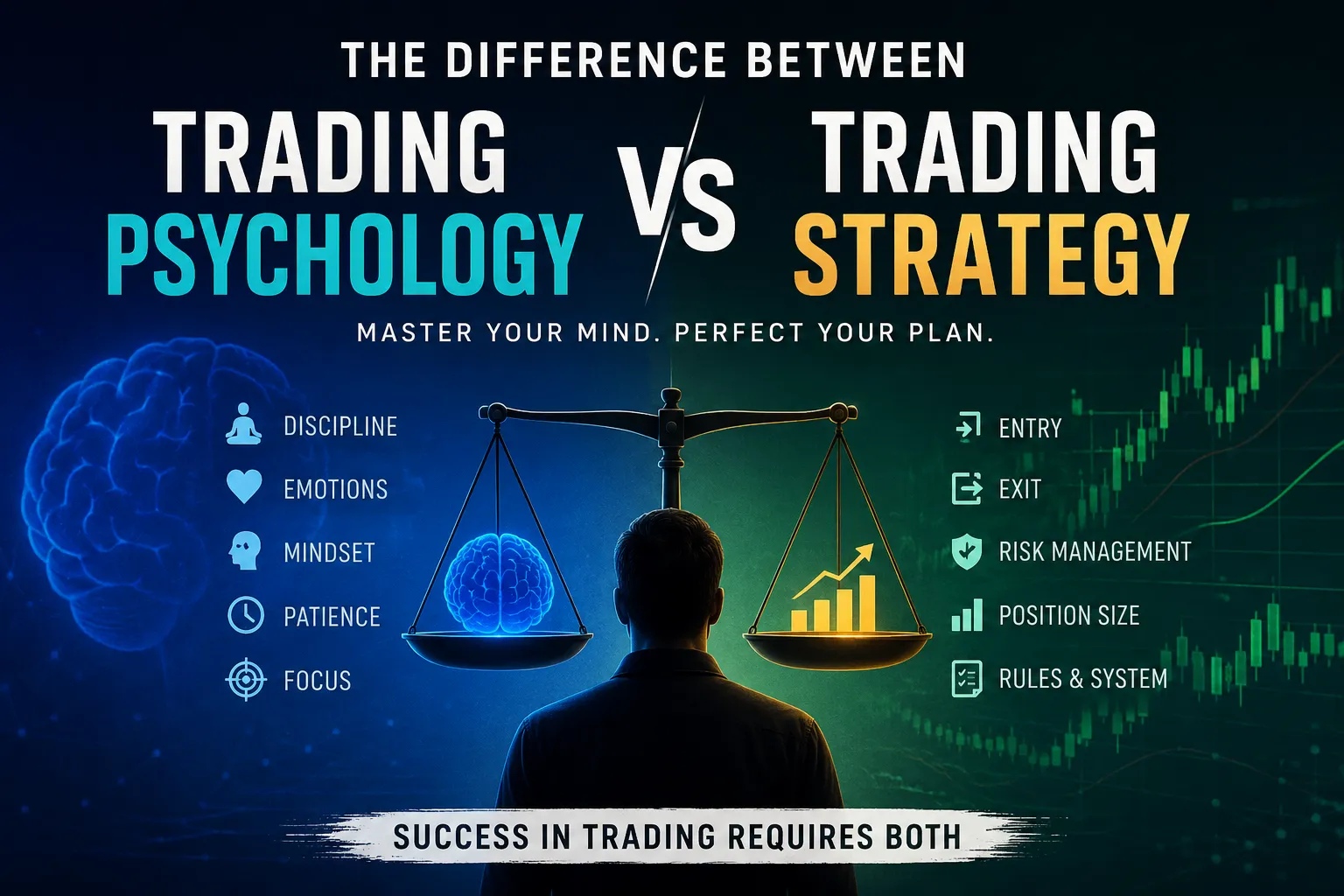

A trader can have a clean chart and a tested setup. Then price moves against him for ninety seconds, and the plan disappears. That is where the real difference shows up. Strategy tells you what to do. Psychology decides whether you can still do it under pressure.
That is why serious traders search for an Evan Marks trading psychology coach when market knowledge is not the problem. They know the rules. They break them anyway.
What is trading strategy?
Trading strategy is the technical system you use to find and manage trades. It covers your market, setup, entry, stop loss, target, position size, time frame, and risk reward profile.
A strategy answers direct questions.
What needs to happen before I enter?
Where am I wrong?
How much can I lose?
Where do I take profit?
When do I do nothing?
A breakout trader may buy strength above resistance. A mean reversion trader may fade extremes. A trend follower may accept many small losses for one large winner.
Here is the hard opinion. Most traders do not have a strategy problem first. They have a testing problem. They confuse a chart idea with an edge.
If you cannot explain expectancy, sample size, win rate, average loss, and average win, you do not have a strategy. You have a hope with candlesticks on it.
What is trading psychology?
Trading psychology is the mental and emotional system behind your decisions. It includes fear, greed, loss aversion, overconfidence, revenge trading, FOMO, patience, focus, self talk, and emotional regulation.
It is not just “staying calm.” That phrase is too soft.
Trading psychology is the ability to execute your process while your body wants relief. It matters most during a drawdown, after a large win, or after three losses in a row.
One common pattern looks simple. A trader risks one percent per trade for two weeks. Then one bad morning hits. He doubles size to “get back even.” The strategy did not change. The identity threat changed.
That single revenge trade can erase ten disciplined sessions.
This is why the phrase Evan Marks trading psychology coach belongs in the execution conversation. It does not belong in a motivation pitch. Coaching should not be a pep talk. It should find the exact moment where behavior leaves the model.
Strategy is the map. Psychology is the driver.
A strategy is useless without execution. Psychology is dangerous without a real edge.
This is where online debates get lazy. Some people say trading is 80 percent psychology. Others say psychology means nothing without a profitable system. Both sides miss the point.
The relationship is sequential.
First, build a valid trading strategy.
Second, build a trading plan around it.
Third, train the psychology needed to follow it.
Think of a race car. Strategy is the engine, tires, fuel, and track data. Psychology is the driver handling speed, noise, fatigue, and fear. A calm driver in a broken car still loses.
| Area | Trading Strategy | Trading Psychology |
|---|---|---|
| Core question | What is the edge? | Can I execute it? |
| Main tools | Backtesting, charts, rules | Journaling, review, conditioning |
| Failure sign | No expectancy | Rule breaking |
| Fix | Research and testing | Behavioral training |
Where traders confuse the two
Here is the common trap. A trader takes five losing trades and says, “My strategy is broken.” Sometimes it is. Often, the sample is too small.
Another trader moves stops, adds size, and exits early. He says, “I need a better strategy.” No. He needs a behavioral audit.
Use this simple test.
If you followed your rules and lost, review the strategy.
If you broke your rules and lost, review the psychology.
If you followed bad rules, review both.
A practical case is overtrading. Your setup appears twice per day, but you take nine trades. Your strategy did not create those extra seven trades. Boredom, urgency, dopamine, and avoidance did.
Another case is early profit taking. Your target sits at three risk units. You exit at one because profit feels fragile.
Tools help, but they do not save you
TradingView is excellent for charting and alerts, but it will not stop impulse. Thinkorswim gives strong options tools, but it cannot regulate your nervous system. Interactive Brokers has serious execution access, but it will not fix revenge trading.
MetaTrader 5 works well for forex workflows. NinjaTrader and Sierra Chart suit futures traders who need speed and depth. Excel and Google Sheets still beat many fancy dashboards for honest review.
For journals, TraderSync, Tradervue, Edgewonk, and TradesViz can expose patterns. My preference is simple. Use the tool you will update after a bad day. Fancy software means nothing if shame keeps the data empty.
How to train both at the same time
Start with a twenty trade audit. Write the setup, entry, stop, target, risk size, emotional state, rule breaks, and outcome.
Do not ask, “Did I make money?”
Ask better questions.
Did I take only valid setups?
Did I size correctly?
Did I accept the stop?
Did I exit because of rules or relief?
What emotion appeared before the mistake?
After twenty trades, split errors into two buckets. Strategy errors include weak setups, poor stops, and unclear exits. Psychology errors include hesitation, chasing, oversizing, and revenge entries.
That split builds a stronger risk mindset and shows whether the M1 Mental Trading Academy fits your next step.
Final answer
Trading strategy is your method for finding and managing opportunity. Trading psychology is your capacity to execute that method when pressure, ego, fear, and money collide.
You need both. But you do not need them in the same way.
A weak strategy needs research. Weak psychology needs training. A trader who cannot separate the two keeps rebuilding the wrong machine.
That is the quiet edge behind serious performance work. An Evan Marks trading psychology coach does not replace your strategy. The right coach helps you stop betraying the strategy you already worked hard to build.



























Sign in to leave a comment.