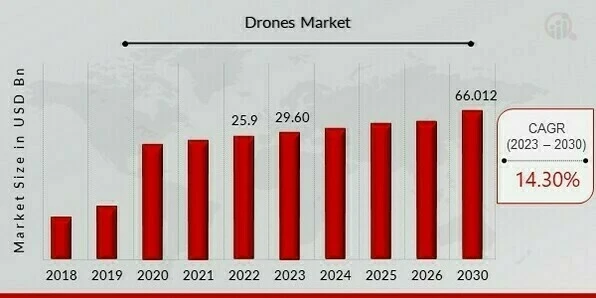

Drones Market Outlook
Drones, once a niche hobbyist toy, have evolved into a powerful and versatile tool reshaping industry from agriculture to infrastructure inspection. Their ability to access remote locations, capture high-quality data, and perform tasks more efficiently than traditional methods has fueled a meteoric rise in the drone market, transforming it into a multi-billion-dollar industry with immense potential for future growth.
This evolution hasn't happened overnight. Early drones were primarily remote-controlled aircraft, limited in functionality and often expensive. However, advancements in several key areas have propelled their development. Miniaturization of electronics, improved battery technology, and the integration of sophisticated sensors like GPS, accelerometers, and high-resolution cameras have made drones smaller, more powerful, and easier to control. The advent of autonomous flight capabilities, enabled by sophisticated software and AI algorithms, has further broadened their applications.
Today, the drone market is segmented by various factors, including drone type (multi-rotor, fixed-wing, hybrid), application (commercial, recreational, military), and payload capacity. While recreational drones still hold a significant share of the market, the commercial sector is experiencing the most rapid growth. This is driven by the increasing adoption of drones across a wide range of industries:
Agriculture: Drones are revolutionizing farming practices. Equipped with multispectral cameras and sensors, they can capture detailed images of crops, identifying areas affected by disease, pests, or nutrient deficiencies. This data allows farmers to target their interventions precisely, optimizing resource allocation and increasing yields while minimizing environmental impact. Drones are also used for aerial spraying of pesticides and fertilizers, improving efficiency and reducing exposure for farmworkers.
Construction and Infrastructure: Inspecting bridges, pipelines, and other infrastructure can be a dangerous and time-consuming task. Drones offer a safer and more efficient alternative. They can capture high-resolution images and videos, identifying structural defects, corrosion, and other potential problems. This data enables proactive maintenance, preventing costly repairs and ensuring the safety of infrastructure. In construction, drones are used for surveying, progress monitoring, and creating 3D models of construction sites, improving project management and efficiency.
Delivery and Logistics: The potential of drones to transform delivery and logistics is immense. Companies are exploring the use of drones for delivering packages, particularly in remote or hard-to-reach areas. While regulatory hurdles still exist, the promise of faster, cheaper, and more efficient delivery is driving significant innovation in this space. From delivering medical supplies to remote communities to transporting e-commerce packages, drones are poised to disrupt traditional delivery models.
Security and Surveillance: Drones are increasingly used for security and surveillance applications. Their ability to provide aerial views and cover large areas makes them valuable tools for law enforcement, border patrol, and private security companies. Drones equipped with thermal imaging cameras can be used for search and rescue operations, detecting heat signatures and locating missing persons.
Media and Entertainment: Drones have become an indispensable tool for filmmakers, photographers, and videographers. They offer the ability to capture stunning aerial footage, adding a new dimension to visual storytelling. From sweeping landscape shots to dynamic action sequences, drones are enhancing the visual appeal of movies, documentaries, and commercials.
Inspection and Monitoring: Industries like oil and gas, mining, and renewable energy are using drones for inspection and monitoring of their assets. Drones can access remote and hazardous locations, inspecting pipelines, wind turbines, and solar panels, identifying potential issues and preventing costly downtime.
Despite the immense potential of drones, several challenges remain. Regulations surrounding drone operations vary across different countries and regions, creating a complex landscape for businesses operating in this space. Concerns about privacy and safety also need to be addressed to ensure the responsible use of drones. Furthermore, the development of robust and reliable drone technology, including improved battery life and autonomous flight capabilities, is crucial for realizing the full potential of this technology.





























Sign in to leave a comment.