
Why Management Education Is Changing
Management education is moving beyond traditional classrooms, textbooks, and examinations. Today, businesses operate in an environment shaped by artificial intelligence, data analytics, digital transformation, global competition, and changing consumer behaviour. As a result, businesses increasingly seek management professionals who can understand fundamental business concepts while adapting to emerging technologies and solving practical problems. The AICTE's model curriculum for MBA and PGDM programs specifically emphasizes experiential learning, internships, live projects, industry interaction, and the practical application of knowledge as important elements of modern management education.
These changes in the business environment are one of the main reasons PGDM programmes are growing in popularity in India. Unlike a purely theoretical approach, a well-designed PGDM course can connect classroom concepts with real-world business situations through case studies, simulations, projects, and industry exposure. Students can develop skills in areas such as marketing, finance, human resources, operations, and business analytics while also learning how these functions work together within an organization.
Why PGDM Courses Are Becoming Popular
Industry-Oriented Curriculum
One of the major advantages of a PGDM is its ability to keep the curriculum closely aligned with current industry requirements. Businesses are constantly changing, so management education also needs to evolve. Modern technologies and changing customer expectations require students to develop capabilities that go beyond simply memorising management theories.
Modern PGDM programs are increasingly incorporating subjects related to business analytics, digital marketing, artificial intelligence, entrepreneurship, and strategic management. Many management institutions are also introducing AI and digital transformation into their programs, highlighting the growing importance of technology in modern business decision-making.
Practical and Experiential Learning
Imagine learning to swim by reading a 500-page book about swimming but never actually getting into a pool. You may understand the concepts, but real-world experience is what builds confidence and practical ability. Management education works in much the same way. Students need opportunities to apply what they learn to real business and management challenges.
The AICTE management curriculum recommends activities such as industry internships, consultancy projects, field projects, community development projects, live projects, and other experiential learning programs. These experiences can help students develop teamwork, communication, analytical thinking, and problem-solving skills before they enter the workforce.
The Role of AI and Digital Transformation
Data Analytics and AI Skills
Artificial intelligence is rapidly changing the skills required of modern managers. AI is no longer limited to technical departments. Marketing teams use AI to gain customer insights, finance teams use analytical tools for forecasting, HR departments use technology for talent management, and operations teams use data to improve efficiency.
Management programs are responding to these changes by incorporating AI, machine learning, data analytics, and digital transformation into management education. IIM Indore, for example, offers an Executive PG Diploma in Management with a focus on Artificial Intelligence, covering areas such as machine learning, deep learning, data science, conversational AI, and big data.
Preparing Students for Future Careers
The future manager will not simply be responsible for managing employees. Managers will increasingly need to work with data, technology, digital platforms, and cross-functional teams. This creates demand for professionals who can communicate effectively with technical specialists while keeping business objectives in focus.
For PGDM students, this means developing a combination of business expertise and digital knowledge. A student with a background in marketing, for example, can become more valuable by developing skills in customer analytics, performance marketing, and AI-assisted decision-making.
Specialisations Make PGDM More Flexible
Another factor attracting students to PGDM programmes is the availability of specialised career pathways. Instead of following the same curriculum throughout the programme, students may have opportunities to develop expertise in areas that align with their interests and career goals.
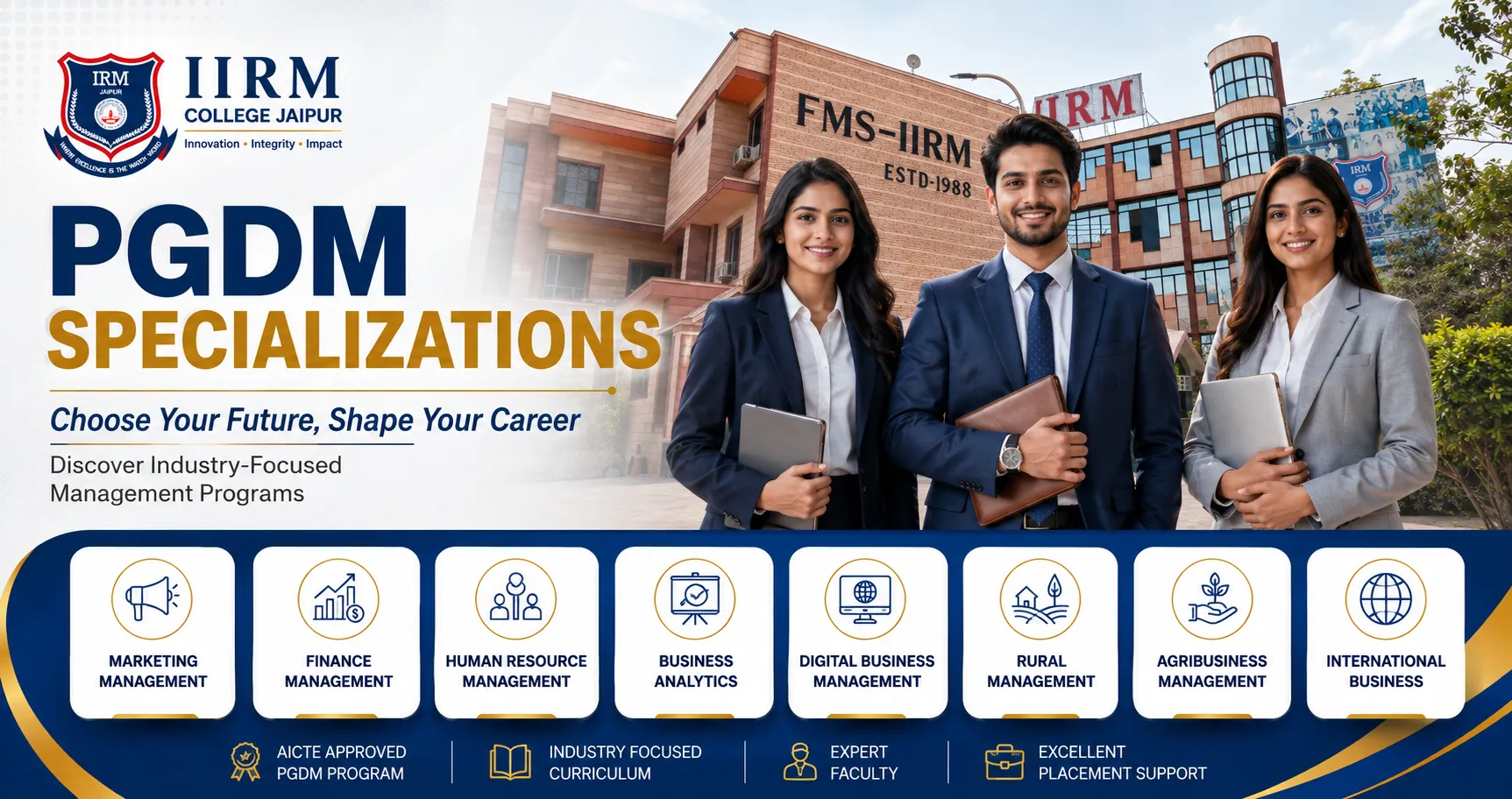
Some popular areas include Marketing, Finance, Human Resources, Business Analytics, International Business, Operations, Digital Business, Rural Management, and Agribusiness Management. Specialisations are also emerging in sectors such as agriculture and securities markets. NISM's PGDM in Securities Markets, for example, combines management education with areas such as portfolio management, corporate finance, investment banking, risk management, and wealth management.
This flexibility makes PGDM particularly appealing to students who already have an idea of the type of industry or career they would like to pursue.
PGDM and Employability
Industry Exposure and Internships
One of the most important questions for every management student is: How will this program help me build my career?" The answer depends largely on the quality of the institution and the way the program is designed. A well-designed PGDM should not only provide academic knowledge but also help students understand how organizations actually function.
Internships, live projects, presentations, industry interactions, case competitions, and corporate events can provide students with valuable real-world exposure. These activities can also help students improve their professional communication skills and understand workplace expectations.
This focus is becoming increasingly important in management education. AICTE recognizes the gap between management graduates and industry expectations and recommends stronger industry collaboration and live projects to provide students with better practical exposure.
How to Choose the Right PGDM Course
Accreditation, Faculty, and Placement Support
The growing popularity of PGDM has also given students more choices. However, having more options can sometimes make the selection process confusing. Before choosing a program, students should carefully evaluate AICTE approval, where applicable; curriculum; faculty; industry exposure; internships; infrastructure; placement support; alumni network; and overall program cost.
Students should also look beyond impressive advertising claims. Placement reports, program structure, recruiter profiles, internship opportunities, faculty credentials, and learning facilities can provide a more realistic understanding of an institution. The best PGDM program is not necessarily the one with the most attractive brochure; it is the one that provides a strong combination of academic knowledge, practical exposure, industry interaction, skill development, and career preparation.
The Future of PGDM in India
The future of management education is likely to become increasingly technology-driven, practical, and specialized. Business schools are already experimenting with AI-enabled learning, data analytics, industry-led programs, and specialized career pathways. Recent curriculum developments at institutions such as IMI have incorporated areas such as AI fluency, ESG literacy, communication development, and industry-led learning, demonstrating how management education is adapting to changing employer expectations.
For students, this transformation creates an important opportunity. A PGDM is no longer simply about earning a postgraduate qualification. Its real value lies in developing the ability to understand businesses, analyze information, communicate ideas, use technology effectively, and make informed decisions.
Conclusion
PGDM programs are gaining popularity because management careers themselves are evolving. Businesses increasingly want professionals who can combine management fundamentals with practical experience, technological knowledge, analytical thinking, and adaptability. A well-designed PGDM can provide this combination through specialized subjects, internships, industry interactions, live projects, and technology-focused learning.
For students considering a career in management, the future is not about choosing between business and technology. Instead, it is about understanding how these two areas work together. This is where modern PGDM education can play an important role in preparing students for the changing business environment.
FAQs
1. Is PGDM a good career option in 2026?
Yes, PGDM can be a good option for students interested in pursuing careers in management, particularly when the program offers industry exposure, practical learning, relevant specializations, and modern subjects such as business analytics and AI.
2. Why are PGDM courses becoming increasingly popular?
PGDM courses are becoming increasingly popular because many programs focus on practical learning, industry exposure, specialized career pathways, and skills that are relevant to evolving business requirements.
3. What skills should PGDM students develop?
PGDM students should consider developing leadership, communication, analytical thinking, problem-solving, AI awareness, teamwork, digital skills, and business decision-making abilities. These skills can help them adapt to changing workplace requirements.
4. Is AI important for management students?
Yes. AI is increasingly influencing marketing, finance, HR, operations, and strategic decision-making. Management students who understand how AI and data can support business decisions may be better prepared for changing workplace expectations.
5. How should students choose a PGDM college?
Students should carefully evaluate AICTE approval, where applicable, curriculum, faculty, industry exposure, internships, placement support, alumni network, infrastructure, and fees before choosing a PGDM college. They should also compare the program's specializations and learning opportunities with their own career goals.




















Sign in to leave a comment.