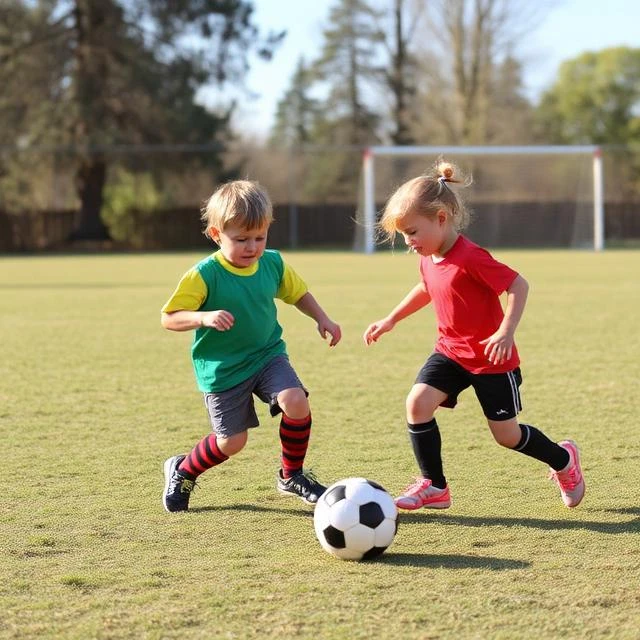
Most youth soccer sessions look fine from the outside. Kids moving, cones lined up, a coach calling out instructions, parents half-watching from the touchline. Nothing obviously wrong. But give it twenty minutes, and the cracks start to show. Some sessions drift. Others have a quiet edge to them, a sense that something is being built. That difference shows up early, especially in Soccer games for 4-year-olds, where the tone of training gets set long before anyone talks about tactics or competition.
It Starts with Purpose, Not Just Activity
A lot of programs rely on motion. Keep the kids busy, and the hour takes care of itself. The better ones are more intentional. Every game has a point, even if it looks simple. Tag with a ball, small races, and basic passing games. Done properly, those moments teach balance, timing, and awareness. Done poorly, they are just noise. Soccer games for 4-year-olds are a good test case. In weaker setups, it is chaos dressed up as fun. In stronger ones, it still feels like play, but there is structure underneath, guiding how a child moves and reacts without forcing it.
Coaching That Teaches, Not Just Supervises
The coach is usually the giveaway. Some run sessions like traffic control, keeping things moving, stepping in only when something breaks down. Others pay attention differently. They notice the angle of a foot, the timing of a run, the moment a child hesitates. Then they step in, briefly, clearly, and let the play continue. It is not loud or dramatic. It is steady, almost quiet. Over time, those small corrections stack up. Kids begin to understand the game instead of just participating in it.
Structure That Builds Over Time
Ask a simple question. What did this group work on last week, and how did today build on it? In many programs, there is no real answer. Sessions exist on their own, disconnected. Better environments treat training like a sequence. A skill appears, returns, evolves. Players recognize patterns. They start to anticipate what comes next. That sense of continuity is usually what parents are searching for when they type the best soccer academy in Valhalla, NY, even if they are really just hoping for something that feels more serious and less random.
Development Beyond the Ball
Technique matters, of course, but it is only part of the picture. Watch how kids behave between touches. Do they scan the field or stare at the ball? Do they recover after a mistake or check out for a few seconds? These habits form early and stick. A thoughtful program shapes them without making a speech about it. It comes through the way sessions are run, the standards that are set, and the expectations that do not need repeating. Places like S3A Strategic Smart Soccer tend to lean into this side of development, where the goal is not just better players but sharper, more aware ones.
Conclusion
The gap between average and high-quality training is not dramatic in a single session. It builds slowly, almost quietly, until the difference is obvious. One path produces players who go through the motions. The other produces players who notice more, think faster, and carry themselves differently on the field. For anyone unsure, the best approach is simple. Watch closely. Pay attention to the details that usually get ignored. Then step in and experience it directly. A single session, seen properly, tends to answer the question better than anything else.




























Sign in to leave a comment.